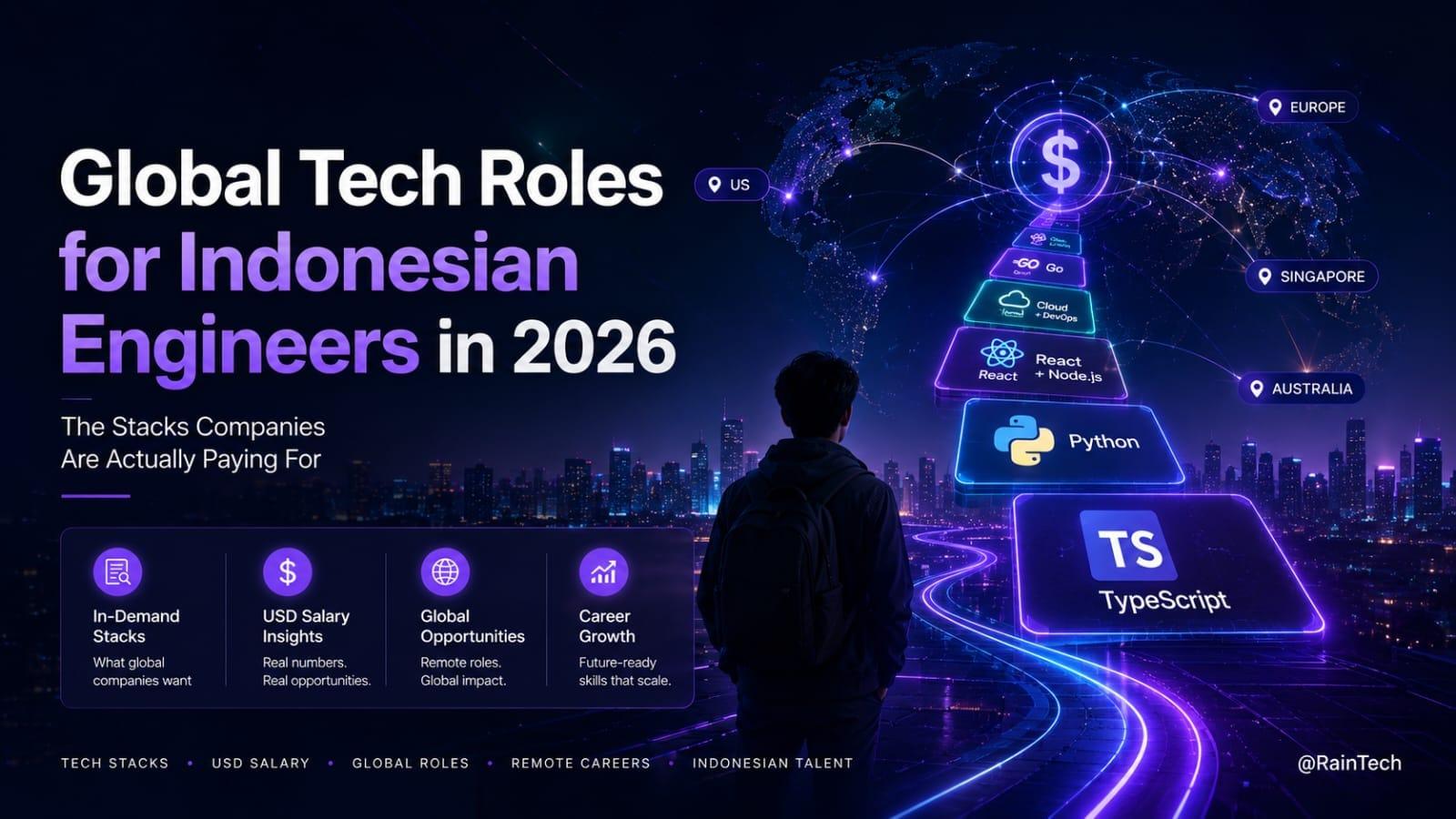
A lot of articles will tell you that Indonesia has world-class tech talent. Far fewer answer the more practical question: which stacks do you actually need to get hired — and paid in USD — by a global company?
Not every stack that is popular in Indonesia is what international companies are looking for. And not everything international companies want requires you to start from scratch — chances are you already have the foundation.
This article breaks it down with real data: which stacks are in highest demand, what global remote roles typically pay, and how to position yourself in the candidate pool that international hiring managers actually shortlist from.
Where Indonesia Stands in The Global Developer Map
According to GitHub Octoverse 2025, Indonesia is among the countries that quadrupled their developer count over the past five years (2020–2025) — alongside India, Brazil, and Japan. Indonesia also ranks in the global top 10 developer communities by contributor count. Not in the top 10 in Southeast Asia. Top 10 in the world.
What this means practically: the Indonesian developer community is large and active enough that hiring managers in the US, UK, Europe, Australia, and Singapore are paying attention. The question is no longer "do they know about Indonesian developers?" The question is "will they find your profile when they look?"
Average salary for Indonesian remote software engineers in global roles: $50,146/year according to Arc.dev 2026 — over $4,000/month. That is not the ceiling. That is the average. Engineers with the right stack and strong production track record can sit significantly above it.
Stack #1: Typescript
Why Typescript
According to GitHub Octoverse 2025, TypeScript became the #1 language by contributor count on GitHub as of August 2025 — overtaking both Python and JavaScript. It grew by over 1 million contributors year-over-year, a 66.63% growth rate. This is not a trend. It is a standard shift.
Why it Happened
- Nearly every modern framework now scaffolds in TypeScript by default: Next.js, NestJS, Angular, SvelteKit.
- AI coding tools (GitHub Copilot, Cursor) work significantly better with TypeScript due to type safety.
- Global companies with mature codebases will not hire developers who only know JavaScript without TypeScript.
Where Indonesian Engineers Stand
Developers who have worked with international stacks in the last 2–3 years almost universally already use TypeScript. Those who have not are typically working in local companies with legacy codebases — a gap that is increasingly visible to international hiring managers.
What to Master
TypeScript fundamentals (types, interfaces, generics, utility types), strict mode ("strict": true is standard at most global companies), and integration with the framework you already use — Next.js, NestJS, or React.
Salary Range
- Tier 2 Mid-level (3–5 years): $1,200–$2,000/month.
- Tier 3 Senior (5+ years): $2,000–$3,000/month.
Stack #2: Phyton
Why Phyton
Python jumped 7 percentage points in the Stack Overflow Developer Survey 2025 — the largest single-year increase of any major language. On GitHub, Python contributors grew +48.78% year-over-year. According to GitHub Octoverse 2025, Python powers approximately 50% of all AI repositories.
If you want to work for companies building AI products — and in 2026, that is almost every growth-stage company — Python is the entry point.
Where Indonesian Engineers Stand
Python adoption in Indonesia has grown significantly, driven by data science programmes at universities and bootcamps. Engineers with a mathematics or statistics background who learned Python tend to have stronger fundamentals than those who picked it up purely because of its popularity — and international hiring managers notice this.
What to Master
- Backend API: FastAPI (grew +5pp in SO 2025) or Django REST Framework.
- Data/ML adjacent: Pandas, NumPy, foundational scikit-learn for AI-adjacent roles.
- Deployment: Docker + basic cloud (AWS Lambda, GCP Cloud Run) for production Python.
- Async Python: asyncio and httpx — increasingly standard in modern Python backends.
Salary Range
- Tier 2 Mid-level: $1,200–$2,000/month.
- Tier 3 Senior: $2,000–$3,000/month.
- Tier 4 Staff/Principal (AI/ML specialization): $3,000+/month.
Stack #3: React + Node.js
Why React + Node.js
JavaScript is still used by 66% of developers in Stack Overflow 2025. Node.js remains the most-used web framework. React is still the #1 frontend framework for global companies.
But there is an important caveat: because the pool is so large, competition is stronger.
Developers listing "React, 3 years" on their CV number in the millions globally. What distinguishes an Indonesian engineer from candidates elsewhere is not the stack — it is proof that they can ship production-quality features to international standards.
What to Master to Actually Compete
- TypeScript + React (not JavaScript + React) — this is close to a minimum requirement for global roles.
- Modern state management: Zustand, Jotai, or TanStack Query — not Redux-only.
- Performance optimization: code splitting, lazy loading, Core Web Vitals.
- Testing: at minimum, write unit tests with Vitest or Jest.
- For Node.js backend: TypeScript, familiar with Express or Fastify, ideally NestJS experience.
Salary Range
- Tier 2: $1,200–$2,000/month.
- Tier 3: $2,000–$3,000/month.
Stack #4: Cloud + DevOps
Why This Matters
This is not an alternative stack, it is a multiplier for every other stack. According to Stack Overflow 2025, Docker usage jumped +17 percentage points — the largest single-year increase of any technology surveyed. AWS is used by 43.3% of developers. Kubernetes by 28.5%.
An engineer who can write Python and deploy it to AWS with a CI/CD pipeline is significantly more valuable than one who can only write the code.
Where Indonesian Engineers Stand
Many Indonesian developers have a gap here. Strong coders who have never set up a deployment, are unfamiliar with Docker hands-on, or depend entirely on a DevOps teammate for infrastructure — this is visible to international hiring managers and limits your appeal.
Global companies — especially startups and scale-ups — expect engineers to at minimum:
- Read and write a Dockerfile.
- Run local development with Docker Compose.
- Understand basic CI/CD (GitHub Actions is the most common).
- Deploy to at least one cloud provider.
This does not mean becoming a DevOps engineer. It means not being someone who can only run code locally.
Combination Most in Demand
- Python + FastAPI + Docker + AWS → backend/AI role.
- TypeScript + NestJS + Docker + GitHub Actions → backend/fullstack role.
- React + TypeScript + Vercel/Netlify → frontend role.
Stack #5: Go
Why Go
Go is used by 16.4% of developers in Stack Overflow 2025, with a global average salary of $146,879 — one of the highest of any backend language. Go is the language of Kubernetes, Docker, and Terraform. For high-performance microservices and cloud-native infrastructure, it is the dominant choice.
Where Indonesian Engineers Stand
The Go developer pool in Indonesia is smaller than Python or Node.js — but engineers in that pool tend to be senior and well-compensated. If you already have strong backend fundamentals and want to enter a niche with lower competition and a salary premium, Go is a strategic move.
Sourcing time for a verified Go engineer from Indonesia averages 3–4 weeks, versus 1–2 weeks for Node.js equivalents. Demand exists. Supply is limited. That is a good position to be in.
Salary Range
- Tier 3 Senior (Go-specific): $2,500–$3,000/month.
- Tier 4 Staff/Principal: $3,000+/month.
What did not Make the List
PHP/Laravel
Widely used in Indonesia for local companies. For global remote roles, demand exists but is limited — mostly for companies maintaining WordPress or legacy codebases. Not a growing area.
Java (Enterprise)
Demand exists, particularly from European enterprises using Spring. But this is a specific niche that usually requires enterprise environment experience — not the most accessible first entry into global roles.
Blockchain/Web 3
Had a peak, has consolidated. Volatile demand. Do not build your primary career path here unless you already have real experience and specific interest.
How RainTech Connects Indonesian Engineers to Global Roles
RainTech is not a job board. We are not a platform where you apply and disappear into a CV black hole.
We maintain a pool of 3,000+ Indonesian engineers who have been technically screened by our co-founder Veri Ferdiansyah (former CTO and VP of Engineering at multiple startups).
When global companies from the US, UK, Australia, Singapore, and Europe come to us looking for engineers, we match them to candidates already in the pool.
What differentiates engineers who make it in:
- Solid, proven production experience — systems with real users, real load, and real debugging. Not tutorial projects.
- Global communication readiness — clear async updates, ability to explain technical decisions, asking specific questions rather than going silent when requirements are unclear.
- Adaptability — comfortable with the higher ambiguity and faster pace of international startup environments.
If you are at this level — or close to it — joining RainTech's talent pool is more effective than applying to dozens of individual postings.
FAQs
Which stacks gives the fastest path to USD income for Indonesian engineers in 2026?
TypeScript + React or TypeScript + Node.js for those with an existing JavaScript foundation — the largest pool with the fastest onramp. Python + FastAPI for those targeting AI-adjacent roles. Strengthen one stack to production-ready level before adding another.
Do I need to master all the stacks listed above?
No. One stack mastered deeply with evidence of production experience is far more valuable than three stacks mastered halfway. Add Docker and basic CI/CD as a multiplier — that combination already separates you from the majority of global candidates.
What is a realistic salary for an Indonesian engineer in a global remote role?
Based on Arc.dev 2026, the average is approximately $50,146/year (~$4,178/month). RainTech tiers: Tier 2 mid-level (3–5 years) $1,200–$2,000/month; Tier 3 senior (5+ years) $2,000–$3,000/month; Tier 4 staff/principal $3,000+/month. Go or AI/ML Python specializations can exceed these ranges.
Is imperfect English a blocker for global remote roles?
Not if your communication is clear and proactive. What matters: clear async updates in Slack or Notion, ability to explain technical decisions in English, and asking specific questions. Clear communication matters far more than perfect grammar.
Does RainTech only work with senior engineers?
No. RainTech works with engineers from Tier 1 (junior, $800–$1,200/month) through Tier 4 (staff/principal, $3,000+/month). What we look for at every level is evidence that you can deliver — not just a list of technologies on your CV.
Your stack is on the list. What is the next step?
If you are an Indonesian engineer with production experience in one of the stacks above, ready to work with an international team at their standard — join RainTech's talent pool. We match you with global companies that are actively hiring.
Related Articles:
- From Local to Global: How to Land a USD Salary as an Indonesia Engineer
- 8 Reasons Why Global Companies Reject Indonesian Engineers (and How to Fix It)
- How to Negotiate Your First Global Remote Contract: A Framework for Indonesian Developers
- Strategic Portfolio Building: How Indonesian Engineers Fix Job-Hopping in 12 Months
- Backend Engineer (.NET) di RainTech: Remote Job, Real Impact
References: