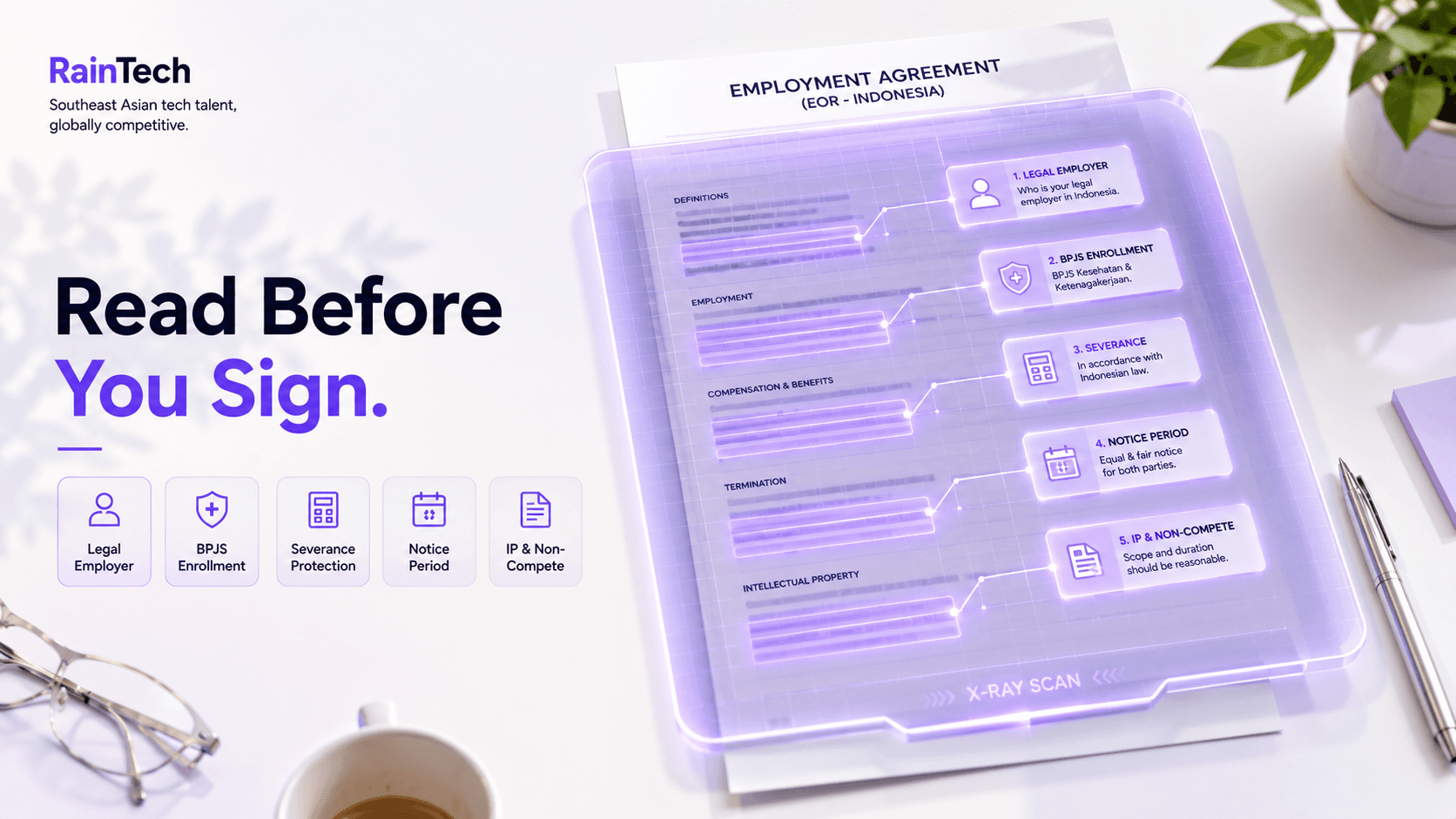
Before signing an EOR-based employment contract with a foreign company, an Indonesian engineer should specifically check: (1) who the legal employer actually is, (2) whether notice periods and termination terms are equal on both sides, (3) whether BPJS enrollment is explicitly stated, (4) whether severance follows Indonesian statutory formulas, and (5) how broad the IP assignment and non-compete clauses are.
Most problems in EOR contracts aren't hidden, they're just written in language most people skim past.
You got the offer. The salary number is good, maybe better than anything you've seen locally.
It's tempting to sign fast before the company changes its mind. But the contract sitting in your inbox right now is the document that determines what happens if things go wrong — not the offer call, not the recruiter's promises, not the Slack messages during onboarding.
Most Indonesian engineers sign EOR contracts without reading past the salary line, and most of the time that's fine. The times it isn't fine are expensive.
Clause 1 — Who Is Actually Your Legal Employer?
This is the single most important line in the entire document, and it's usually buried in the definitions section. In a legitimate EOR arrangement, the contract should name a specific, licensed Indonesian entity as your legal employer — not the foreign company whose product you'll be working on, and not a vague "our partner will handle local employment" statement.
According to Atlas HXM's 2026 EOR due diligence framework, the entity model is one of the most important things to verify before signing: a direct EOR employs workers through its own owned-and-operated legal entities, while an aggregator model resells access to third-party local partners — and the accountability chain gets meaningfully longer and harder to enforce in the aggregator model, especially when a dispute, termination, or payroll issue happens.
What to look for: the exact legal entity name (with Indonesian company registration details, not just a brand name), and a clear statement that this entity — not the client company — is your direct employer.
Clause 2 — Are Notice Periods and Termination Terms Actually Equal?
A well-known pattern in employment contracts generally, not specific to Indonesia, is asymmetric notice: the company can end your employment with little or no notice, while you're required to give 30, 60, or even 90 days if you want to leave.
According to Get PlainDoc's 2026 breakdown of employment contract red flags, an "at-will" clause combined with a long non-compete is a common trap — one side can be terminated instantly with zero notice, while the same contract can still lock that person out of the industry for a year or more afterward.
For Indonesian employment specifically, this matters even more because statutory termination procedure (PHK) requires a minimum 14 working days' written notice from the employer, plus a defined severance formula under Government Regulation No. 35 of 2021 — so a contract that tries to shortcut this with vague "at-will" language isn't just unfair, it may not be enforceable under Indonesian labor law in the first place.
What to look for: matching or reasonably close notice periods for both parties, and explicit reference to severance calculated under Indonesian labor law — not a flat dollar figure that ignores your actual tenure.
Clause 3 — Is BPJS Enrollment Explicitly Stated?
BPJS — Indonesia's mandatory national social security system covering health insurance and employment benefits — isn't optional, and a contract that's silent on it is a real gap, not a minor omission.
Some contracts mention "benefits per local law" without specifying BPJS by name, which sounds fine until you realize there's no accountability if it never actually gets registered.
What to look for: an explicit line stating BPJS Kesehatan and BPJS Ketenagakerjaan enrollment within your first month of employment, ideally with your registration number provided within a specific timeframe.
For the full breakdown of what BPJS should cost your employer and how it should show up on your payslip, see RainTech's complete BPJS guide for foreign employers.
Clause 4 — Does Severance Follow Indonesian Statutory Formulas?
This connects directly to Clause 2, but it deserves its own check because it's where the real financial exposure sits if the relationship ends.
A compliant Indonesian employment contract should reference severance calculated according to the components defined under Indonesian labor law — Uang Pesangon (severance based on tenure), Uang Penghargaan Masa Kerja (long-service pay after 3+ years), and Uang Penggantian Hak (compensation for unused leave and other entitlements) — not a flat "one month's notice pay" figure that may fall well short of what you're legally owed, especially once you've been employed for several years.
What to look for: any reference at all to how severance is calculated. If the contract is silent on this entirely, that's a gap worth asking about directly before signing.
RainTech's guide to negotiating a remote contract with an Indonesian tax lens covers how to raise this kind of gap with a recruiter without sounding like you're accusing them of anything — it's usually just an oversight in the template, not a deliberate omission.
Clause 5 — How Broad Is the IP Assignment and Non-Compete Language?
This is the clause engineers skip fastest because it reads like boilerplate legal text — and it's exactly why it deserves attention.
According to Inclusively remote's guide on key clauses every remote worker should know before signing a contract, vague scope-of-work and overly broad restrictive covenants are two of the most common ways one-sided contracts trap remote workers into terms they didn't intend to accept.
Two specific things to check:
IP Assignment Scope
Does it apply only to work created during employment and using company resources, or does it try to claim ownership of anything you build — including personal side projects — for the entire duration of your employment, regardless of whether company time or tools were involved?
Non-Compete Scope and Duration
Is it limited to a specific, named set of direct competitors for a reasonable period (commonly 6–12 months), or is it broad enough to functionally block you from working in tech at all for a year or more after leaving?
What to look for: IP assignment scoped to work product only, and non-compete clauses naming specific competitors with a defined, reasonable time limit — not open-ended language covering "the industry" broadly.
Why This Matters More With a Foreign Employer, Not Less
"The assumption we run into most is that because the salary is in USD and the company is well-known internationally, the contract must automatically be solid," says Fatimah Hasna, Co-Founder & COO of RainTech, who has spent 8+ years leading HR and EOR compliance operations for global companies hiring in Indonesia. "That's backwards. A foreign company's legal team is usually excellent at protecting the company under the laws they know — which is their home country's laws, not Indonesia's. Whether Indonesian statutory protections actually show up in your contract depends entirely on whether a licensed Indonesian EOR is in the middle of that relationship, doing the translation correctly."
This is the same structural gap covered from the employer's side in RainTech's guide to EOR contract traps most founders miss, the risks run in both directions, and a contract that protects the employer properly under Indonesian law is generally the same contract that protects the employee properly too.
Salary is usually the first thing engineers compare when weighing offers, but it's worth remembering that a strong number on a weak contract is still a weak offer.
RainTech's breakdown of the real Indonesian developer salary gap covers why two offers with similar headline numbers can end up worth very different amounts once contract structure, not just salary, is factored in.
FAQs
What's the difference between being hired as an "employee" versus a "contractor" by a foreign company through EOR?
An employee hired through a genuine EOR gets BPJS enrollment, statutory leave, and severance protection under Indonesian labor law. A contractor arrangement — even with the same day-to-day work — typically doesn't include these protections. If your work involves fixed hours, ongoing supervision, and regular monthly pay, Indonesian law generally treats that as employment regardless of the contract label. See RainTech's guide on EOR versus contractor misclassification for how this distinction is assessed.
Can I negotiate these clauses, or is the contract final once it's sent to me?
Most of these terms are negotiable, especially notice period symmetry and non-compete scope. Statutory minimums like BPJS enrollment and severance formulas aren't negotiable down — they're legal requirements — but a company can be asked to make them explicit in writing rather than leaving them implied.
Should I get a lawyer to review my contract before signing?
For a standard EOR-mediated offer with a licensed provider, careful self-review against a checklist like this one usually covers the major risks. For unusually large compensation packages, equity components, or if anything in the contract feels unclear even after asking questions, a one-time consultation with an employment lawyer is a reasonable cost relative to what a bad contract could cost you later.
What should I do if a clause looks wrong but the company won't clarify it?
Treat reluctance to clarify contract language as information in itself. A legitimate employer and a properly licensed EOR should be able to explain any clause in plain language without hesitation. If that explanation doesn't come, or comes with pressure to sign quickly, that's worth weighing seriously against the opportunity.
Next Step
A good offer and a good contract aren't the same thing. Checking these five clauses takes twenty minutes and can save you months of dispute later if the relationship doesn't work out.
Looking for your next role with a foreign employer that gets this right from day one? Join RainTech's talent pool and get matched with global companies hiring through a properly licensed, entity-owned EOR — BPJS, severance terms, and IP scope handled correctly, in writing, before you ever sign.