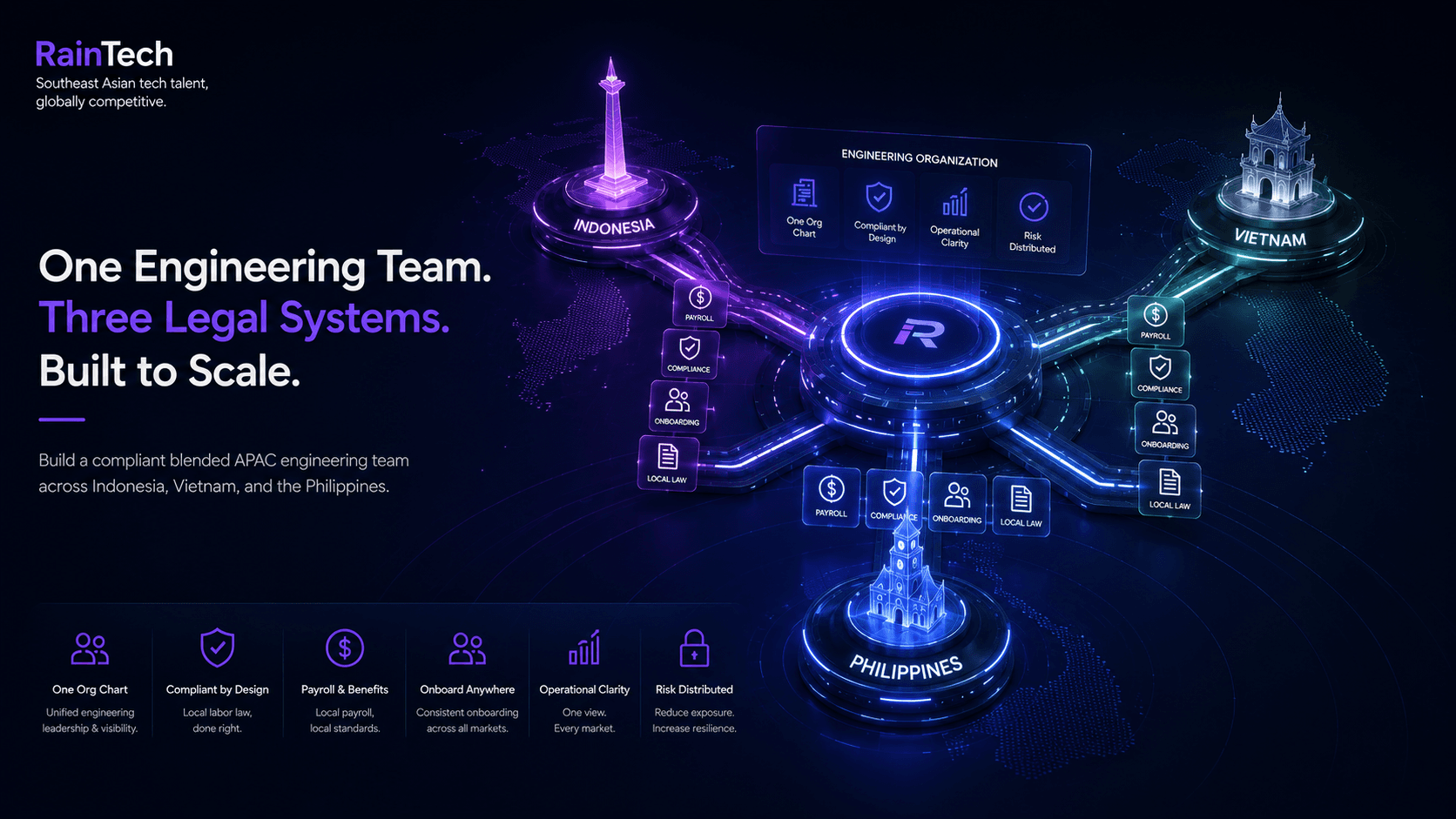
A blended APAC engineering team is a distributed team where a company hires developers across two or more Southeast Asian countries — most commonly Indonesia, Vietnam, and the Philippines — using separate compliant employment structures (EOR or entity) in each country, coordinated under one engineering org chart.
It's not the same decision as picking one country; it's a structured decision that most CTOs get wrong by treating three different legal jurisdictions as one hiring pipeline.
If your engineering org already has a developer in Ho Chi Minh City, a QA lead in Manila, and you're now looking at Jakarta for backend talent, you're not choosing a country anymore — you're managing three separate legal jurisdictions, three payroll cycles, and three sets of labor law under one team Slack channel.
Most companies get to this point by accident, hiring opportunistically as good candidates appear, and only realize the structural gap once a compliance question ("wait, who's actually the legal employer for our Manila hire?") has no clean answer.
Why This is a Different Question Than "Indonesia or Vietnam?"
Most content on Southeast Asian tech hiring frames the decision as a single choice: pick the best country and hire there.
RainTech has covered that comparison directly. See the breakdown of remote engineers in Indonesia vs Vietnam vs Philippines and the deeper 2026 CTO-focused comparison of Indonesia vs Vietnam.
A blended team is a different problem. You're not deciding which country wins, you're deciding how to run three (or two) simultaneously without your HR and legal overhead scaling linearly with headcount.
That's a structure question, not a talent-pool question, and it's the gap most APAC hiring content doesn't address.
Why Companies End Up Blended in the First Place
Three patterns show up repeatedly:
Talent-Pool Diversification
Companies that scale past 5–6 engineers in one country start hitting the ceiling of easily reachable senior talent in that specific market and expand sourcing to a neighboring country rather than compete harder for the same shrinking pool.
Risk Distribution
Some CTOs deliberately avoid concentrating an entire engineering function in one jurisdiction — spreading key roles across two countries reduces exposure to any single country's regulatory shifts, currency volatility, or talent-market tightening.
Acquisition or Historical Accident
A company acquires a startup with an existing Vietnam team, or a founder's first hire happens to be in the Philippines through a personal network, and Indonesia gets added later as the team scales.
None of these are wrong reasons. The problem isn't the blend, it's running it without a structured decision made on purpose.
The Core Structural Decision: One EOR, Or One Per Country?
This is where most blended teams create unnecessary risk. There are two viable models:
Model 1 — Country Specific EOR per Market
You use a specialized, locally-licensed EOR in each country: one partner for Indonesia, a separate one for Vietnam, a separate one for the Philippines. Each provider owns deep, current compliance expertise in exactly one jurisdiction.
Model 2 — One Multi Country EOR Platform
You use a single EOR platform that claims coverage across all three countries, aiming for one dashboard and one invoice.
The tradeoff is real and worth naming directly: multi-country platforms win on administrative simplicity but frequently operate through third-party in-country partner networks rather than owned local entities — meaning the actual compliance execution in each country is still handled by a subcontracted local partner you never see.
According to a 2026 breakdown of EOR provider evaluation from People Managing People, the single most important question to ask any EOR provider is whether they own their local entities directly or rely on a partner network, since partner-dependent models add an intermediary, communication delays, and split accountability when something goes wrong.
For companies running a genuinely blended team, this usually means: the deepest compliance quality comes from treating each country as its own specialized relationship, not from optimizing for a single login screen.
RainTech's own comparison of EOR versus setting up a PT PMA entity in Indonesia covers the same principle for a single market — depth of local compliance expertise matters more than administrative consolidation, especially once your headcount in any one country crosses 5–8 people.
What "Indonesia as Anchor" Actually Means
For companies building a blended APAC team, Indonesia typically functions best as the anchor market — the country where the largest share of the engineering function sits — for three structural reasons that show up consistently in how these teams evolve:
Talent Depth at Scale
Indonesia's developer population is the largest in Southeast Asia by a wide margin, which matters specifically when a company needs to scale a single team past 8–10 engineers without exhausting the reachable senior pool.
Compliance Predictability Once Structured Correctly
Indonesia's BPJS and labor law framework is detailed and non-negotiable — see RainTech's full BPJS compliance guide — but once a company builds the right EOR relationship, it becomes a known, repeatable cost structure rather than an ongoing risk.
Timezone Overlap for Western Clients
Indonesia's WIB time zone (UTC+7) gives 4–5 working-hour overlap with European mornings and US Pacific evenings, which product teams consistently cite as the deciding factor once salary comparisons across countries land within a similar range.
RainTech has observed this pattern directly. "The companies that come to us with a Vietnam or Philippines team already running usually aren't choosing Indonesia instead — they're choosing it as the base the rest of the team gets built around," says Fatimah Hasna, Co-Founder & COO of RainTech, who has spent 8+ years leading HR and compliance operations for global companies expanding into Indonesia. "The question we get isn't 'why Indonesia' anymore. It's 'how do we add Indonesia without breaking what's already working in the other two markets.'"
The Three Operational Failure Points in Blended Teams
1. Inconsistent Onboarding Speed Creates a Two-Tier Team Culture
If your Vietnam hire starts in 10 days and your Indonesia hire takes 6 weeks because the EOR relationship isn't mature, new hires notice — and it shapes how seriously they take the company's operational competence from day one.
One European client of RainTech's was candid about this exact contrast: after a slow, multi-week setup experience in a different market, RainTech's 5-day Indonesia onboarding was, in their words, a genuine surprise for how organized the process was end to end.
2. Payroll Date Misalignment Across Timezones and Banking Systems
Indonesia, Vietnam, and the Philippines each have different statutory payroll cutoffs, public holiday calendars, and banking processing windows. Running all three off a single assumed pay date is one of the most common — and most avoidable — sources of employee complaints in blended teams.
3. Termination Process Differences Get Discovered too Late
Notice periods, severance formulas, and dispute escalation paths differ meaningfully by country. A manager used to a straightforward Philippines exit process can badly misjudge an Indonesia termination, which follows a stricter statutory formula and procedure than most neighboring markets.
According to N-iX's 2026 guide to distributed engineering best practices, structure — not tooling — is what determines whether a distributed team actually works, and async-first processes still require deliberate design rather than the absence of meetings; the same principle applies at the compliance layer, not just the collaboration layer.
A Simple Framework: Where Each Country Fits
| Factor | Indonesia | Vietnam | Philippines |
|---|---|---|---|
| Typical strength | Backend, data, scale-stage engineering depth | Mobile, embedded, technical execution speed | English-fluent client-facing roles, QA, support |
| Time zone (Western Europe overlap) | Moderate-high (UTC+7) | Moderate (UTC+7) | Moderate-high (UTC+8) |
| Time zone (US overlap) | Evening PT overlap | Evening PT overlap | Evening PT overlap |
| Talent pool depth for scaling past 10 | High | Moderate | Moderate |
This isn't a ranking — it's a way to decide which country carries which function, so the blend has a logic behind it instead of being three unrelated hiring decisions stapled together.
FAQs
Does RainTech provide EOR services in Vietnam and the Philippines as well as Indonesia?
No — RainTech operates exclusively in Indonesia, which is deliberate. The depth of BPJS, tax, and labor law expertise that a genuinely blended team needs in each country is difficult to maintain at the same quality across three jurisdictions from one provider. For companies running a blended team, RainTech recommends using specialized, locally-licensed partners in Vietnam and the Philippines alongside RainTech's Indonesia coverage, rather than consolidating everything under one multi-country platform.
Is it cheaper to use one multi-country EOR platform instead of separate country-specific providers?
Often marginally, on paper — but the cost comparison misses the compliance-quality tradeoff. Multi-country platforms frequently subcontract in-country compliance execution to local partners, adding a layer of indirection exactly where accuracy matters most. For teams under roughly 20–30 total headcount across all countries, the administrative savings rarely offset the added risk.
How much time zone overlap does an Indonesia-anchored team get with a US company?
Indonesia's WIB time zone (UTC+7) overlaps with US Pacific time in the evening hours and gives close to a full working day of overlap with European mornings — similar to Vietnam and slightly less than the Philippines' UTC+8, though the practical difference across all three is usually under 1–2 hours.
What's the biggest mistake companies make when adding Indonesia to an existing Vietnam or Philippines team?
Assuming the same EOR structure, notice periods, and payroll cadence apply. Indonesia's termination process and BPJS obligations are more detailed than either neighboring market, and treating it as a drop-in replacement usually surfaces compliance gaps within the first 90 days.
Next Step
Running a blended APAC team well isn't about picking the "best" country — it's about giving each country the specialized compliance depth it needs while keeping the team feeling like one org, not three.
Already have engineers in Vietnam or the Philippines and evaluating Indonesia as the next market? Book a free 15-minute call with RainTech to map out how an Indonesia hire would slot into your existing structure — payroll timing, onboarding speed, and cost, side by side with what you're already running.
Want the full cost picture first? See RainTech's transparent EOR Indonesia pricing, or read how Australian SaaS teams have structured similar multi-market product squads in RainTech's breakdown of tech pod economics across US, UK, and Indonesia.