You have a solid GitHub. You have shipped real features. You have applied to 30 global remote roles in the last three months. You have heard back from two, and neither went past the first screen.
The problem is almost never your code. It is how you are presenting yourself to hiring managers who spend less than 30 seconds deciding whether to read further.
This guide is about that 30 seconds — what hiring managers actually see when they open your profile, what makes them keep reading, and what makes them close the tab.
Why Indonesian Developers are Invisible to Global Hiring Managers
GitHub Octoverse 2025 confirmed that Indonesia is among the countries that quadrupled their developer count over the past five years, placing Indonesia in the global top 10 developer communities by contributor count. The talent is there. The visibility is not.
The gap is not about technical skill. It is about how Indonesian engineers present themselves in the application layer, the specific signals that global hiring managers use to shortlist candidates from a pool where most applications are rejected in under a minute.
Most Indonesian developers applying to global roles are doing three things wrong simultaneously: presenting themselves as a list of technologies rather than a record of outcomes, optimizing for local hiring norms that do not translate to international audiences, and leaving the communication question unanswered — which is the question global hiring managers are most anxious about.
The Four Things Global Hiring Managers Actually Look for
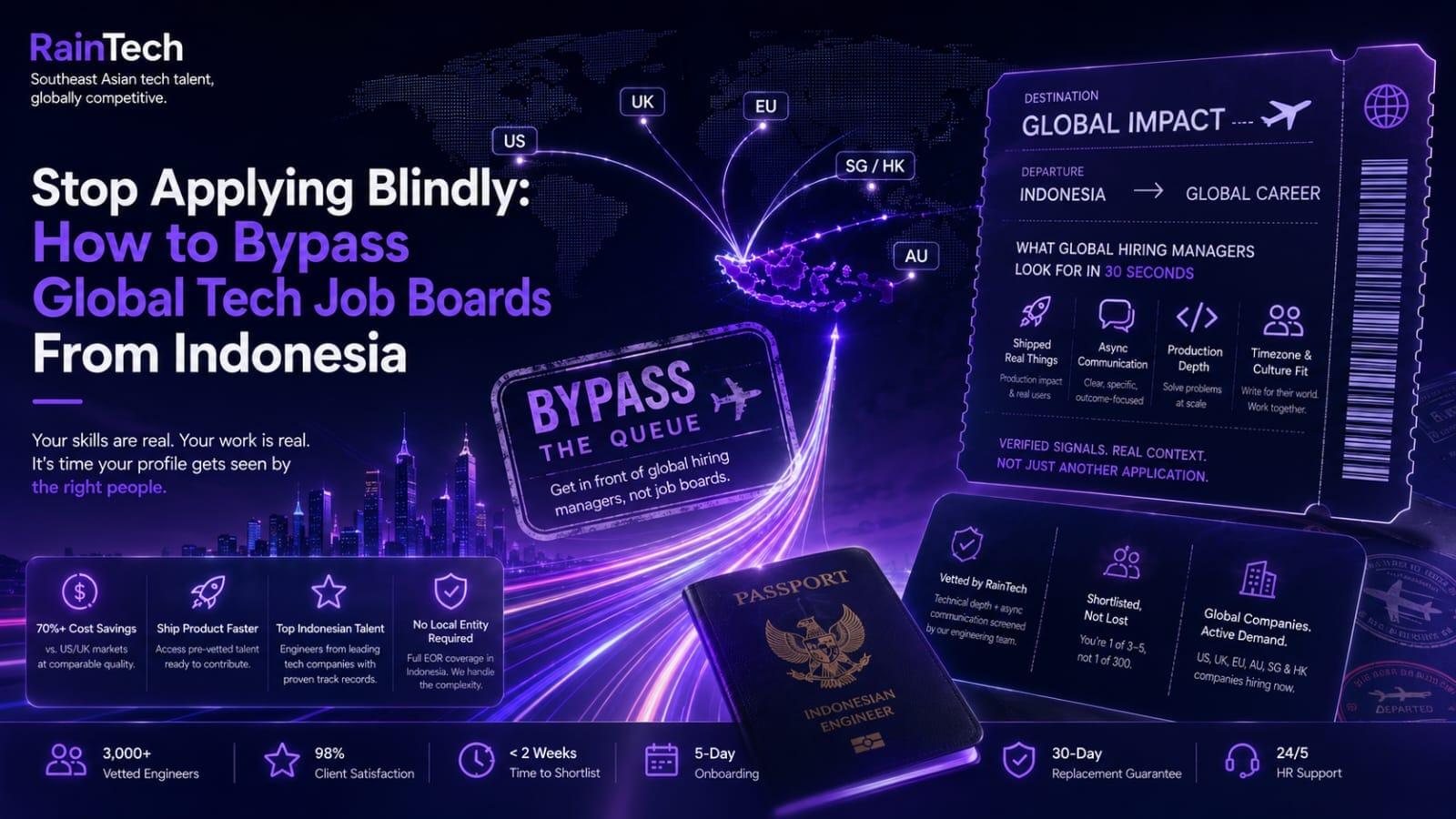
Understanding what a hiring manager is doing when they open your application changes how you present yourself. They are not reading. They are scanning for four specific signals in a specific order.
Signal 1: Have You Shipped Real Things to Real Users?
The first question any technical hiring manager asks when opening a profile is: has this person built something that actually ran in production? Not a tutorial. Not a course project. A system with real users, real load, and real consequences for failure.
Your GitHub profile answers this question, or it does not. A repository with a detailed README explaining what the system does, who uses it, what scale it operates at, and what technical decisions were made is dramatically more compelling than a repository with clean code and no context.
If your best work is inside a private company codebase, document it: write a public case study in your README or portfolio that explains what you built, without exposing proprietary code.
Signal 2: Can You Communicate in a Remote Environment?
According to Arc.dev's remote hiring data, async communication ability is consistently ranked among the top three factors global companies evaluate when hiring remote engineers, equal in weight to technical skill for many teams.
This is the question Indonesian engineers most consistently leave unanswered in their applications.
Your application itself is the communication test. A cover letter or application message that is vague, generic, or copied from a template signals immediately that async communication will be a problem.
A message that is specific — explaining why this company, what problem you want to work on, what relevant experience you bring — signals the opposite. Three specific sentences beat three paragraphs of generic enthusiasm every time.
Signal 3: Do You Understand The Stack at Production Depth?
Global companies hire engineers who understand not just how to use a technology but what happens when it breaks at scale.
The difference between "I know React" and "I optimized a React component that was causing 3-second re-renders by isolating state and memoizing selectors" is the difference between a candidate who gets screened out and one who gets a call.
Rewrite every technology claim in your profile as a production outcome. Not tools you have used, but problems you have solved using those tools.
Signal 4: Are You Ready to Work in Their Timezone and Culture?
This question is rarely asked directly but always evaluated. Mention your timezone explicitly — not as an apology but as context: "UTC+7, with availability for overlap in EU morning or US evening."
Demonstrate cultural fluency through your writing style: direct, specific, outcome-focused. The hiring managers most likely to read your application are in the US, UK, EU, Singapore, or Australia — write for them, not for a local Indonesian audience.
The CV and Profile Fixes That Make the Biggest Difference
Your LinkedIn About Section is not a Biography
"I am a passionate software engineer with experience in full-stack development" describes approximately 40 million people on LinkedIn. Rewrite it as your professional value statement: what you build, for what kind of company, at what level of complexity. Two sentences. Specific. Outcome-focused.
Your Github Profile README is Your First Impression
Most Indonesian engineers do not have one. The ones who do often fill it with contribution graphs and badge collections. What a global hiring manager wants to see: what you build, what stack you operate at, one or two highlighted projects with brief production context, and how to reach you. Five minutes of setup that changes your hit rate significantly.
Your Project Descriptions Need a "So What"
"E-commerce app built with React and Node.js" — every bootcamp graduate in the world has this.
"B2C marketplace serving 2,000 monthly active users, optimized checkout flow that reduced cart abandonment by 18%" — this is a project with a story.
Add the "so what" to every project: what problem did it solve, for whom, and what was the measurable outcome.
Remove The Skills Laundry List
A skills section that lists 40 technologies signals that none of them are deep. Keep your primary stack — the technologies you can discuss at production depth — and remove everything else. Depth signals are more valuable than breadth signals for global remote roles.
The Communication Gap that Kills Applications Before They Start
This is the hardest thing to hear and the most important: for global remote companies, the way you write your application is the first sample of the work you will do every day.
Most global remote teams are async-first. Engineers are expected to write clear PRs, document decisions, surface blockers early, and communicate context without a manager following up. The hiring manager reading your application is evaluating whether you can do this, based on the application itself.
What this means practically: every piece of writing in your application should demonstrate the communication behaviors that remote teams run on. Specific. Outcome-focused. No filler. The ability to explain a complex technical decision clearly in writing is more valuable in a remote environment than any specific framework knowledge.
If writing in professional English is a genuine gap, this is worth investing in — not because perfect grammar is required, but because clarity is.
The Indonesian engineers who consistently land global remote roles are not necessarily the most technically advanced. They are the ones who communicate their technical work most clearly.
Why RainTech's Talent Pool is a Different Channel
Job boards and direct applications put you in a pool of hundreds of applicants where your profile has 30 seconds of attention. RainTech's talent pool works differently.
When a global company comes to RainTech looking for an engineer, RainTech surfaces pre-vetted candidates directly to the hiring manager — with context about your technical background, communication readiness, and production experience already established through RainTech's screening process. You are not one of 300 applications. You are one of 3–5 shortlisted candidates.
Veri Ferdiansyah, RainTech's Co-Founder & CEO with 8+ years building Indonesian engineering teams, leads the technical screening personally. The engineers who make it into the active pool are those with verified production experience and demonstrated async communication ability, the two signals that global hiring managers actually shortlist on.
RainTech works with companies from the US, UK, EU, Australia, Singapore, and Hong Kong. Active demand across Tier 2 mid-level ($1,200–$2,000/month) and Tier 3 senior ($2,000–$3,000/month) roles in backend, full-stack, cloud, AI/ML, and cybersecurity.
FAQs
How important is GitHub for getting a global remote job as an Indonesian engineer?
GitHub is the most important async signal of technical credibility, it is the one place a hiring manager can verify your claims independently. But a GitHub profile with strong code and no context is almost as invisible as having no GitHub at all. Add README documentation to your top repositories explaining what the system does, who uses it, and what technical decisions you made. That context is what turns a repository from a code dump into a portfolio piece.
Do I need a perfect English CV to get hired by a global company?
No. You need a clear, specific, outcome-focused CV. Global hiring managers are not grading grammar, they are looking for evidence that you can communicate technical work clearly in writing. A shorter, more specific CV in good-but-imperfect English consistently outperforms a longer, more generic CV with perfect grammar.
Should I mention my timezone in my application?
Yes — proactively and positively. State your timezone (UTC+7) and your available overlap window. This removes a common source of hiring manager hesitation and signals that you have worked in remote cross-timezone environments before.
Is it better to apply directly to companies or join a talent platform like RainTech?
Both have a place, but they work differently. Direct applications put you in a large, anonymous pool where shortlisting is competitive and arbitrary. RainTech's talent pool surfaces directly to companies that are actively looking for Indonesian engineers and have already decided they want to hire from Indonesia — a fundamentally different buying stage. For engineers who meet the technical and communication bar, RainTech is a significantly faster path to a first global hire.
What level of experience does RainTech look for in its talent pool?
RainTech places engineers from Tier 1 junior ($800–$1,200/month) through Tier 4 staff/principal ($3,000+/month). What matters at every level is evidence of production experience and async communication readiness, not just a list of technologies on a CV.
Conclusion
The Indonesian engineers landing global remote roles in 2026 are not necessarily the most technically advanced. They are the ones who have closed the visibility gap — presenting their production experience clearly, writing applications that demonstrate async communication ability, and getting in front of hiring managers through channels that are not anonymous application pools.
If your technical skills are there but your applications are not converting, the fix is almost always in the presentation layer, and most of it takes hours, not months.
If you want a faster path, join RainTech’s vetted talent pool today to bypass the standard queue and get your profile directly in front of global companies actively looking for Indonesian engineers with your exact technical and communication credentials.
Related Articles:
- Why Strong Engineers Fail in Remote Teams: A Guide to Screening Indonesian Tech Talent
- 5 Tech Stacks for Indonesian Engineers to Earn USD in 2026
- From Local to Global: How to Land a USD Salary as an Indonesia Engineer
- How to Negotiate Your First Global Remote Contract: A Framework for Indonesian Developers
- Indonesia Tech Talent Tiers 2026: Exact Salaries, Output by Level, and ROI vs US Developers