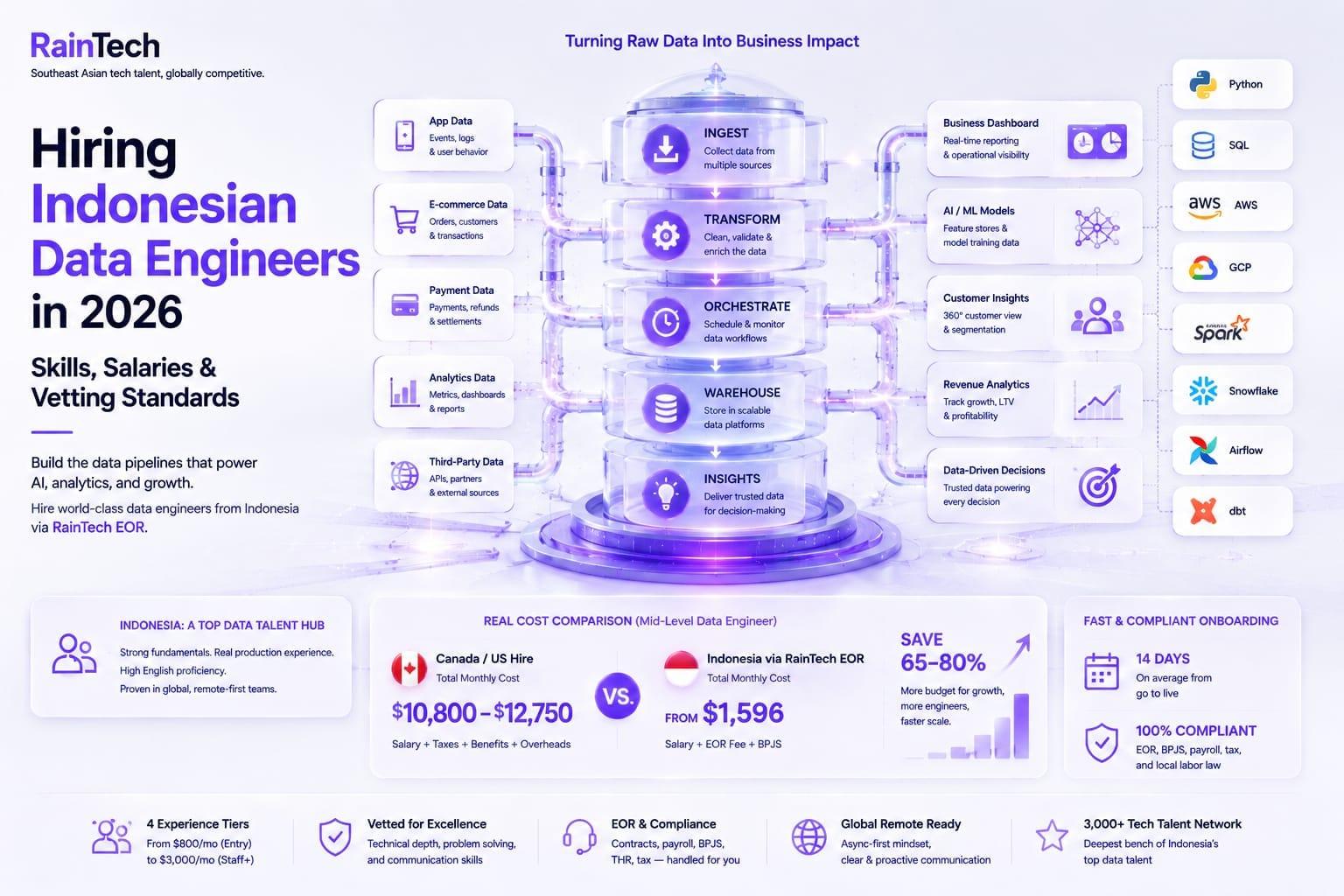
Indonesian data engineers hired through RainTech are priced across four experience tiers — starting from $800/month for entry-level and from $3,000/month for Staff/Principal level.
Add RainTech's $300 EOR fee and statutory BPJS contributions, and total all-in cost for a mid-level Tier 2 data engineer starts from $1,596/month — compared to $10,800–$12,750/month for an equivalent US hire.
The role demands a core stack of Python, SQL, and at least one cloud data platform — most commonly AWS or GCP — plus working knowledge of pipeline orchestration tools like Apache Airflow or dbt.
Hiring through an Employer of Record (EOR) is the fastest legal path for overseas companies to bring Indonesian data engineers onto their team without establishing a local entity, with onboarding achievable in 14 days or less.
Why Data Engineers Are Suddenly the Hardest Role to Fill Globally
The global data engineering services market is estimated at $105.39 billion in 2026, projected to grow at a compound annual rate of 15.12% through 2031.
Every company building an AI product, a real-time analytics dashboard, or a machine learning pipeline needs data engineers first — before data scientists, before ML engineers, before anyone else. The data has to move cleanly before it can be used.
The consequence is a supply problem that is getting worse, not better. Globally, analysts estimate approximately 2.9 million data-related job vacancies remain unfilled because companies cannot find qualified professionals fast enough.
In the US alone, the average data engineer salary has reached $130,000–$153,000 annually, with senior specialists in competitive markets earning significantly more.
For any company that is not headquartered in a major US tech hub, that compensation ceiling makes local hiring structurally difficult. The alternative — hiring data engineers remotely from Indonesia — is not a compromise. It is, increasingly, the first choice of engineering teams that have done the math and understand what Indonesian talent can actually deliver.
"The demand we see for data engineers specifically has increased in the last 12 months," says Veri Ferdiansyah, Co-Founder & CEO of RainTech, who spent 8+ years as CTO and VP of Engineering at Indonesian tech startups. "These are not generic roles anymore. The companies coming to us want someone who has shipped real pipelines, not just passed a certification. That is a different kind of screening."
What Indonesian Data Engineers Actually Know (And What to Verify)
Not all "data engineer" job titles represent the same depth of capability. Before setting salary expectations or writing a job description, it helps to understand how the Indonesian data engineering market is structured.
The Core Technical Stack you Should Require
According to a 365 Data Science analysis of 1,000 global data engineer job postings, the most in-demand skills in 2026 are:
- Python — required in 70% of postings. The lingua franca of data pipelines and transformation logic.
- SQL — required in 69% of postings. Non-negotiable for any candidate handling relational data sources.
- Apache Spark — required in 38.7% of postings. The dominant framework for large-scale distributed data processing.
- Snowflake — required in 29.2% of postings. Fast-growing, especially among SaaS and analytics-heavy companies.
- Databricks — required in 16.8% of postings. Increasingly standard for companies with ML pipelines.
Indonesian data engineers who have worked for domestic tech companies — GoTo, Traveloka, Bukalapak, or their ecosystem partners — tend to have strong real-world exposure to high-volume data pipelines.
These are not small-scale systems: GoTo alone processes transaction data for tens of millions of daily active users. Engineers who came up through these environments have built pipelines at a scale most Western mid-market companies will never approach.
What the Indonesian market sometimes lacks depth in: enterprise data governance, dbt proficiency (still growing), and exposure to Databricks specifically — since cloud stack preferences in the Indonesian market have historically leaned toward GCP and AWS over Azure.
How to Tier Candidates by Actual Capability
Tier 1 — Entry level (0–2 years, from $800/mo)
Comfortable with SQL and Python for ETL tasks. Familiar with one cloud platform, typically AWS or GCP. Has worked on structured datasets but has not yet owned a production pipeline end-to-end. Best suited for teams that can provide technical mentorship and have a senior data engineer to review their work.
Tier 2 — Mid level (3–5 years, from $1,200/mo)
Has built and maintained production pipelines with real traffic. Works independently with orchestration tools like Airflow or Prefect, handles schema design and data modeling, and has debugged pipeline failures in production. Can operate with minimal supervision. This tier represents the strongest value-to-cost ratio for most global engineering teams.
Tier 3 — Senior level (5–8 years, from $2,000/mo)
Owns data architecture decisions. Has designed multi-source ingestion pipelines, worked with streaming data (Kafka, Flink), and mentored junior engineers. Can communicate infrastructure trade-offs to non-technical stakeholders — product managers, finance leads, CTOs.
Tier 4 — Staff/Principal level (8+ years, from $3,000/mo)
Drives data strategy across the organization. Has experience defining data platform standards, evaluating tooling across the modern data stack, and leading data engineering chapters or guilds. Rare in the Indonesian market but available through RainTech's curated network.
For global companies running lean, Tier 2 is typically the most cost-efficient first hire — experienced enough to operate independently, but at a fraction of what the same seniority costs in the US or UK. See RainTech's full 2026 Indonesian tech salary tiers and ROI guide for a complete breakdown across all engineering roles.
Salary Reality Check: What You Will Actually Pay
RainTech structures data engineer compensation across four tiers based on experience depth and responsibility scope. Here is how that maps to actual cost for a global company, including EOR fee and statutory contributions.
| Tier | Experience | Starting Salary | RainTech EOR Fee | BPJS (employer) | All-in Monthly |
|---|---|---|---|---|---|
| Tier 1 | 0–2 yrs | from $800 | $300 | ~$65 | from $1,165 |
| Tier 2 | 3–5 yrs | from $1,200 | $300 | ~$96 | from $1,596 |
| Tier 3 | 5–8 yrs | from $2,000 | $300 | ~$160 | from $2,460 |
| Tier 4 | 8+ yrs | from $3,000 | $300 | ~$240 | from $3,540 |
How This Compares to The US Market
The average data engineer salary in the US is $130,000–$153,000 per year, or roughly $10,800–$12,750 per month — before employer payroll taxes, health benefits, and other overhead. A Tier 2 Indonesian data engineer through RainTech runs from $1,596/month all-in. That is a saving of more than $9,000 per engineer, per month at equivalent seniority.
For a team of three — a Tier 3 pipeline lead, a Tier 2 ETL engineer, and a Tier 1 junior — total monthly cost through RainTech runs approximately $5,221/month all-in. The equivalent US team would cost $28,000–$35,000/month. Annual saving: $270,000–$356,000 — enough to fund a full additional product or engineering hire locally.
For a full breakdown of cost structures across all engineering roles and seniority levels, see Indonesia tech hiring costs in 2026: myth vs. reality.
How to Vet a Data Engineer Remotely Without Getting It Wrong
Remote vetting for data engineers is different from vetting for product engineers. The failure modes are also different. A backend engineer who writes mediocre code will ship slowly. A data engineer who builds a bad pipeline will silently corrupt your analytics, and you may not discover the problem for months.
Here is the vetting framework RainTech applies, which global companies can use directly or adapt:
Stage 1 — Portfolio Audit (Before Any Interview)
Ask for: links to GitHub repositories or data projects, descriptions of production pipelines they have built (volume, frequency, tools), and any public contributions to open-source data tooling. A candidate who cannot describe a production pipeline they shipped — including what broke and how they fixed it — is not yet a mid-level hire, regardless of their resume.
Stage 2 — Technical Screen (60–90 minutes)
A focused assessment covering:
- SQL: multi-table joins, window functions, query optimization on a sample dataset
- Python: write a simple ETL script that reads from a CSV, transforms data, and loads to a mock target
- Pipeline design: whiteboard a data pipeline architecture for a described scenario (e.g., "you need to ingest real-time clickstream data from three sources into a warehouse — walk me through how you'd design this")
Avoid purely algorithmic coding challenges (LeetCode-style). Data engineers are not software engineers — their value is in system design and data handling, not binary tree traversal.
Stage 3 — Communication and Async Readiness Check
Send a written brief describing a data quality problem (schema drift from a third-party API). Ask the candidate to respond asynchronously, in writing, with their diagnosis and proposed fix. This tests English communication under technical pressure — the real bottleneck for remote collaboration — and reveals how they think independently without being able to ask follow-up questions.
"Beyond technical competency, we specifically look for resilience and adaptability," says Veri. "Global roles demand that an engineer can flag a problem clearly, propose a solution, and move forward — not wait for a manager to unblock them. That is what we screen for, and it is what makes the difference between a hire who thrives remotely and one who struggles."
Stage 4 — Reference or Work Sample
For mid-level and senior hires, request one reference from a previous direct manager, or a sample of actual pipeline code they have written (sanitized if needed). This is standard practice for senior technical hires globally and should not be waived for remote hires.
What Changes When You Hire a Data Engineer vs. a Software Engineer
Companies that have previously hired Indonesian software engineers sometimes assume the same process applies to data engineers. It mostly does, but with a few meaningful differences worth anticipating.
The Tooling Environment Matters More
A software engineer can adapt to a new tech stack relatively quickly. A data engineer who has only worked in AWS-native services (Glue, Redshift, S3) will have a steeper learning curve if your stack is entirely GCP (BigQuery, Dataflow, Pub/Sub). Specify your data stack explicitly in the job description, not just the general cloud provider.
The Iteration Cycle is Longer
Pipeline bugs are often silent. Unlike application code where a broken feature triggers an immediate error, a misconfigured pipeline may process data incorrectly for days before downstream analytics reveal the problem. This means the onboarding period for a data engineer should include a structured review of their first pipeline outputs — not just a code review, but a data quality audit.
Stakeholder Communication is a Bigger Factor
Data engineers in global teams often interact with data analysts, product managers, and finance teams — not just engineering colleagues. Candidates who communicate clearly in writing, ask precise clarifying questions, and can explain technical constraints in plain language are more valuable than candidates with marginally better technical scores and poor communication.
For further guidance on overall hiring costs and what to budget beyond salary, see RainTech's breakdown of Indonesia tech hiring costs in 2026: myth vs. reality.
The Legal Path: Getting a Data Engineer on Your Team Without a Local Entity
The process is the same as hiring any Indonesian tech professional — an EOR handles the legal employer layer so you do not need to establish a PT PMA or branch office.
What RainTech manages on your behalf:
- Bilingual employment contract (Bahasa Indonesia + English), compliant with Indonesian Manpower Law
- BPJS Ketenagakerjaan and BPJS Kesehatan registration and monthly contributions
- PPh 21 income tax withholding and reporting
- THR (Tunjangan Hari Raya) payment before Eid al-Fitr
- Annual leave tracking and statutory benefit administration
- Payroll disbursement in IDR, invoicing to your company in USD
Timeline from first conversation to engineer onboarded: 14 days on average. The fastest RainTech has completed this end-to-end — for a European client with a hard project deadline — was five working days.
FAQs
Is it hard to find data engineers in Indonesia who know dbt and Snowflake specifically?
Candidates with dbt and Snowflake experience exist in Indonesia but are less common than those with Python, SQL, and AWS/GCP backgrounds. Mid-level engineers who are strong in core data fundamentals typically pick up dbt within 4–6 weeks. If your stack is heavily Snowflake-centric, factor in a short ramp period, or specify this explicitly in your sourcing brief so RainTech can screen for it.
Can I hire a data engineer in Indonesia who also does some ML work?
Yes — the boundary between data engineering and ML engineering is increasingly blurry in Indonesia, particularly among engineers with 4+ years of experience. Many candidates have built feature pipelines, worked with MLflow or Kubeflow, and are comfortable with the infrastructure layer of ML systems. Be specific about the split you expect (e.g., 70% pipeline / 30% ML) so vetting is calibrated correctly.
How do I handle IP ownership and data security if my engineer is employed through an EOR in Indonesia?
IP ownership and confidentiality are governed by the employment contract — RainTech's standard bilingual contracts include IP assignment clauses that transfer ownership of work products to the client company. For data security, standard practices apply: access controls, VPN requirements, and NDAs. The EOR structure does not create additional IP risk compared to hiring a remote employee in any other country.
What if the data engineer I hire doesn't work out after 2–3 months?
RainTech includes a 30-day replacement guarantee on placed candidates. For EOR employees, termination follows Indonesian Manpower Law procedures — typically a bipartite notice period. RainTech manages the offboarding process, including final payroll, BPJS deregistration, and any severance calculations. Most terminations for performance within the first 3 months are handled under the probationary period terms, which simplify the process significantly.
Do Indonesian data engineers work well with US or European data teams across time zones?
The majority of RainTech-placed engineers operate in async-first environments with US or European teams. The practical approach that works best: daily written standups via Slack or Notion, 2-week sprint cycles with clear ticket specs, and one weekly overlap call scheduled at a time that works for both parties. Engineers who have worked in international environments previously adapt faster — this is something RainTech screens for explicitly during the assessment process.
Next Step
Building a data team in Indonesia is not complicated — but getting the tier, the stack match, and the legal structure right from the start saves you from costly re-hires and compliance headaches down the road.
Ready to build your data infrastructure? Here is how you can take the next step:
- Map your budget: View RainTech's pricing to calculate your exact all-in monthly cost instantly.
- Explore our process: Read how RainTech's EOR and sourcing process work, including how Veri's technical screening separates candidates who have shipped real pipelines from those who just list tools on their CV.
- Evaluate your options: See how RainTech compares to other EOR providers in Indonesia to ensure you are choosing the right partner for your team.
Related articles:
- Indonesian Tech Salaries 2026: The Founder’s Guide to Building High-Density Squads
- Myth vs. Reality: The Actual Cost of Hiring Indonesian Tech Talent in 2026
- 5 Biggest Mistakes Hiring Indonesian Developers 2025
- Understanding Employer of Record: An Essential Guide for Global Companies Hiring in Indonesia
External references: