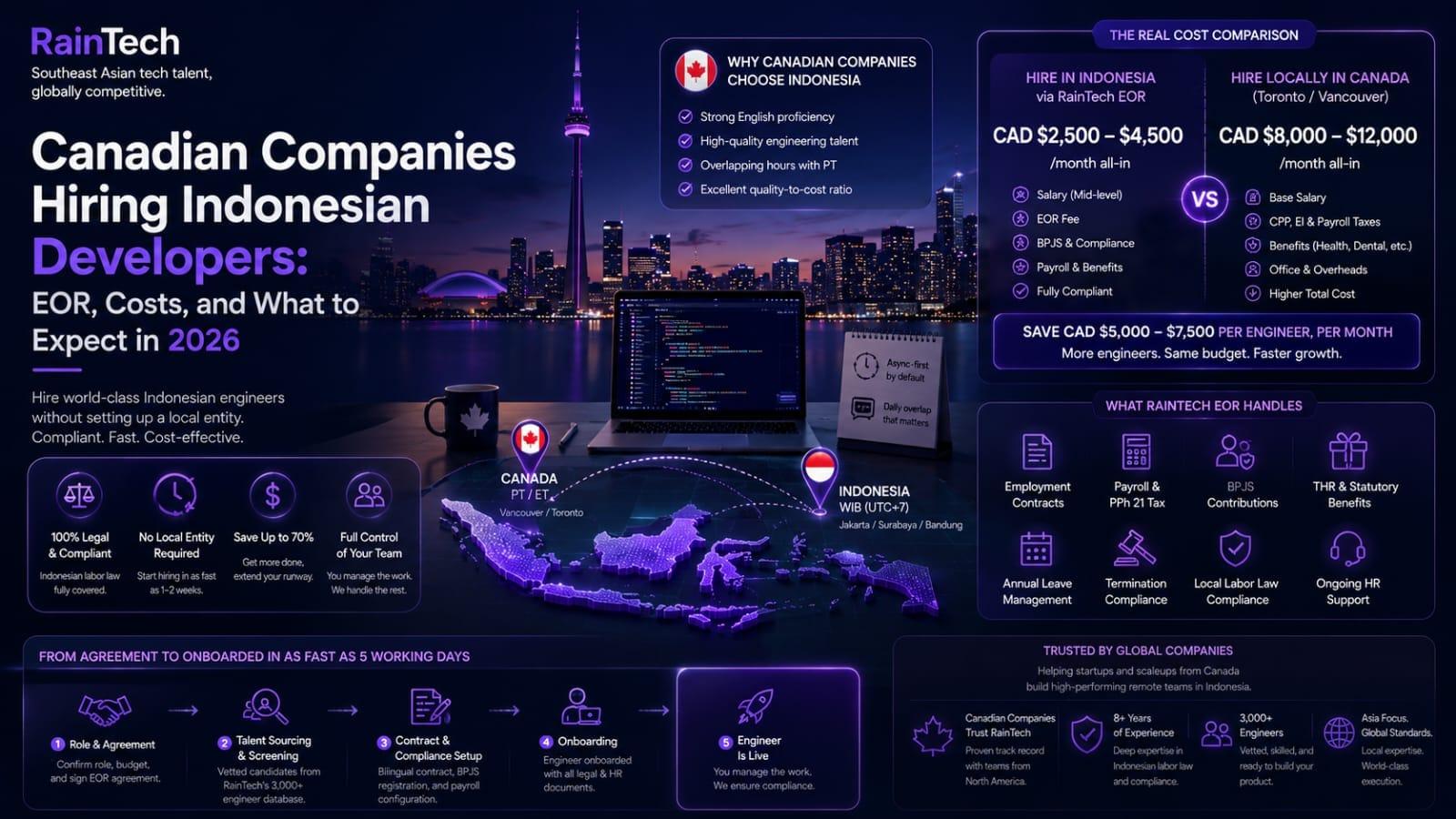
Canadian companies can legally hire Indonesian developers without setting up a local entity in Indonesia by using an Employer of Record (EOR). The EOR becomes the legal employer on paper, handling payroll, BPJS contributions, employment contracts under Indonesian law, and statutory compliance — while the Canadian company retains full day-to-day management of the engineer.
Total cost for a mid-level Indonesian developer through an EOR typically runs CAD $2,500–$4,500 per month all-in, compared to CAD $8,000–$12,000 for an equivalent hire in Toronto or Vancouver.
This guide covers how the model works specifically for Canadian companies, what the legal structure looks like, the real cost breakdown, time zone considerations, and what to expect at each stage of the process.
Why Canadian Companies Are Looking at Indonesia Right Now
Canada's tech talent gap is not a future problem, it is a current operational constraint.
According to the Information and Communications Technology Council (ICTC), Canada will need to fill over 250,000 tech-related jobs by 2026, making it one of the most promising sectors for career growth.
At the same time, the average salary for a senior software engineer in Toronto is CA$137,940 per year, with top earners at competitive companies pushing past CA$200,000 in total compensation.
For a Series A startup in Toronto or a SaaS company scaling out of Vancouver, that math creates a hard ceiling on team size. You can hire two senior Canadian engineers, or you can hire four to five equally skilled engineers in Indonesia at the same total budget — with the same code quality, stronger English proficiency than most APAC markets, and a time zone that overlaps meaningfully with the Canadian Pacific coast.
This is not a new pattern. About half of companies that work with RainTech have prior experience hiring in Asia — often in India, the Philippines, or Vietnam — but increasingly choose Indonesia as a first or expanded market because of the quality-to-cost ratio and the growing depth of the Indonesian tech ecosystem.
"What we see from clients who come from countries like Canada is that they've already done the mental math on salary," says Veri Ferdiansyah, Co-Founder & CEO of RainTech and former CTO at multiple tech startups in Indonesia. "What they haven't figured out yet is the legal path. That's usually what the first conversation is about."
The Core Legal Question: Can a Canadian Company Hire in Indonesia Without a Local Entity?
Yes, and the mechanism is well-established.
In most cases, companies must establish a local legal entity to hire employees directly in Indonesia. However, using an Employer of Record (EOR) allows you to hire employees in Indonesia without setting up a subsidiary or registering a business locally.
The EOR acts as the legal employer on your behalf, managing compliant hiring, employment contracts, payroll, tax withholding, and statutory benefits in accordance with Indonesian labor laws.
For a Canadian company, this means the EOR — in this case, RainTech — holds the employment contract with the Indonesian engineer. RainTech is the registered Indonesian entity that bears the legal employer responsibilities: BPJS contributions, PPh 21 income tax withholding, THR (religious holiday bonus), annual leave entitlements, and all obligations under Indonesian Manpower Law.
The Canadian company, meanwhile, manages the engineer's daily work exactly as they would a remote team member anywhere else — through Slack, GitHub, Linear, or whatever tools the team uses.
There is no registration requirement on the Canadian side specific to this arrangement. No PT PMA (foreign-owned Indonesian company), no branch office, no Indonesian tax ID. The EOR handles the Indonesian side. The Canadian company pays the EOR invoice in USD or CAD, and the EOR disburses salary in IDR to the engineer.
What It Actually Costs: A Real Breakdown for Canadian Founders
This is the calculation most articles skip. Here is what a Canadian company actually pays when hiring through RainTech's EOR.
Scenario: Hiring one mid-level backend engineer (4–6 years experience)
| Cost Component | Monthly Amount (USD) | CAD Equivalent (~1.36) |
|---|---|---|
| Engineer salary (mid-level, Indonesia) | $1,500–$2,000 | CAD $2,040–$2,720 |
| RainTech EOR fee | $300 | CAD $408 |
| BPJS contributions (employer portion, ~4.24% + 4%) | ~$125–$165 | CAD $170–$225 |
| Total monthly cost | ~$1,925–$2,465 | CAD $2,618–$3,352 |
Compared to Hiring Locally in Toronto
| Cost Component | Monthly Amount (CAD) |
|---|---|
| Mid-level developer salary (Toronto) | CAD $7,500–$9,500 |
| CPP employer contribution (5.95%) | CAD $446–$565 |
| EI employer premium (~2.21%) | CAD $166–$210 |
| Benefits (health, dental, standard package) | CAD $400–$600 |
| Total monthly cost | CAD $8,512–$10,875 |
Effective saving per engineer per month: CAD $5,160–$7,523. Per year: CAD $61,920–$90,276.
For a team of three engineers, that is CAD $185,000–$270,000 in annual cost reduction — capital that can fund product development, go-to-market, or simply extend runway by 12–18 months.
These savings figures align with what RainTech clients consistently cite. "Clients usually decide on RainTech because of the cost savings — up to 70% — combined with the speed of hiring and our deep database of Indonesian tech talent," says Fatimah Hasna, Co-Founder & COO of RainTech, who brings eight years of experience in EOR and international recruitment.
The Time Zone Reality
Canada spans six time zones. This matters when evaluating whether an Indonesian team can work effectively with a Canadian parent company.
Canada Pacific (Vancouver, PT) vs Indonesia (WIB, UTC+7)
The gap is 15 hours. A Vancouver team starting work at 9am PT will find their Indonesian engineers wrapping up their day. Overlap: roughly 1–2 hours if the Indonesian team works a slightly extended day.
Canada Eastern (Toronto, ET) vs Indonesia (WIB, UTC+7)
The gap is 11–12 hours (depending on daylight saving). A Toronto team starting at 9am ET has zero real-time overlap with a standard Indonesian working day.
This is a genuine constraint and worth stating clearly. For most Canadian companies working with Indonesian engineers, the model that works best is async-first communication — detailed tickets, well-documented specs, Loom videos for walkthroughs — with one scheduled overlap call per day in the early morning Vancouver time or late evening Toronto time.
"The engineers we place have been briefed specifically on global work culture — what direct communication looks like, how to flag blockers proactively, and how to operate effectively without needing constant synchronous check-ins," says Veri. "That's part of what we screen for, not just technical competency."
Companies that have hired across India or Philippines typically adapt quickly. The same async patterns apply. The advantage Indonesia has over India for Canadian Pacific companies is that WIB (UTC+7) vs IST (UTC+5:30) puts Indonesian engineers slightly closer to Australia — which matters if the Canadian company also has an APAC presence.
The Legal Setup Process: What Happens After You Say Yes
Here is the actual sequence when a Canadian company starts with RainTech:
Week 1: Role Confirmation and Agreement
The Canadian company confirms the role requirements: tech stack, seniority level, working hours expectation, salary budget. RainTech prepares the service agreement and compliance documentation. Average time from first conversation to signed agreement: 1–2 weeks, depending on client readiness.
Week 1–2: Candidate Sourcing (if needed) or EOR Setup for Existing Candidate
If RainTech is sourcing: candidates are drawn from RainTech's database of 3,000+ vetted Indonesian tech professionals, screened by Veri's team for technical competency, English communication, and remote work readiness. If the Canadian company has already identified a candidate: RainTech sets up the EOR structure around that person directly.
Week 2: Contract Preparation and Onboarding
RainTech prepares a bilingual employment contract (Bahasa Indonesia + English) compliant with Indonesian Manpower Law. BPJS Ketenagakerjaan and BPJS Kesehatan registration is completed. Payroll setup is configured. The engineer receives an onboarding package including their contract, benefits summary, and first point of contact.
Day 14 (or Earlier)
Engineer is live The Canadian company has a working team member.
RainTech continues as the employer of record — managing payroll disbursement every month, THR payment before Eid, BPJS reporting, and any HR issues that arise.
The fastest RainTech has completed this sequence — from first call to engineer onboarded — is five working days, for a European client who needed to meet a critical project deadline.
What Canadian Companies Typically Get Wrong on the First Try
Based on RainTech's intake conversations with Canadian founders and HR leads, three misunderstandings come up consistently:
Misunderstanding 1
"We can just use a contractor arrangement to start." The Indonesian legal framework does not recognize indefinite contractor arrangements for what is functionally full-time employment.
A developer working 40 hours a week on your core product, under your supervision, with a regular payment — that is an employment relationship under Indonesian law, regardless of what the contract says. Starting with a contractor arrangement and planning to "formalize later" creates retroactive liability. The cleaner path is EOR from day one.
Misunderstanding 2
"The EOR fee is on top of the salary, so it's expensive." The $300/month EOR fee is often compared to the wrong baseline.
Compared to the cost of establishing a PT PMA (Indonesian foreign-owned company) — which involves legal fees, notary costs, capital requirements, and ongoing compliance overhead — the EOR fee is a fraction of the alternative.
Compared to the total Canadian employer cost (CPP, EI, benefits), the EOR fee is a rounding error.
Misunderstanding 3
"We need to find the talent ourselves first." Some Canadian companies arrive with a candidate already identified — a developer they met through LinkedIn or a referral.
That is fine; RainTech can set up the EOR structure around an existing hire. But many founders underestimate how much vetting matters at a distance. A resume and a video call are not sufficient to assess technical depth, remote work discipline, or English communication fluency under pressure.
RainTech's screening process — led by Veri, who has an engineering background — addresses this specifically.
How This Compares to Other Routes
Canadian companies considering Indonesia typically evaluate three alternatives:
Option 1: Hire a Canadian Remote Developer (Lower Cost Region)
Average salary for a senior developer in Montreal or Calgary: CAD $90,000–$120,000/year. Still 2–3x the cost of an Indonesian hire via EOR. Compliance is simpler but the cost delta is significant.
Option 2: Set Up a PT PMA (Indonesian Foreign Company)
Timeline: 3–6 months. Cost: CAD $15,000–$40,000 in legal and setup fees. Suitable only for companies planning to hire 10+ people in Indonesia long-term.
For most Canadian startups testing the market with 2–4 hires, this is overkill. For a detailed comparison, see EOR vs PT PMA: Why SG/HK Startups Avoid Early Entities — the same logic applies to Canadian companies.
Option 3: Use a Global EOR Platform (Deel, Remote.com)
These platforms work and offer Indonesia coverage. The difference with RainTech is specialization: RainTech operates exclusively in Indonesia and Southeast Asia, with a founder who has a technical background and personally screens candidates.
For companies where candidate quality matters as much as compliance coverage — which is most tech companies — the specialist model tends to produce better outcomes than a global platform with shallow Indonesia expertise.
The Decision Framework for Canadian Companies
EOR in Indonesia makes sense if:
- You need to hire 1–10 engineers and are not ready to establish a local entity.
- Your budget per engineer is CAD $3,000–$5,000/month all-in (vs CAD $8,000–$12,000 locally).
- You are comfortable with async-first workflows and can structure work in 2-week sprints.
- You want compliance handled without building internal Indonesian HR expertise.
EOR in Indonesia may not be the right fit if:
- Your work requires all engineers to be physically present in Canada.
- Your security or data compliance requirements restrict employment of staff in certain jurisdictions.
- You are building a highly synchronous real-time team where time zone overlap is non-negotiable.
For most Canadian SaaS, fintech, or digital-product companies, the first list describes the situation accurately.
FAQs
Can a Canadian company legally hire developers in Indonesia without a local entity?
Yes, Canadian companies can legally hire Indonesian talent without setting up a local entity by using an Employer of Record (EOR). The EOR acts as the legal employer on paper, handling all local payroll, taxes, and labor law compliance. Meanwhile, your company retains full daily operational management of the engineers.
How much can a Canadian company save by hiring through an EOR in Indonesia?
Hiring a mid-level Indonesian developer through an EOR typically costs CAD $2,500–$4,500 per month all-in. In comparison, a similar local hire in Toronto or Vancouver costs around CAD $8,000–$12,000 monthly. This allows Canadian founders to save up to 70% on development costs.
How do Canadian teams manage the time zone difference with Indonesia?
Most teams successfully adapt by using an async-first workflow with detailed documentation and Loom videos. There is usually a 15-hour gap with Vancouver and an 11-to-12-hour gap with Toronto. Teams typically schedule one daily sync call during early Canadian mornings or late evenings.
How long does it take to onboard an Indonesian developer through RainTech?
The standard timeline from the initial conversation to a signed agreement takes about 1 to 2 weeks. RainTech handles everything including compliant bilingual contracts, payroll setup, and statutory benefits registration. In urgent cases to meet critical deadlines, the entire onboarding sequence can be completed in just 5 working days.
Next Step
If you are a Canadian company evaluating whether Indonesia is the right hiring market, RainTech handles the entire legal and administrative layer for you.
Get started today by viewing RainTech pricing to map out your budget, or see how RainTech's EOR works to understand how we keep your business fully compliant under local manpower laws.
To see how your talent options stack up, you can also explore our 2026 Indonesian tech salary tiers to find the exact engineering expertise your product needs.
Related articles:
- Indonesia Remote Team: 2026 HR & Payroll Compliance Guide
- Stop Waiting 6 Months: Why EOR is Crushing PT PMA for Indonesian Tech Hiring in 2026
- Understanding Employer of Record: An Essential Guide for Global Companies Hiring in Indonesia
External references: