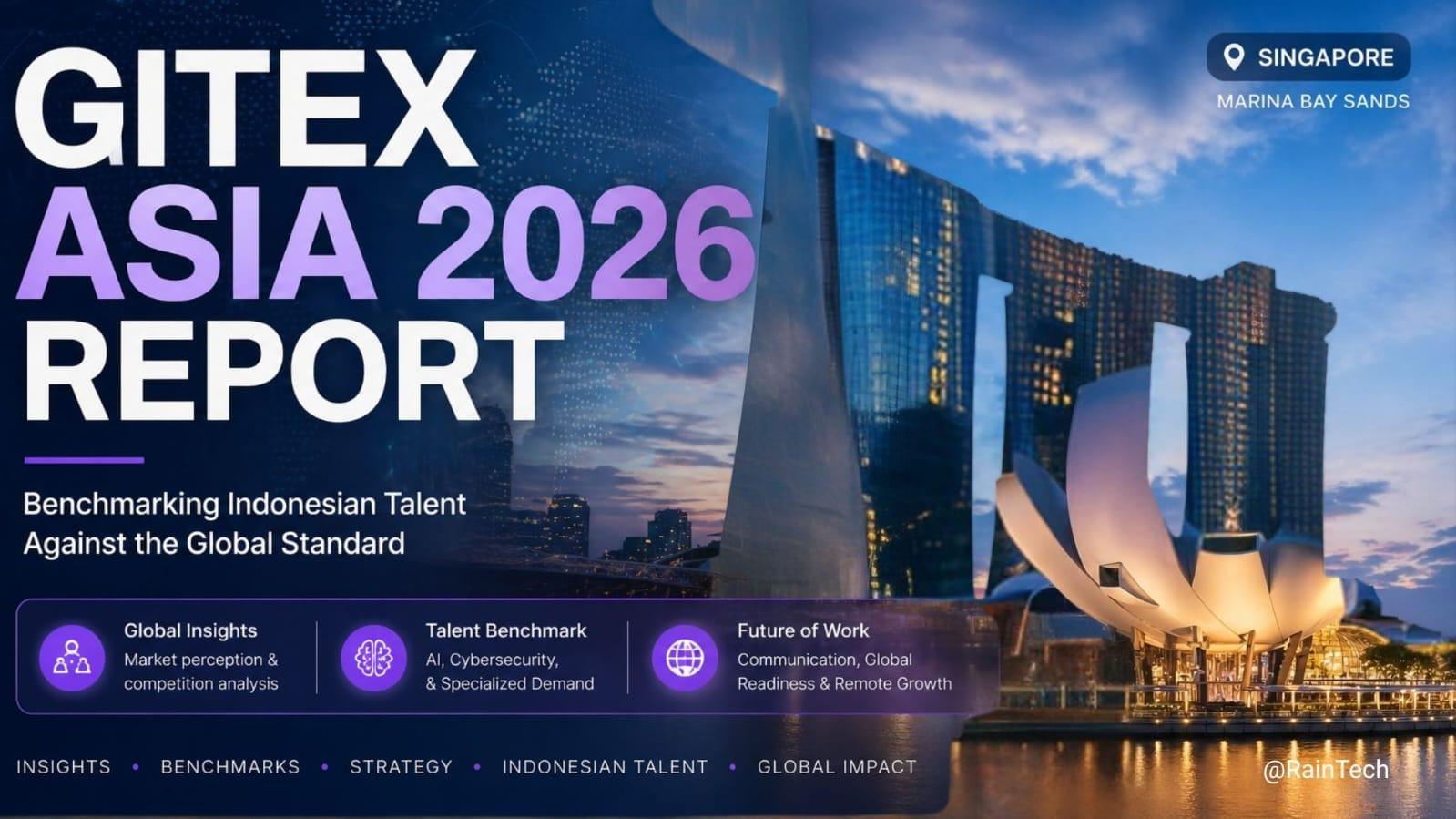
SINGAPORE — The conversation at GITEX Asia 2026 was no longer about whether companies should hire remotely, but where they should go next.
As the RainTech team walked the halls of Marina Bay Sands, one thing became clear: Indonesia is at a pivotal moment.
While Southeast Asia is a global darling, the competition for attention is fierce. Our founder, Veri Ferdiansyah spent two days validating the "Indonesian Value Proposition" against global benchmarks.
This report summarizes our key findings on market perception, talent gaps, and the shifting demand in the regional tech ecosystem.
The Market Perception: Indonesia Competition with Vietnam
In the world of tech talent sourcing, perception is reality. At GITEX, we observed a distinct contrast in how global CTOs perceive the two regional giants: Indonesia and Vietnam.
Vietnam is currently seen as a mature hub for disciplined, high-volume engineering. Meanwhile, Indonesia is perceived as the "High-Potential Frontier"—full of scalable talent but often hindered by a perceived lack of ecosystem maturity.
Comparative Insight: Indonesia vs Vietnam (2026 Benchmark)
| Factor | Indonesia (Market Sentiment) | Vietnam (Market Sentiment) |
|---|---|---|
| Talent DNA | Product-centric & highly adaptable. | Logic-heavy & execution-focused. |
| Global Readiness | High adaptability, variable communication. | High discipline, lower English proficiency. |
| Strategic Advantage | Scalability in Tier 2-3 seniority. | Reliability in high-volume Tier 1-2. |
The RainTech Take: Indonesia’s "Hero" strength lies in its Product-Mindset. Unlike pure outsourcing hubs, Indonesian engineers often have experience working in fast-paced B2C startups (GoTo, Traveloka), making them more "global-ready" for companies that value initiative over mere ticket-closing.
The Surge in Specialized Demand: AI, Cyber, and Beyond
The most aggressive interest we recorded at GITEX Asia came from sectors in rapid-scaling phases: AI/ML, Cybersecurity, and B2B SaaS.
However, there is a recurring skepticism regarding Indonesia's ability to supply "Specialized" engineers. Most global founders know we have great web developers, but they are still questioning our depth in Applied AI and Cloud Architecture.
During our networking sessions, we demonstrated that the talent exists—but it is often "hidden" within local unicorns. RainTech's mission is to bridge this visibility gap, helping international firms expand their team in Indonesia by tapping into these high-skill pockets that typical recruitment platforms miss.
Addressing the "Communication Tax"
A common point of friction discussed at the event was the communication gap. International visitors acknowledged the technical brilliance of Indonesian talent but expressed concerns over the "Communication Tax"—the hidden cost of delays caused by language barriers or cultural misalignment.
Our analysis shows that "Global Readiness" is now a more critical metric than pure technical syntax. At RainTech, we’ve pivoted our vetting process to focus on Async Communication Proficiency. We don't just screen for code; we screen for the ability to thrive in a cross-border environment.
FAQs
Is Indonesia still cost-competitive compared to Vietnam in 2026?
Yes. While salaries in both regions are rising, Indonesia offers a superior "cost-to-quality" ratio for senior roles (5+ years). While Vietnam is becoming saturated with demand from US and Japan, Indonesia’s senior pool remains a highly efficient option for companies looking to scale.
What is the biggest risk for global companies entering the Indonesian market?
The biggest risk is Operational Friction—navigating local compliance and talent retention without local expertise. This is why many founders we met at GITEX are moving away from direct hiring towards specialized partners who understand the local nuances of remote team solutions.
How does RainTech validate specialized skills like AI or cybersecurity?
We don't rely on keyword-matching. Every specialist in our pool is technically vetted by our co-founder, ensuring they have production-level experience. We look for engineers who have solved real-world problems at scale, not just those who have completed online certifications.
How is the talent retention in Indonesia compared to other tech hubs?
Indonesian tech talent is known for high loyalty when provided with clear career paths and international exposure. Unlike the "job-hopping" culture seen in more saturated markets, Indonesian engineers value stability and the opportunity to work on global products, making them a sustainable choice for long-term team building.
How does Indonesia's current tech infrastructure support global remote work?
While perception lags, reality has improved significantly. Tier 1 cities like Jakarta, Bandung, and Yogyakarta now have infrastructure that easily supports high-bandwidth remote work. RainTech further mitigates infrastructure risks by vetting talent for reliable setups, ensuring that "working from Indonesia" feels as seamless as hiring from anywhere else.
What's Next for RainTech?
Attending GITEX Asia 2026 was more than just a networking exercise. It was a validation of our belief that Indonesian talent belongs on the global stage. We returned with a clearer roadmap on how to better serve our clients and empower our local talent.
As we move forward, RainTech will continue to refine its Employer of Record (EOR) services to meet the high-speed demands of the global AI and SaaS industries.
Let’s discuss your specific requirements. Contact RainTech Today and let’s bridge the gap together.
Related Articles: