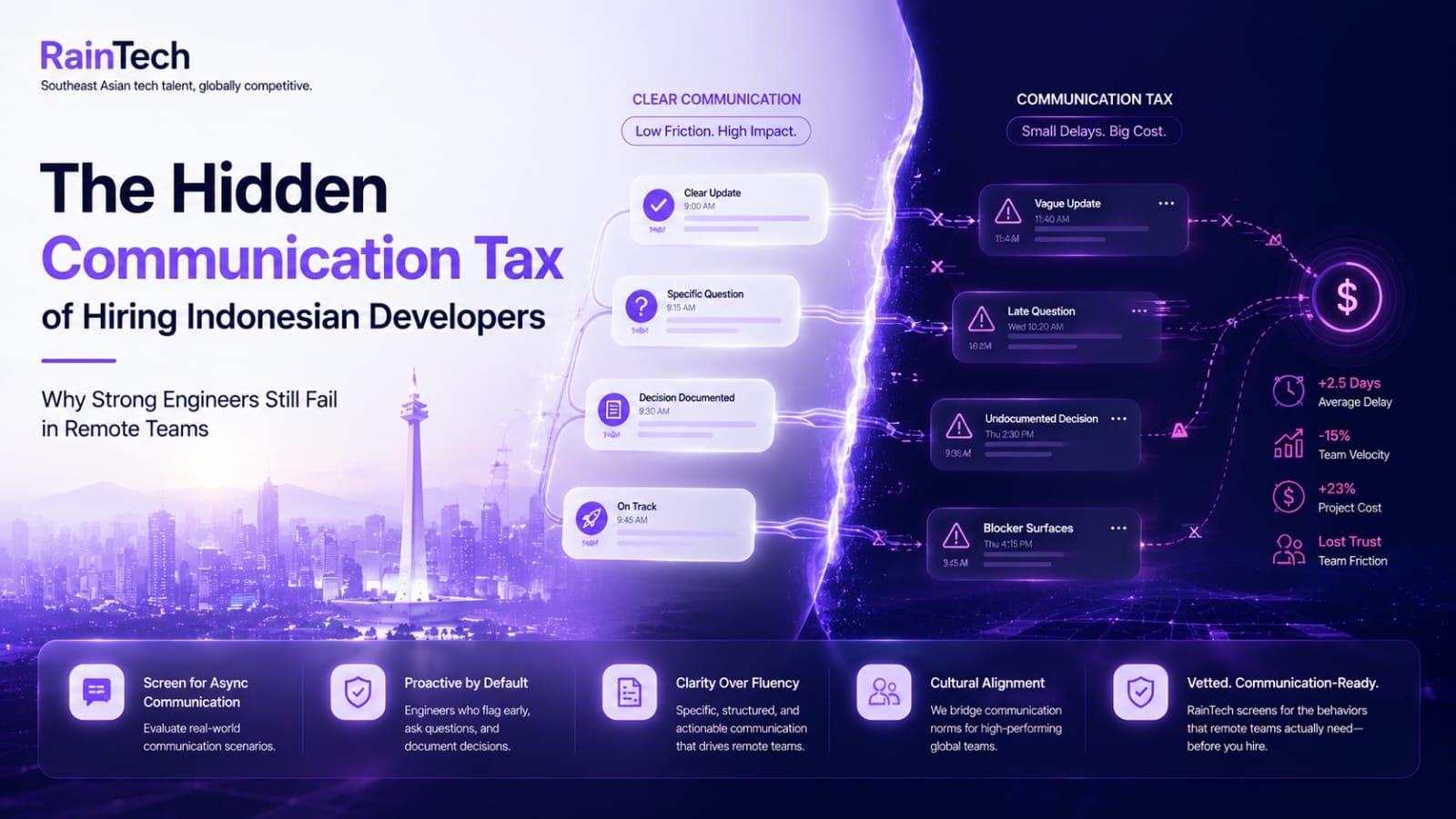
You found a strong candidate. The technical screen went well, better than most candidates you have seen from any market. Then the async communication started, and something felt off. Updates were vague. Questions came too late. A blocker that should have been flagged on Monday surfaced on Thursday.
This is the scenario that keeps hiring managers from pulling the trigger on Indonesian engineers. Not the technical capability, that passes the bar. The question is whether the communication will work in a remote environment where most of your team never meets face to face.
It is a legitimate concern. And it deserves a more honest answer than "Indonesian developers communicate great", because the reality is more nuanced than that, and understanding the nuance is what determines whether your remote hire actually works.
What the Data Actually Says About Indonesian English Proficiency
According to the EF English Proficiency Index 2025 — based on 2.2 million test takers across 123 countries — Indonesia ranks 80th globally with a score of 471, placing it in the Low Proficiency band.
Within Asia, Indonesia sits 12th out of 25 countries, behind Malaysia (581), the Philippines (569), Hong Kong (538), South Korea (522), and Vietnam (500).
On paper, this looks like a red flag. In practice, it requires more careful reading.
The national score of 471 obscures a data point that matters more for tech hiring: Jakarta scores 523 — firmly in the Moderate Proficiency band — outperforming major Asian capitals including Bangkok (467), Beijing (514), and Vientiane (486).
Indonesia's strongest-performing age cohort is 21–25 years old, averaging 503. The engineers most likely to be in your candidate pool — mid-level professionals in their mid-to-late twenties working in Jakarta's tech sector — sit meaningfully above the national average that gets cited in hiring discussions.
The second important nuance: Vietnam's national score of 500 places it in the Moderate band, technically above Indonesia's national ranking. This surprises most hiring managers who assume Indonesia's English is stronger.
But as with Indonesia, Vietnam's national average tells you nothing specific about the engineers you will actually be interviewing. What matters is not where a country sits in a ranking, it is whether the individual candidate in front of you has developed the async communication behaviors that distributed teams actually run on.
Country rankings are a starting point for awareness. They are a poor basis for a hiring decision.
The Communication Tax — What It Actually Costs
The term has emerged in remote hiring circles to describe the hidden cost of language and cultural friction in distributed teams. It is not just about grammar. It is about the cumulative cost of:
- Delayed blockers that compound into missed sprints.
- Vague status updates that require follow-up to interpret.
- Requirements that were unclear but never questioned.
- Decisions that were made without documentation.
- Feedback that was received but not understood.
According to the We Work Remotely State of Remote Work 2025 — one of the most comprehensive annual surveys of distributed teams — communication gaps remain among the most consistently cited challenges in remote work environments, even as the tools and infrastructure supporting remote work have matured significantly.
The report makes clear that this is not purely a language problem: it is a remote communication practice problem. Teams that have not built explicit async communication norms — regardless of language proficiency — report the same friction patterns: delayed blockers, vague status updates, decisions made without documentation.
This reframes the question entirely. The hiring risk with Indonesian engineers is not "is their English good enough to have a phone call." It is "have they developed the async communication practices that distributed teams actually run on."
Those are different skills. They can be assessed separately. And they can be screened for before the hire is made.
What "Communication-Ready" Actually Means for Remote Engineering Roles
After years of placing Indonesian engineers into global remote teams, RainTech has developed a working definition of what communication-ready looks like in practice.
It is not about accent or grammar. It is about five specific behaviors:
1.Proactive Blocker Escalation
Does the engineer surface blockers before they become delays — or after? Engineers who wait until a blocker has cost two days to mention it create compounding damage in async environments. Communication-ready engineers flag early, specifically, and with context: "I'm blocked on X because of Y — here are the options I see."
2.Specific Question-Asking
The difference between "I don't understand the requirements" and "In the spec, it says X — does that mean we handle edge case Y as Z or as W?" is enormous in a remote environment. The first creates a back-and-forth that can consume days. The second resolves in one reply.
3.Written Decision Documentation
Engineers who make architectural or implementation decisions without documenting them create knowledge silos that are expensive to unwind when they leave or when a new team member joins. Communication-ready engineers write down decisions, even informally, as a default behavior.
4.Async Status Updates that do not Require Interpretation
"Working on it" is not a status update. "Auth module 70% complete, PR ready tomorrow morning UTC+7, one open question on token expiry behavior — will document in PR description" is. The difference between these two is not English proficiency, it is async communication discipline.
5.Pushing Back on Unclear Requirements in Writing
This is the hardest one to screen for and the most valuable. Engineers who accept unclear requirements and build the wrong thing cost more than engineers who ask uncomfortable clarifying questions upfront. Communication-ready engineers push back — respectfully, specifically, in writing.
How RainTech Screens for Communication Readiness — Not Just English Level
RainTech's screening process treats communication assessment as a separate evaluation from technical skill, equal in weight, not an afterthought.
Veri Ferdiansyah, Co-Founder & CEO, brought this observation back from GITEX Asia 2026 directly: English proficiency was the most consistently raised concern among global hiring managers who had worked with Indonesian engineers. Not technical capability. Not timezone. Communication.
The response at RainTech was not to add an English test to the screening process. It was to build an assessment specifically designed to evaluate the five behaviors above, because those behaviors are what predict remote team performance, not a grammar score.
The assessment includes:
Async Scenario Response
Candidates are given a realistic remote work scenario (a blocker, an unclear requirement, a production incident) and asked to respond in writing as they would in a real Slack or email environment. The evaluator is looking for specificity, proactivity, and clarity — not perfect grammar.
Written Technical Explanation
Candidates are asked to explain a technical decision they have made in a previous role, in writing, as if explaining it to a non-technical product manager. This tests both English functional competency and the ability to translate technical thinking into accessible language.
Requirement Pushback Exercise
Candidates are given a deliberately ambiguous requirement and asked what questions they would ask before starting work. The quality of the questions — their specificity, their coverage of edge cases, their framing — reveals more about communication readiness than any language test.
Only candidates who pass both technical screening and communication assessment reach the client shortlist. This is how RainTech's 98% client satisfaction rate is built — not by promising that Indonesian developers all communicate well, but by ensuring that the ones we place actually do.
The Cultural Context that Most Guides Miss
English proficiency is one dimension of communication readiness. Cultural communication norms are another, and for Indonesian engineers specifically, there is one pattern that creates consistent friction in remote teams with Western companies if it is not addressed early.
Indonesian professional culture has a strong norm around indirect communication and avoiding direct disagreement, particularly with someone perceived as more senior.
In a co-located environment, this can be managed through non-verbal cues and informal conversation. In an async remote environment, it surfaces as silence when there should be a question, and agreement when there is actually uncertainty.
This is not a character flaw. It is a cultural communication style that works well in many contexts and requires specific adaptation in remote-first, async-heavy global teams.
RainTech addresses this in two ways. First, in the screening process — the requirement pushback exercise specifically tests whether a candidate can override this norm when the work requires it.
Second, in the onboarding guidance provided to clients — setting explicit expectations early about how the team communicates disagreement and uncertainty removes the ambiguity that makes indirect communication feel safer.
The companies that onboard Indonesian engineers successfully are the ones who create the conditions for direct communication, not just the ones who hire candidates who have it naturally.
What this Means for Your Hiring Process
If you are evaluating Indonesian engineers and communication is your primary concern, here is the practical framework:
Do not use English proficiency as a proxy for communication readiness. They are related but not the same thing. An engineer with B2 English and strong async discipline will outperform an engineer with C1 English who has never worked in a distributed team.
Add a written async scenario to your technical screen. Before or after the technical interview, ask the candidate to respond to a realistic remote work scenario in writing. This takes 20 minutes and tells you more than an hour-long video call.
Set explicit communication norms at onboarding, not after the first friction. Document how your team escalates blockers, what a good status update looks like, and how you handle disagreement. Indonesian engineers who receive this context upfront adapt quickly. The ones who have to infer it from observation take longer and make more mistakes in the process.
Use RainTech's pre-screened pool. Every candidate RainTech places has passed a communication assessment designed specifically for remote engineering environments. You are not starting from scratch.
FAQs
Is English proficiency a dealbreaker for hiring Indonesian engineers?
Not if you screen for the right things. Indonesia ranks 80th globally in the EF EPI 2025 at the national level — but Jakarta's city-level score of 523 sits in the Moderate band, and the 21–25 age cohort averages 503. More importantly, country-level rankings measure general English ability, not the async communication skills that remote engineering teams actually run on. Indonesian engineers who have worked in international product environments consistently demonstrate the communication behaviors that matter: proactive blocker escalation, specific questioning, written decision documentation.
How does Indonesian English proficiency compare to Vietnam and India?
According to the EF English Proficiency Index 2025, Indonesia scores 471 — placing it in the Low Proficiency band at the national level. Vietnam scores 500 and sits in the Moderate band, technically above Indonesia. India scores 484, also in the Low band. The Philippines scores 569 in the High band. However, Jakarta's city-level score of 523 is a more relevant benchmark for tech hiring, since the majority of Indonesia's senior engineering talent is concentrated in the capital. Country-level averages are consistently poor predictors of individual candidate performance within a screened engineering pool.
What is the Communication Tax and how do I measure it?
The Communication Tax is the hidden productivity cost of language and cultural friction in remote teams — delayed blockers, vague updates, unquestioned unclear requirements. It compounds over time and is often invisible until a project slips. The best way to measure it is retrospectively: track how often engineers surface blockers proactively, how many clarifying questions they ask before starting work, and how often their status updates require follow-up to interpret.
Does RainTech conduct English tests as part of screening?
Not a standardized English test. RainTech's communication assessment is built around realistic async scenarios — written responses to blockers, technical explanations for non-technical stakeholders, and requirement pushback exercises. These predict remote team performance more accurately than grammar scores.
How should I onboard an Indonesian engineer to set communication expectations?
In the first week, document explicitly: how your team escalates blockers, what a good async status update looks like, and how disagreement is communicated. Do not assume these norms are obvious — they are not universal, and Indonesian professional culture has specific defaults around indirect communication that benefit from explicit framing early.
Can cultural communication differences be overcome in a remote environment?
Yes — with the right setup. The engineers RainTech places have passed a screening process specifically designed to identify candidates who can operate effectively in direct, async-first remote environments. Client onboarding guidance from RainTech also covers the specific communication norms to establish in the first two weeks, which significantly reduces early-stage friction.
Conclusion
The communication concern around Indonesian engineers is legitimate, but it is entirely answerable. It shouldn't be a reason to avoid one of the fastest-growing tech markets in Southeast Asia.
Instead, it is a clear signal that you need to screen more carefully, moving past outdated grammar tests to evaluate the actual async behaviors that distributed teams run on.
High-performing, communication-ready engineers exist in Indonesia, but they aren't found on generic job boards or through standard technical rounds. They are uncovered through a rigorous, behavioral-focused selection process.
If you want to eliminate the hiring guesswork and see what a truly vetted shortlist looks like, talk to RainTech about communication-screened candidates who are ready to integrate into your engineering sprints from day one.
Related Articles:
- Why Strong Engineers Fail in Remote Teams: A Guide to Screening Indonesian Tech Talent
- Building a Remote-Friendly Culture for Indonesian Tech Talent
- Remote Engineers: Why Indonesia Might Beat Vietnam & Philippines
- How APAC Startups Retain Tech Talent: Real Lessons from Remote Onboarding (2025 Edition)
- EOR Indonesia Pricing: Avoid Hidden Fees with Our 2026 Guide