Your security team has a gap. You know it. Your board knows it. The question is not whether to fill it — it is whether you can find someone qualified before the next incident makes the decision for you.
The markets you have been searching in — US, UK, Eastern Europe — are giving you the same answer: too expensive, too slow, or too competitive. What most CISOs have not done yet is look at Indonesia.
That is a gap in perception, not in supply. Indonesia has one of the most active ethical hacking communities in Southeast Asia, a fintech sector that has produced battle-tested AppSec engineers, and a growing cohort of cloud security and DevSecOps specialists.
The ISC2 Cybersecurity Workforce Study 2025 — based on responses from 16,029 cybersecurity practitioners globally — marks a significant shift in how the industry understands the shortage: organizations are no longer just reporting a lack of people, they are reporting a lack of the right skills.
Critical specializations in AI security, cloud architecture, zero-trust implementation, and application security are now cited as more pressing than raw headcount.
For companies trying to hire these specific profiles, the supply problem is not improving — it is becoming more targeted and harder to solve through conventional markets.
This is what that supply chain looks like in Indonesia.
Why Indonesia is a Underrated Source of Cybersecurity Talent
Perception has not caught up with reality. Most global hiring managers associate Indonesia with web development and mobile engineering — which is fair, given the depth of that pool.
But Indonesia's fintech boom, its large banking sector, and one of the most active ethical hacking communities in Southeast Asia have quietly produced a cohort of security engineers that most international companies have never seriously evaluated.
Veri Ferdiansyah, Co-Founder & CEO of RainTech, observed this directly at GITEX Asia 2026:
The visibility problem works in your favor if you move early. The companies that have already started building security functions with Indonesian engineers are doing so before this talent pool becomes competitive.
Where Indonesian Cybersecurity Talent is Strongest
Understanding where the depth sits — and where it does not — is essential before sourcing begins.
Application Security (AppSec)
Indonesia's large software engineering base has produced a strong cohort of AppSec engineers who have worked inside product teams at fintech companies, e-commerce platforms, and digital banking apps.
Engineers with hands-on experience in threat modeling, secure code review, and penetration testing on live financial applications are available in the mid-to-senior range. This is the deepest and most immediately hireable specialization in Indonesia's security pool.
Penetration Testing & Red Team
Indonesia has one of the most active ethical hacking communities in Southeast Asia. HackerOne's platform data consistently places Indonesia among the top countries by hacker count and vulnerability reports submitted — a direct, verifiable signal of offensive security depth that goes beyond self-reported CVs.
Engineers with documented bug bounty payouts, HackerOne or Bugcrowd profiles, and CTF competition histories represent a credible and practically validated source of penetration testing talent.
Security Operations (SOC)
SOC analysts and engineers — including those with SIEM experience on Splunk, Microsoft Sentinel, and IBM QRadar — are available at junior to mid levels. Indonesia's growing managed security services sector has trained this cohort systematically. Volume is good; senior depth is more limited.
Cloud Security & DevSecOps
As AWS, GCP, and Azure adoption has grown in Indonesia's tech sector, a subset of cloud engineers have specialized in IAM, CSPM, and DevSecOps pipelines. This is a growing area — not yet as deep as AppSec, but expanding fast and worth evaluating for companies building cloud-native security functions.
Where the Gap are Honest
OT/ICS security supply is very limited in Indonesia. Hardware security and firmware analysis is niche, requiring specialist screening. For roles requiring familiarity with FedRAMP or HIPAA, plan for onboarding investment — exposure to these frameworks exists but needs to be specifically surfaced.
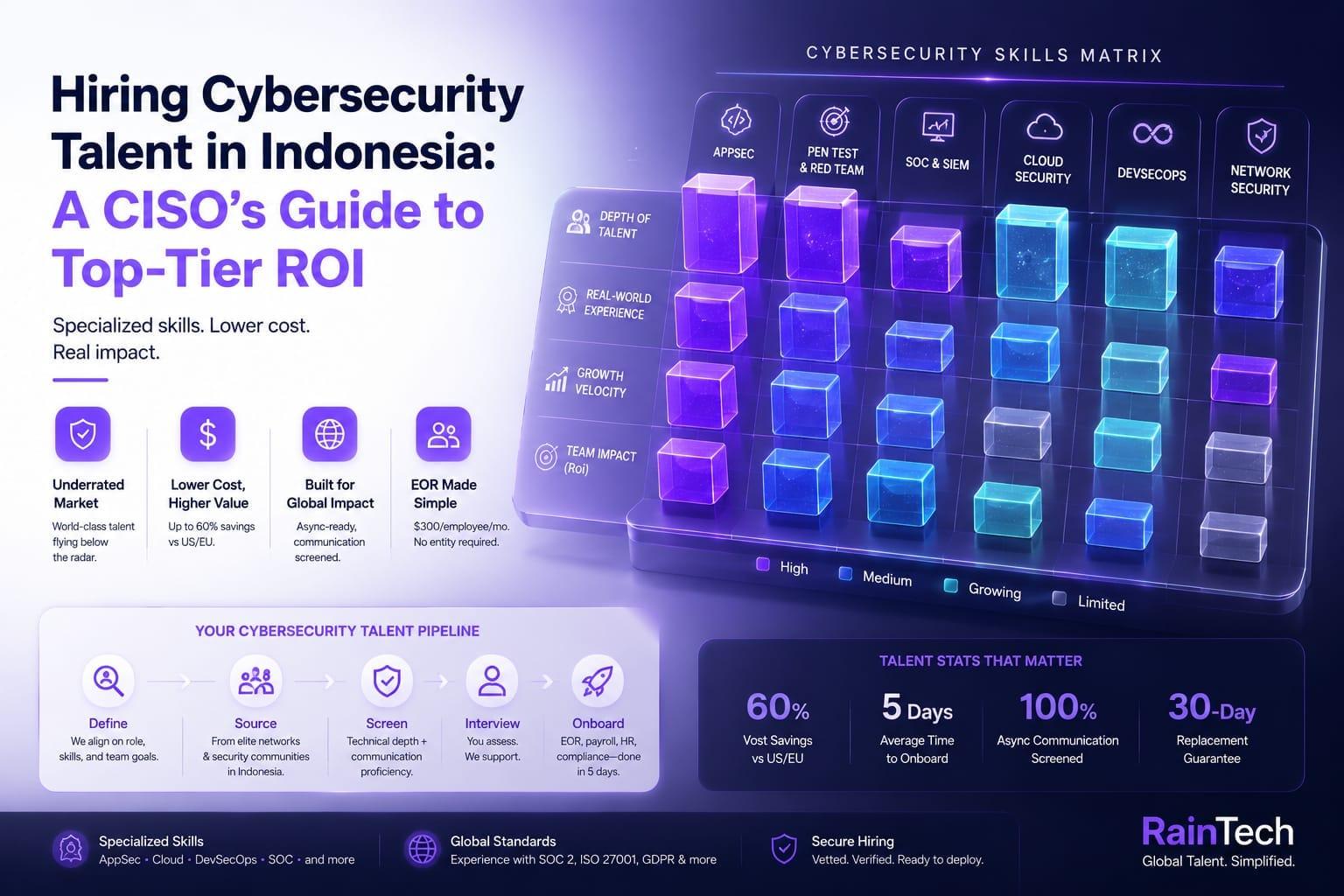
The Skills Matrix: Indonesian Cybersecurity Engineers at a Glance
| Specialization | Supply Depth | Recommended Seniority | Salary Range (RainTech) |
|---|---|---|---|
| Application Security (AppSec) | Medium-High | Mid to Senior | $1,200–$3,000/mo |
| Penetration Testing / Red Team | Medium | Mid to Senior | $1,200–$3,000/mo |
| SOC Analyst / SIEM Operations | Medium | Junior to Mid | $800–$2,000/mo |
| Cloud Security (AWS/GCP/Azure) | Medium | Mid to Senior | $1,200–$3,000/mo |
| Network Security & Hardening | Medium | Mid | $1,200–$2,000/mo |
| DevSecOps | Growing | Mid to Senior | $1,200–$3,000/mo |
| OT/ICS Security | Low | Specialist only | $3,000+/mo |
How to Build a Cybersecurity Team from Indonesia: Realistic Composition by Company Stage
One of the most common mistakes global companies make is thinking about cybersecurity hiring as a single-role decision. In practice, the question is not just "can I hire a security engineer from Indonesia?" — it is "what does a realistic, functional security team from Indonesia look like at my company stage?"
Early Stage Startup (1-2 Security Hires)
At this stage, you need breadth over specialization. The best fit is typically a Senior AppSec Engineer who can cover secure code review, threat modeling, and basic penetration testing — someone who has worked inside a product team and understands the pace of startup development.
Pair this with a Mid-level SOC Analyst if your infrastructure requires ongoing monitoring. Total monthly cost via RainTech EOR: approximately $3,500–$5,300 (salaries) + $600 EOR fees.
Growth-Stage Company (3-5 Security Hires)
Here the team starts to specialize. A realistic composition: one Senior AppSec lead, one Cloud Security Engineer (AWS or GCP focus depending on your stack), one Penetration Tester for scheduled assessments, and one to two SOC Analysts for ongoing coverage.
This gives you a team capable of handling both proactive security engineering and reactive incident response — a combination most companies at this stage are trying to build.
Enterprise or Regulated Industry (5+ Hires)
At this scale, Indonesia can support a full security function with the exception of OT/ICS and highly jurisdiction-specific compliance roles. RainTech recommends a discovery call at this stage to map your specific requirements against the available pool — the right team composition depends heavily on your industry, regulatory environment, and existing security architecture.
How to Assess Indonesian Cybersecurity Engineers Properly
Cybersecurity hiring fails when companies apply standard software engineering interview formats to security roles. RainTech's screening process, led by Veri Ferdiansyah, focuses on evidence of real-world application rather than certification checklists:
- Documented CVEs or bug bounty payouts — verifiable proof of offensive security capability.
- CTF competition history — strong signal for adversarial problem-solving.
- Pentest reports or security audit samples (redacted for confidentiality).
- SIEM alert triage case studies for SOC roles.
- Architecture walkthroughs for cloud security and DevSecOps roles.
Certifications — OSCP, CEH, CISSP, CompTIA Security+ — are useful filters but not sufficient on their own. Practical evidence of application takes priority in RainTech's vetting.
The Communication Layer that Most Companies Skip
Security engineers who cannot communicate findings clearly create as much risk as the vulnerabilities they are supposed to find. A penetration tester who cannot write a coherent executive summary, or a SOC analyst who cannot escalate an incident clearly under pressure, undermines the value of their technical skill.
RainTech screens all cybersecurity candidates for async communication proficiency — the ability to document findings, write clear incident reports, and operate effectively in remote cross-border teams — as a separate and non-negotiable evaluation layer.
This was one of the most consistent themes from GITEX Asia 2026: companies that had previously hired security talent remotely without communication screening reported friction that eroded ROI over time.
How RainTech Sources and Places Cybersecurity Engineers
Step 1 — Specialization Brief
RainTech's team works with your CISO or CTO to define the exact security specialization, required evidence of competency, regulatory framework exposure, team composition goals, and async communication expectations.
Step 2 — Targeted Candidate Sourcing
RainTech surfaces cybersecurity candidates from specialist networks, Indonesia's ethical hacking community, and alumni of the fintech and banking sector — where security standards are highest. This is not a job board search.
Step 3 — Technical + Communication Screening
Candidates are assessed on both technical depth and async communication proficiency before they reach your shortlist.
Step 4 — Your Interview
You run your own technical assessment. RainTech can provide role-specific interview framework guidance on request.
Step 5 — EOR Onboarding
Once you select a candidate, RainTech handles all Indonesian employment legalities as Employer of Record: labor contracts, BPJS registration, payroll in IDR, tax compliance, and 24/5 HR support — at $300/employee/month.
No local entity required. Based on our track record with European clients, full onboarding typically completes within 5 business days of offer acceptance.
FAQs
Is Indonesia's cybersecurity talent pool large enough to support ongoing hiring, or is this a one-time opportunity?
The pool is growing and sustainable for companies hiring one to three security engineers at a time. The ISC2 Cybersecurity Workforce Study 2025 notes that the industry's most pressing shortage has shifted from headcount to specific skills — AppSec, cloud security, and AI-aware security roles in particular. These are precisely the specializations where Indonesia's fintech alumni pool has developed real depth. For companies targeting these profiles, Indonesia represents a supply channel that most international buyers have not yet evaluated.
Do Indonesian cybersecurity engineers have experience with international compliance frameworks like SOC 2, ISO 27001, or GDPR?
Some do, particularly those who have worked in multinational companies or with clients in regulated industries. This needs to be specified upfront in the role brief so RainTech can surface candidates with relevant exposure.
What certifications are most common among Indonesian cybersecurity engineers?
CompTIA Security+, CEH, and OSCP are the most common formal certifications. Many experienced engineers also carry practical credentials through HackerOne or Bugcrowd participation, CTF competition history, or documented CVEs.
Can I hire a cybersecurity engineer from Indonesia as a contractor?
Technically yes, via RainTech's Payroll Management service at $30/contractor/month. However, if the engagement is functionally full-time, EOR is the legally correct structure under Indonesian labor law. Misclassification carries real legal and financial risk — RainTech can advise on which structure fits your situation.
How does RainTech handle background check requirements for security roles?
RainTech can facilitate background verification as part of the onboarding process. For roles requiring government-level security clearances tied to a specific jurisdiction, consult your legal counsel — whether remote Indonesian employees can satisfy those requirements varies by country and clearance type.
How does the 30-day replacement guarantee work for cybersecurity roles?
Under RainTech's Talent Placement model, if a placed candidate does not meet expectations within the first 30 days, RainTech will source a replacement at no additional placement fee. This applies to all roles including cybersecurity specialists.
Conclusion
Cybersecurity talent is globally scarce, and the shortage has moved beyond raw numbers—it’s now about finding very specific, battle-tested skills.
As we saw at GITEX Asia 2026, the global interest in Indonesian security engineers is surging.
The "early mover" advantage is real; the companies acting now are securing the best AppSec and Pen-Test talent before the market becomes hyper-competitive.
At RainTech, we simplify this high-stakes hiring for you. We move beyond certifications by pre-screening every candidate for technical depth, real-world deployment evidence, and remote communication readiness.
You won't get a database to sort through—you'll get a vetted shortlist that is actually ready to interview.
To find the right fit for your security function, you can book a cybersecurity hiring call with RainTech and let us map our vetted talent pool to your specific compliance and infrastructure needs.
Related Articles:
- Indonesia's Tech Talent Outlook 2025: Demand, Strategies, and Real Actions
- EOR Indonesia Pricing: Avoid Hidden Fees with Our 2026 Guide
- EOR vs Contractor: Avoiding Misclassification in Indonesia
- BPJS Indonesia Guide: Costs, Risks, and Employer Rules (2026)
- Indonesia Tech Talent Tiers 2026: Exact Salaries, Output by Level, and ROI vs US Developers