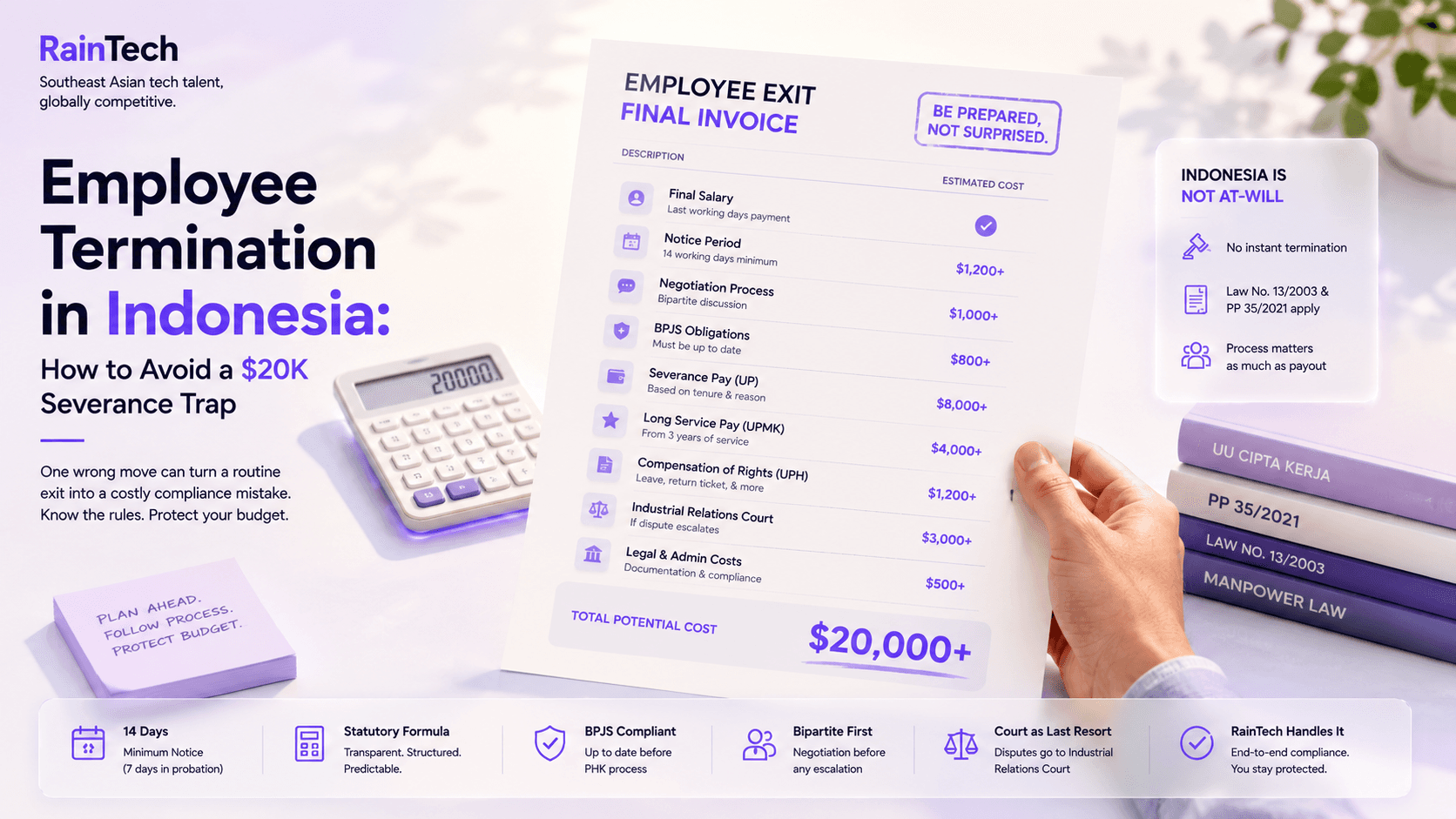
Indonesia does not have at-will employment. There is no "we're letting you go, effective today" — not for foreign companies, not for local ones.
Every termination runs through a statutory formula, a mandatory notice period, and a negotiation process that starts the moment you decide someone isn't working out, not the moment you tell them.
Most foreign employers don't learn this when hiring. They learn it mid-termination, when a routine performance exit turns into a severance number they didn't budget for, a notice letter with formatting requirements they didn't know existed, and — if the employee objects — a dispute process that can run for months through Indonesia's Industrial Relations Court.
Why "At-Will" Thinking Gets Foreign Employers in Trouble
If your company is used to US-style at-will employment or a simple notice-and-go model common in parts of Europe, Indonesia's framework will feel unfamiliar fast.
Termination here — called PHK, Pemutusan Hubungan Kerja — is governed by Law No. 13 of 2003 on Manpower, as amended by the 2023 Job Creation Law (UU Cipta Kerja), with the operational detail sitting in Government Regulation No. 35 of 2021 (PP 35/2021). Together, these define the minimum a departing employee is owed (Constitutional Court Decision 168/PUU-XXI/2023 made the severance table a floor, not a fixed amount) and exactly what steps you must follow to get there.
The practical difference from at-will markets: the reason for termination is not a formality — it's the variable that determines the entire payout. The same employee, same tenure, same salary can be owed anywhere from nothing to 25+ months of salary depending on why the employment ends.
This is the same regulatory environment covered in RainTech's guide to BPJS obligations for foreign employers — termination compliance and BPJS compliance are directly linked, since BPJS contributions must be current before a PHK process can close cleanly.
The Three Components of an Indonesian Severance Package
For permanent employees (PKWTT — Perjanjian Kerja Waktu Tidak Tertentu), a termination payout is built from three separate components defined under PP 35/2021:
Uang Pesangon (UP) — Severance Pay
Based purely on tenure: one month's salary for under a year of service, plus one month for each completed year, capped at 9 months from 8 years of service.
Uang Penghargaan Masa Kerja (UPMK) — Long Service Pay
Kicks in after 3 years of service, starting at 2 months' salary and scaling up to 10 months' salary at 24+ years.
Uang Penggantian Hak (UPH) — Compensation of Rights
Unused annual leave, return-travel costs to the employee's place of recruitment (if relocated for the job), and anything else specified in the employment agreement.
Fixed-term contract employees (PKWT) are on a different track entirely — they're not entitled to UP or UPMK at all. Instead they receive a proportional Compensation Pay when the contract ends: months worked ÷ 12, multiplied by one month's salary.
The Multiplier: Why the Same Tenure Can Mean Wildly Different Payouts
This is the part that surprises foreign employers most. PP 35/2021 doesn't just hand you the base UP/UPMK numbers above — it applies a multiplier based on the reason for termination, and that multiplier is where budgets go wrong.
| Termination Reason | UP Multiplier | UPMK Multiplier |
|---|---|---|
| Efficiency measures, company still profitable | 1x | 1x |
| Efficiency measures, company running losses | 0.5x | 1x |
| Prolonged illness or work-accident disability beyond 12 months | 2x | 1x |
| Employee resignation (voluntary) | 0x | 0x (separation pay per contract instead) |
| Contract violation after three warning letters | 0.5x | 1x |
| Retirement | 1.75x | 1x |
According to L&E Global's overview of Indonesian termination law, an employee reaching retirement age after 22 years of service on a monthly salary of IDR 15,000,000 is entitled to severance pay at 1.75 times the standard package plus one full service pay component — a combined payout north of IDR 356 million in that single example.
Worked Examples Using RainTech's Salary Tiers
Here's what this looks like against RainTech's actual 2026 compensation benchmarks — the numbers most foreign companies are budgeting against when they hire through RainTech's EOR service.
Scenario A — Tier 2 Mid-Level developer ($1,200/month), 3 years tenure, role eliminated for efficiency (company still profitable)
| Component | Calculation | Amount |
|---|---|---|
| UP (severance) | 4 months × 1x × $1,200 | $4,800 |
| UPMK (long service) | 2 months × 1x × $1,200 | $2,400 |
| UPH (unused leave, ~10 days) | proportional | ~$400 |
| Total | ~$7,600 |
Scenario B: Tier 3 Senior developer ($2,000/month), 5 years tenure, role eliminated for efficiency (company running losses)
| Component | Calculation | Amount |
|---|---|---|
| UP (severance) | 6 months × 0.5x × $2,000 | $6,000 |
| UPMK (long service) | 2 months × 1x × $2,000 | $4,000 |
| UPH (unused leave, ~10 days) | proportional | ~$700 |
| Total | ~$10,700 |
Scenario B earns more and has two more years of tenure, yet its severance multiplier is half of Scenario A's because the company is making losses: the reason sets the multiplier. Getting the classification wrong in either direction creates exposure: understate it and the employee disputes the payout; overstate it and you've overpaid a departing hire for no legal reason.
A note on JKP (Jaminan Kehilangan Pekerjaan, job-loss insurance): eligible employees who lose their job for reasons other than resignation, retirement, permanent total disability or death also receive JKP benefits from BPJS Ketenagakerjaan on top of employer-paid severance, currently 60% of wages (capped at IDR 5 million) for up to six months plus job-market information and training, funded by the government and a share of the JKK contribution.
The Procedure: What Has to Happen Before You Pay Anyone
Getting the number right is only half the compliance picture. Skipping the process invalidates the termination even if the severance math is perfect.
Step 1 — Written notice, minimum 14 working days out (7 days if the employee is still on probation). The notice must state the reason, the proposed severance calculation, and the payment date — in Bahasa Indonesia or bilingual format, signed by an authorized Indonesian representative.
Step 2 — The employee has 7 working days to respond, accepting or rejecting the termination and calculation in writing.
Step 3a — If accepted: the employer reports the termination to the Manpower Office, and a signed mutual termination agreement can be registered with the Industrial Relations Court. Clean exit.
Step 3b — If rejected: the case enters bipartite negotiation between employer and employee. If that fails, it moves to mediation through the local Manpower Office (Disnaker). If mediation fails, it goes to Indonesia's Industrial Relations Court — a process that, per employment law firm commentary, can run for months.
This mirrors what RainTech has already flagged in why cutting corners on compliance drives Indonesian developers to quit — a botched termination doesn't just cost the departing employee's payout, it signals to the rest of your team how the company handles its legal obligations.
What Happens When Foreign Employers Try to Skip This
According to RecruitGo's 2026 breakdown of PP 35/2021, termination scenarios span 19 distinct categories with their own multipliers, and termination without a valid legal reason is not one of them: the employee can reject it, and since Constitutional Court Decision 168/PUU-XXI/2023 the termination only takes effect after a final industrial relations ruling, with wages payable until then.
The employers who end up paying far more than the formula are almost never the ones who planned for a high payout. They're the ones who:
- Tried to handle a termination without an Indonesian legal entity to file the notice through — see RainTech's breakdown of the legal risks of hiring Indonesian developers without an EOR.
- Classified a termination as "resignation" to avoid severance, which the employee then disputed.
- Skipped the 14-day written notice entirely, invalidating the process regardless of how justified the underlying reason was.
- Had unpaid or lapsed BPJS contributions at the point of termination, which blocks a clean PHK filing outright.
"The founders we talk to almost never underestimate the severance number once they see it," says Veri Ferdiansyah, Co-Founder & CEO of RainTech, who leads technical hiring and has spent 8+ years building engineering teams in Indonesia. "What catches them is the process — the notice period, the negotiation window, the filing. Miss one step and the whole termination can be challenged, regardless of what you calculated."
Why This is an EOR Decision, Not Just a Payroll Line Item
An Employer of Record doesn't just process payroll and BPJS contributions — it's the entity that legally exists to issue termination notices, negotiate mutual agreements, and file with the Manpower Office on your behalf. Without an Indonesian legal entity, a foreign company literally cannot execute a compliant PHK process alone.
This is one of the structural reasons RainTech's comparison of EOR versus setting up a PT PMA entity comes down in favor of EOR for most companies under 15–20 Indonesian hires: standing up your own entity to handle terminations correctly takes months and ongoing legal overhead most teams don't need yet.
It also connects directly to hiring decisions made much earlier — misclassifying a long-term hire as a contractor to sidestep severance obligations altogether is its own compliance trap, covered in RainTech's guide to EOR versus contractor misclassification in Indonesia.
FAQs
Can we avoid severance pay by classifying our Indonesian hire as a contractor instead of an employee?
Only if the relationship genuinely functions as independent contracting. If it has fixed hours, ongoing supervision, and regular monthly pay, Indonesian labor law treats it as employment regardless of the contract label — and severance obligations apply on termination the same as any employee.
Do fixed-term contract (PKWT) employees get severance pay when we don't renew their contract?
No. PKWT employees are not entitled to Uang Pesangon or Uang Penghargaan Masa Kerja. They receive a proportional Compensation Pay instead — months worked divided by 12, multiplied by one month's salary — paid at each contract renewal point and at final expiry.
What if the employee refuses to sign the termination agreement?
The case moves into Indonesia's formal dispute resolution track: bipartite negotiation first, then mediation through the local Manpower Office, and — if unresolved — the Industrial Relations Court. This can take months and typically increases the final settlement above the original calculation.
Does an EOR handle the termination process for us, or do we still need a lawyer?
A licensed EOR like RainTech issues the notice, manages the negotiation and Manpower Office filing, and calculates the correct severance package under PP 35/2021 as part of the employment relationship it already administers. Complex disputes that reach mediation or court may still involve outside counsel, but the standard PHK process itself is handled within the EOR relationship.
Is BPJS status relevant to termination?
Yes — directly. Indonesian labor law requires employers to be current on BPJS contributions before a PHK process can close cleanly. Unpaid contributions give the employee grounds to challenge the termination on procedural grounds.
Next step
Termination math looks simple until the reason code changes the number by 20x. Getting it wrong doesn't just cost the payout — it can invalidate the exit entirely and push you into a dispute process that runs for months.
Without an Indonesian legal entity, executing a compliant PHK process is legally impossible for a foreign company. That is where RainTech protects your business.
Through our Employer of Record (EOR) service, we act as your local legal shield—handling bilingual employment contracts, calculating exact PP 35/2021 severance, issuing formal notices, and managing Manpower Office filings so you face zero compliance exposure.
Already have an Indonesian team and not sure your termination process would hold up? Book a Free 15-Minute Compliance Review with RainTech before you issue a single notice letter. We will audit your specific scenario, calculate your actual financial exposure, and outline exactly what steps you need to take.