Most companies frame this decision wrong. They treat Indonesia and Vietnam as two versions of the same thing — cheap, remote, Southeast Asian — and try to decide which is cheaper or which has better English. Then they pick one and wonder later why the hire did not work the way they expected.
The real question is not which country is better. It is which country produces the kind of engineer your company actually needs.
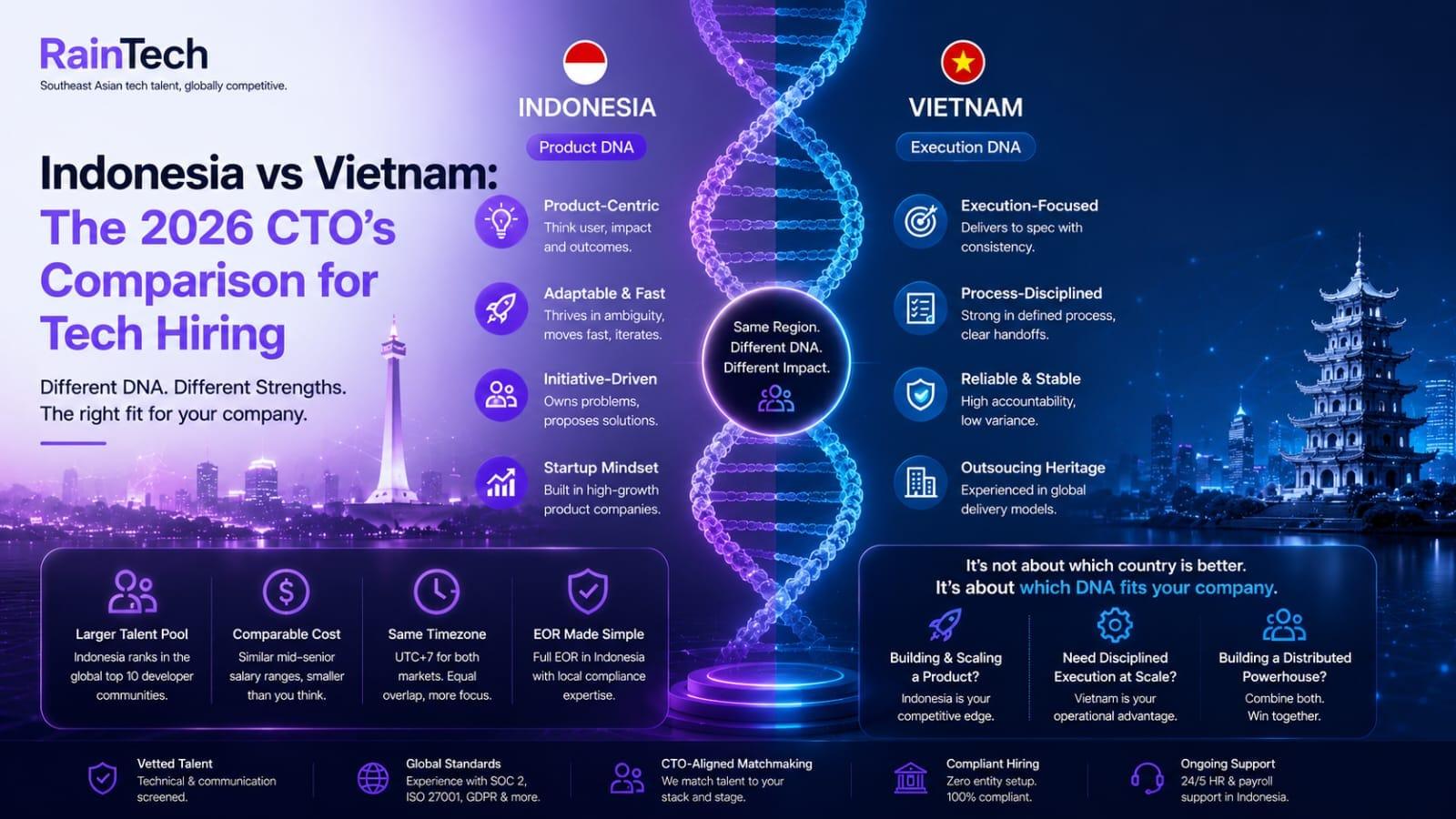
Indonesia and Vietnam have built fundamentally different engineering cultures. One is shaped by fast-moving consumer product companies.
The other by offshore outsourcing. Those origins produce engineers who think differently, work differently, and fit different company stages. Getting this wrong at the hiring stage is expensive to fix six months in.
Here is the comparison global CTOs are not getting from generic EOR marketing material.
How Global Companies Currently Perceive Each Market
Perception shapes shortlists — and right now, the perception gap between Indonesia and Vietnam is real.
At GITEX Asia 2026, RainTech observed a consistent pattern in how global technical leaders framed the two markets. Vietnam is typically described as a mature outsourcing hub: disciplined, high-volume, reliable for execution-heavy engineering work.
Indonesia is described as a high-potential frontier: large talent pool, product-oriented engineers, but less immediately legible to hiring managers unfamiliar with the market.
Neither description is wrong. But both are incomplete — and the incomplete version tends to work against Indonesia in shortlisting conversations, even when Indonesia is objectively the better fit for what a company is trying to build.
The GitHub Octoverse 2025 report adds context that reframes this perception: Indonesia is among the countries that quadrupled their developer contributor count over the past five years, ranking in the global top 10 developer communities by contributor count — not just Southeast Asia, but globally.
Vietnam's developer community is also growing, but Indonesia's raw scale is significantly larger.
Scale is not the only metric that matters. But it is a useful corrective to the assumption that Vietnam is automatically the more developed market.
The Core Difference: Talent DNA
This is the comparison that matters most for hiring decisions, and it is the one most often flattened into a single ranking.
Indonesian engineers have disproportionately developed inside fast-moving, consumer-facing product companies — GoTo, Traveloka, Tokopedia, Bukalapak.
These environments reward adaptability, product intuition, and the ability to move fast under ambiguity. Engineers who come out of this ecosystem tend to think in terms of user outcomes, not just ticket completion.
They are comfortable with scope changes, with building before full requirements are defined, and with owning outcomes rather than just tasks.
Vietnamese engineers have developed in a market shaped significantly by offshore outsourcing — a large portion of Vietnam's tech sector has historically been built around delivering to external specifications for international clients.
This produces engineers who are strong on process discipline, execution consistency, and working within clearly defined requirements. For companies that know exactly what they need built and need it built reliably at volume, this is a genuine strength.
The practical implication: if your company is a product-led startup or scale-up where engineers are expected to contribute to decisions — not just implement them — Indonesian talent tends to be a stronger cultural fit.
If your company is running a mature engineering operation that needs disciplined execution at scale with minimal ambiguity, Vietnamese talent has structural advantages.
Head-to-Head Comparison: The Factors that Actually Matter
| Factor | Indonesia | Vietnam |
|---|---|---|
| Talent pool size | Larger — global top 10 developer community | Smaller — strong but more concentrated |
| Engineer mindset | Product-centric, adaptable, initiative-oriented | Execution-focused, process-disciplined, reliable |
| English proficiency | Variable — screened candidates communicate effectively | Generally lower — documented challenge in cross-border teams |
| Timezone (US West Coast) | UTC+7 — 15hr offset PST | UTC+7 — identical offset |
| Timezone (EU/UK) | UTC+7 — 6–7hr offset CET | UTC+7 — identical offset |
| Senior talent depth (5+ yr) | Strong — unicorn alumni pool | Strong — outsourcing-sector veterans |
| AI/ML production experience | Growing — concentrated in unicorn alumni | Growing — concentrated in outsourcing majors |
| Startup environment fit | High | Medium |
| Enterprise/outsourcing fit | Medium | High |
| EOR availability | Full EOR available (RainTech) | Available via global providers |
| Salary range — Mid (3–5 yr) | $1,200–$2,000/mo | $1,000–$1,800/mo |
| Salary range — Senior (5+ yr) | $2,000–$3,000/mo | $1,800–$2,800/mo |
| Market competition | Growing but not yet saturated | Increasingly competitive — US & Japan demand is high |
On Salary: The Difference is Smaller than You Think
The most common assumption is that Vietnam is meaningfully cheaper than Indonesia. At junior levels, there is some truth to this. But at mid and senior levels — the engineers most global companies are actually trying to hire — the salary gap narrows considerably.
More importantly, Vietnam's senior talent market is experiencing significant demand pressure from US and Japanese companies that have built established sourcing pipelines there.
As competition for the best Vietnamese senior engineers increases, compensation expectations are rising. Indonesia's senior pool, by contrast, remains less contested by international buyers — which means better availability and more stable pricing for companies that move now.
The cost advantage of Vietnam at the senior level is real but shrinking. The cost advantage of Indonesia at the senior level is real and currently more durable.
The English Proficiency Question — Addressed Honestly
This is where Indonesia has a genuine mixed picture that is worth addressing directly rather than glossing over.
English proficiency in Indonesia is variable. This was one of the consistent themes RainTech heard at GITEX Asia 2026 — global hiring managers who had worked with Indonesian engineers reported that technical skill was consistently strong, but async communication quality varied significantly between candidates.
Vietnam's English proficiency is generally rated lower in standardized assessments, but Vietnamese engineers working in the outsourcing sector have often developed structured communication processes — formal handoffs, written specifications, documented deliverables — that partially compensate for language gaps in process-heavy environments.
For remote-first, async-heavy teams at global product companies, neither country's average is sufficient. What matters is individual candidate screening for communication readiness — not country-level averages.
This is why RainTech's screening process for Indonesian candidates includes a dedicated async communication assessment, separate from technical evaluation. The goal is to surface engineers who can write a clear Slack update, document a technical decision, and push back on unclear requirements in writing — the specific skills that determine whether a remote hire actually works in practice.
Which Market is Right for Which Company?
Choose Indonesia if:
- You are building a product-led team where engineers contribute to decisions, not just implement them.
- You need senior-to-staff level engineers with production experience in consumer-facing, high-scale systems.
- You are in AI, fintech, e-commerce, or B2B SaaS — sectors where Indonesian unicorn alumni have deep experience.
- You want a talent market that is not yet saturated with international competition.
- You need full EOR coverage with local compliance expertise, not just a global platform.
Choose Vietnam if:
- You are running a mature engineering operation that needs disciplined, specification-driven execution at volume.
- Your requirements are clearly defined and the primary need is reliable delivery against those requirements.
- You have existing relationships or pipelines in the Vietnamese market.
- Your team operates in a highly structured, process-heavy environment.
Consider Both if:
- You are building a distributed team and want to balance product-mindset engineers (Indonesia) with high-volume execution capacity (Vietnam).
- You are at scale and have differentiated roles that benefit from each talent profile.
Why Indonesia is RainTech's Market — and Why that Matters for You
RainTech is not a generalist global EOR provider. We are Indonesia-specialists. That distinction is operationally significant.
Global EOR platforms that cover 50+ countries maintain compliance frameworks across jurisdictions — but their local depth in any single market is necessarily limited.
For Indonesia specifically, this means gaps in areas that matter: nuanced knowledge of BPJS structures, understanding of Indonesian labor court precedents, relationships with local payroll and tax authorities, and the ability to navigate edge cases in termination, misclassification, or contract disputes.
RainTech's operations are built entirely around one market. Fatimah Hasna, Co-Founder & COO, brings 8+ years of HR and compliance experience specifically within the Indonesian employment landscape.
When a compliance question arises — and in cross-border employment, they always do — the answer comes from someone who has handled that specific situation in Indonesia before, not from a global compliance team approximating from regional knowledge.
For companies that have decided Indonesia is the right market, this depth is the difference between a hire that works and one that creates problems six months in.
FAQs
Is Indonesia cheaper than Vietnam for tech hiring in 2026?
At junior levels, Vietnam carries a slight cost advantage. At mid and senior levels, the gap is narrow — typically $200–$300/month — and closing as international demand for Vietnamese senior engineers increases. For senior roles specifically, Indonesia currently offers better availability at comparable pricing, with less competition from US and Japanese buyers.
Which country has better English proficiency — Indonesia or Vietnam?
Neither country's average is sufficient for remote-first global teams without candidate-level screening. Indonesia's English proficiency is variable but individually screened candidates can communicate effectively in async environments. RainTech's process includes a dedicated communication assessment for this reason — country averages are less useful than individual vetting.
Do Indonesian and Vietnamese engineers have the same timezone?
Yes — both are UTC+7, so timezone overlap with US, EU, and Australian teams is identical. This factor does not differentiate the two markets.
Is Vietnam's talent market more mature than Indonesia's?
Vietnam has a longer track record as an outsourcing destination, which has created process maturity and execution discipline. Indonesia's developer community is significantly larger by absolute numbers and has developed in a product-company context rather than outsourcing — a different kind of maturity that suits different company types.
Can RainTech help me hire in Vietnam as well?
RainTech is Indonesia-specialist. For Vietnam, you would need a separate EOR provider. If your evaluation concludes that Indonesia is the right market, RainTech provides end-to-end coverage — recruitment, EOR, payroll, compliance, and ongoing HR support — without requiring a local entity.
How long does it take to hire a senior Indonesian engineer through RainTech versus a typical Vietnam EOR provider?
RainTech's typical time-to-shortlist for senior Indonesian engineers is under 2 weeks, with full EOR onboarding completed within 5 business days of offer acceptance. Time-to-hire via generalist global EOR platforms varies significantly by provider and market.
Conclusion
Indonesia and Vietnam are not the same market wearing different flags. They produce different kinds of engineers with distinct strengths, and making the right choice depends entirely on the DNA of the company you are building.
For product-led companies scaling in AI, fintech, or SaaS—where engineers must think critically and not just execute tickets—Indonesia’s unicorn alumni pool offers a massive structural advantage. However, if your roadmap requires disciplined, high-volume execution against fixed specifications, Vietnam’s outsourcing heritage remains a genuine fit.
If Indonesia is now on your shortlist, the next step is moving beyond generic market overviews to see how these engineers fit your specific infrastructure.
You can book a market assessment call with RainTech today to get a direct read on the vetted talent available in the pool right now, ensuring your next hire aligns perfectly with your growth stage.
Related articles:
- Remote Engineers: Why Indonesia Might Beat Vietnam & Philippines
- EOR Indonesia Pricing: Avoid Hidden Fees with Our 2026 Guide
- Indonesia Tech Talent Tiers 2026: Exact Salaries, Output by Level, and ROI vs US Developers
- Beyond Cost Efficiency: 5 Reasons Global Tech Leaders Stay in Indonesia
- UK & European Companies: The Exact Legal Path to Hire Indonesian Developers in 2026