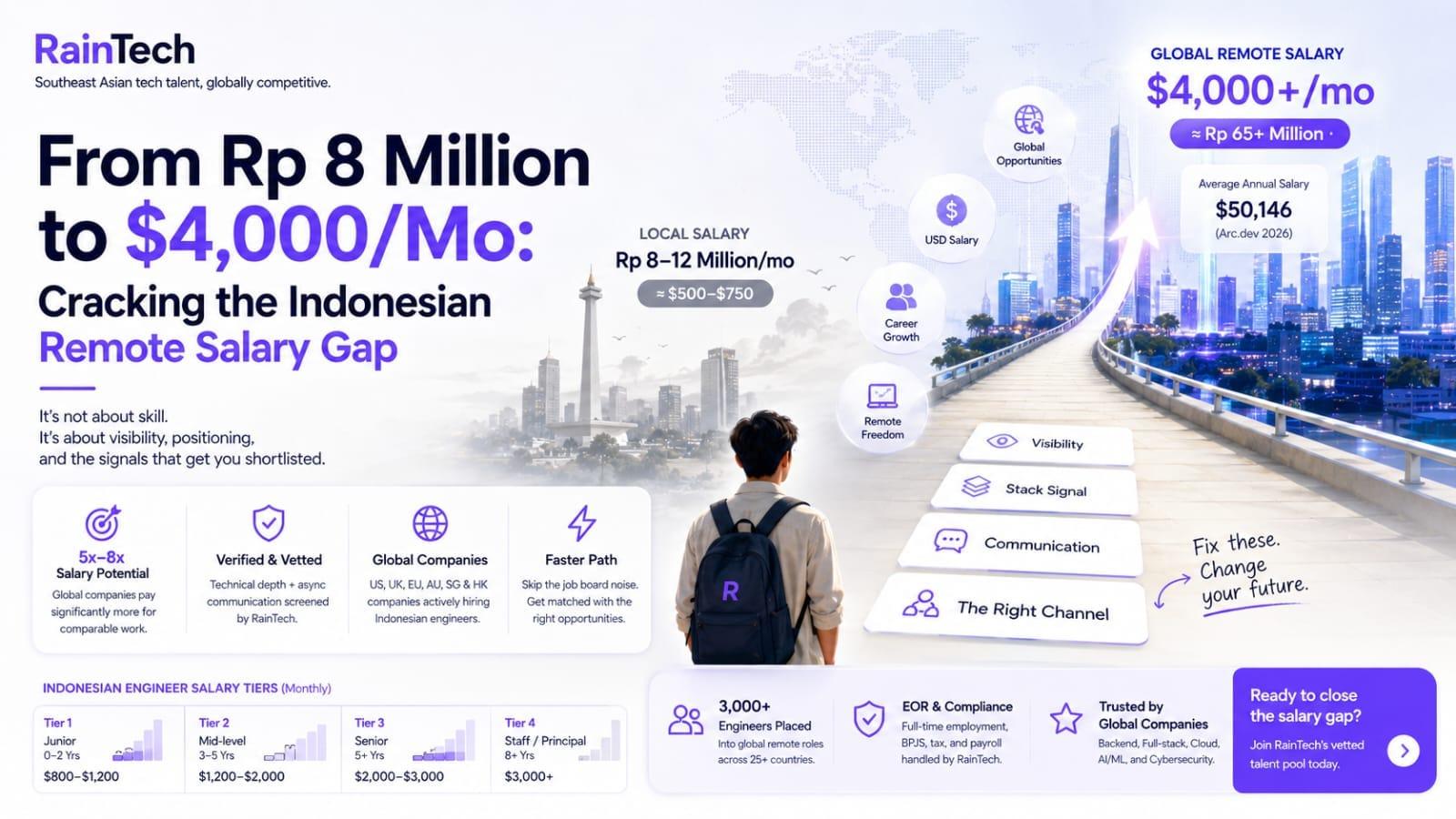
You have been coding for three years. You know your stack. You ship features on time. And you are earning Rp 8–12 million per month — somewhere between $500 and $750 — working for a local company.
Meanwhile, Arc.dev's 2026 remote salary data shows that Indonesian software engineers working for global companies earn an average of $50,146 per year — over $4,000 per month. That is a 5x to 8x difference for engineers doing comparable technical work.
The gap is not primarily about skill level. It is about visibility, positioning, and the specific signals that global hiring managers use to decide who gets shortlisted.
This article breaks down exactly what separates the engineers earning $4,000/month from those still earning $800, and what you can do about each one.
The Four Gaps That Keep Indonesian Engineers in The Local Salary Band
Gap 1: The Visibility Gap
The best-paid Indonesian remote engineers are not the most technically brilliant. They are the most findable. Global hiring managers do not browse Indonesian job boards. They search GitHub, LinkedIn, and specialist networks — and they make shortlisting decisions in under 60 seconds based on what they find.
Most Indonesian engineers with 3–5 years of experience have strong technical skills and zero global visibility. Their GitHub has private repositories from local projects. Their LinkedIn About section says "passionate developer." Their portfolio lists technologies, not outcomes.
The fix is not complicated, but it requires deliberate effort: document your production work publicly, rewrite your profile around outcomes rather than tools, and ensure that a hiring manager who lands on your GitHub or LinkedIn can answer "what has this person actually built and shipped" in under 30 seconds.
Gap 2: The Stack Signal Gap
According to the Stack Overflow Developer Survey 2025, salary correlates strongly with both seniority and the specific technologies an engineer operates in.
Engineers working in Go, cloud-native infrastructure, AI/ML, and TypeScript-first full-stack environments consistently command higher global rates than those whose primary experience is in PHP, vanilla JavaScript, or Java enterprise stacks.
This does not mean you need to abandon your current stack. It means understanding where your stack sits in the global demand curve, and either deepening in a high-demand area or adding a complementary skill that shifts your profile into a more valuable category.
The highest-leverage additions for most Indonesian mid-level engineers in 2026: TypeScript proficiency (if you are working in JavaScript), Docker and basic CI/CD (if you are building without deploying), and Python for data/AI-adjacent roles (if you are targeting the fastest-growing hiring category).
None of these requires starting from scratch, they build on existing foundations.
Gap 3: The Communication Signal Gap
This is the gap most Indonesian engineers underestimate and most global hiring managers are overweight. Remote teams run on async communication — written updates, documented decisions, specific questions, proactive blocker escalation.
Engineers who cannot demonstrate this capability in their application and interview consistently fail to convert global interest into offers, regardless of their technical depth.
The signal gap shows up in three places: how you write your application (generic versus specific and outcome-focused), how you answer technical questions in async written formats (vague versus precise), and how you describe your previous work (list of technologies versus problems solved and decisions made).
The engineers earning $4,000/month are not better coders. They are better communicators of their code, and that skill is learnable. Every piece of writing in your job application is a live sample of the async communication you will do every day in a remote role.
Gap 4: The Channel Gap
This is the most structural gap and the one that explains why technically strong engineers with good visibility still do not get hired.
Most Indonesian engineers looking for global remote work apply through generic job boards — LinkedIn, Indeed, Jobstreet — where Indonesian engineers compete in anonymous pools of hundreds of applicants against candidates from every market globally.
The global companies actively looking for Indonesian talent specifically are not advertising on those platforms. They are working through specialist networks and talent partners who have already validated the candidate pool.
Getting into those channels — rather than competing in open pools where Indonesian candidates are disadvantaged by name recognition, timezone assumptions, and communication anxiety — is a strategic decision that changes the hit rate fundamentally.
What The Salary Tiers Actually Look Like in Practice
RainTech works with global companies hiring Indonesian engineers across four experience tiers. These are not aspirational ranges — they are the rates global companies are actively paying in 2026 for verified, production-experienced Indonesian engineers:
| Tier | Experience | Monthly Salary | What Global Companies Expect |
|---|---|---|---|
| Tier 1 — Junior | 0–2 years | $800–$1,200/mo | Solid fundamentals, ability to ship defined tasks, learning fast |
| Tier 2 — Mid-level | 3–5 years | $1,200–$2,000/mo | Independent feature delivery, production experience, async communication |
| Tier 3 — Senior | 5+ years | $2,000–$3,000/mo | System design input, mentorship, ownership of outcomes not just tasks |
| Tier 4 — Staff/Principal | 8+ years | $3,000+/mo | Architecture decisions, cross-team technical leadership, production at scale |
The jump from Tier 1 to Tier 2 is the most significant in practice, both in salary and in what is expected. The engineers stuck at Tier 1 rates with 3–4 years of experience are almost always there because of the visibility and communication gaps, not because of technical deficiency. They have the skills for Tier 2 but are not presenting themselves at Tier 2 level.
The Fastest Path From Local Rates to Global Rates
There is no single shortcut. But there is a sequence that consistently works for Indonesian engineers making this transition:
Step 1: Fix Your GitHub
Add a profile README. Document your top two or three repositories with production context — what it does, who uses it, what technical decisions you made. This takes one weekend and changes your first impression permanently.
Step 2: Rewrite Your LinkedIn About Section
Two sentences. What you build, for what kind of company, at what level of complexity. Remove all generic language.
Step 3: Identify Your Stack Signal
Where does your current experience sit in the global demand curve? What is the one addition — TypeScript, Docker, Python, cloud basics — that would most credibly move your profile into a higher-demand category? Add it to a real project, not a tutorial.
Step 4: Build One Documented Public Project
A project with a README that explains the problem, the approach, the scale, and the outcome is worth more than ten private repositories from client work. It gives a hiring manager something to talk about in the first call.
Step 5: Get Into The Right Channel
Applying to 50 generic remote job listings will produce worse results than being shortlisted by a specialist network that puts you directly in front of a hiring manager who has already decided they want an Indonesian engineer. This is the channel gap, and it is the one that RainTech's talent pool is specifically designed to close.
What RainTech's Talent Pool Gives You That Job Boards Don't
When you join RainTech's vetted talent pool, you are not submitting an application into a void. You are entering a network where global companies come specifically looking for Indonesian engineers — and where your profile has been validated by Veri Ferdiansyah, RainTech's Co-Founder & CEO, with 8+ years of experience building Indonesian engineering teams for international clients.
The vetting process covers technical depth and async communication readiness, the two things that determine whether a global company shortlists you. Engineers in the active pool are matched to companies from the US, UK, EU, Australia, Singapore, and Hong Kong with active hiring needs in backend, full-stack, cloud, AI/ML, and cybersecurity.
The 3,000+ engineers in RainTech's network who have been placed into global roles did not get there by applying harder on LinkedIn. They got there by being findable to the right companies through the right channel, at the right moment when a company was actively looking.
FAQs
I have 3 years of experience but am still earning local rates. Am I in the right tier for global hiring?
Three years with production experience and documented work puts you at the low end of Tier 2 ($1,200–$2,000/month) for global hiring, significantly above most local Indonesian salaries. The gap between where you are and where you could be earning is almost always about visibility and channel, not technical readiness. The fix starts with your GitHub and LinkedIn, not with more years of experience.
Do I need to be in Jakarta to get hired by a global company through RainTech?
No. RainTech places engineers from across Indonesia. The primary requirement is reliable internet connectivity and a professional remote work setup, not physical location. Tier 1 cities (Jakarta, Bandung, Surabaya, Yogyakarta) have the deepest infrastructure, but RainTech evaluates candidates from anywhere in the country.
How long does it typically take to go from joining RainTech's pool to getting placed?
Matching timelines vary based on your tier, specialization, and current demand. For active Tier 2 and Tier 3 engineers in backend, full-stack, or cloud, demand is consistent. RainTech's typical time-to-shortlist for clients is under 2 weeks — which means once you are in the active pool and a relevant company brief comes in, the timeline is fast.
Will I be paid in USD through RainTech?
Your employment contract is governed by Indonesian law, and payroll is processed in IDR, but the salary is benchmarked to USD rates and converted at market rate. RainTech handles all BPJS, tax, and payroll compliance as Employer of Record, so you receive full legal employment benefits alongside the global salary.
What is the most important thing I can do right now to increase my chances of being shortlisted?
Document one real production project publicly on GitHub with a full README explaining the problem, scale, and technical decisions — then apply to RainTech's talent pool with that project as your primary portfolio piece. That combination — verified production evidence plus specialist channel access — is the single highest-leverage move available to an Indonesian engineer trying to break into global rates.
Conclusion
The $4,000/month average is real. The 5x–8x gap between local and global rates for Indonesian engineers doing comparable technical work is not a skills gap. It is a visibility gap, a communication signal gap, and a channel gap — all of which are fixable with deliberate effort over weeks, not years.
The engineers earning global rates in 2026 are not waiting for the right opportunity to appear on a job board. They are in the right networks, presenting themselves clearly, and being matched to companies that are actively looking for them.
To fast-track your transition and close the channel gap, join RainTech's vetted talent pool today and let our network connect your profile directly with international companies ready to pay for your real value.
Related Article:
- From Local to Global: How to Land a USD Salary as an Indonesia Engineer
- 5 Tech Stacks for Indonesian Engineers to Earn USD in 2026
- Indonesia Tech Talent Tiers 2026: Exact Salaries, Output by Level, and ROI vs US Developers
- How to Negotiate Your First Global Remote Contract: A Framework for Indonesian Developers
- 8 Reasons Why Global Companies Reject Indonesian Engineers (and How to Fix it)