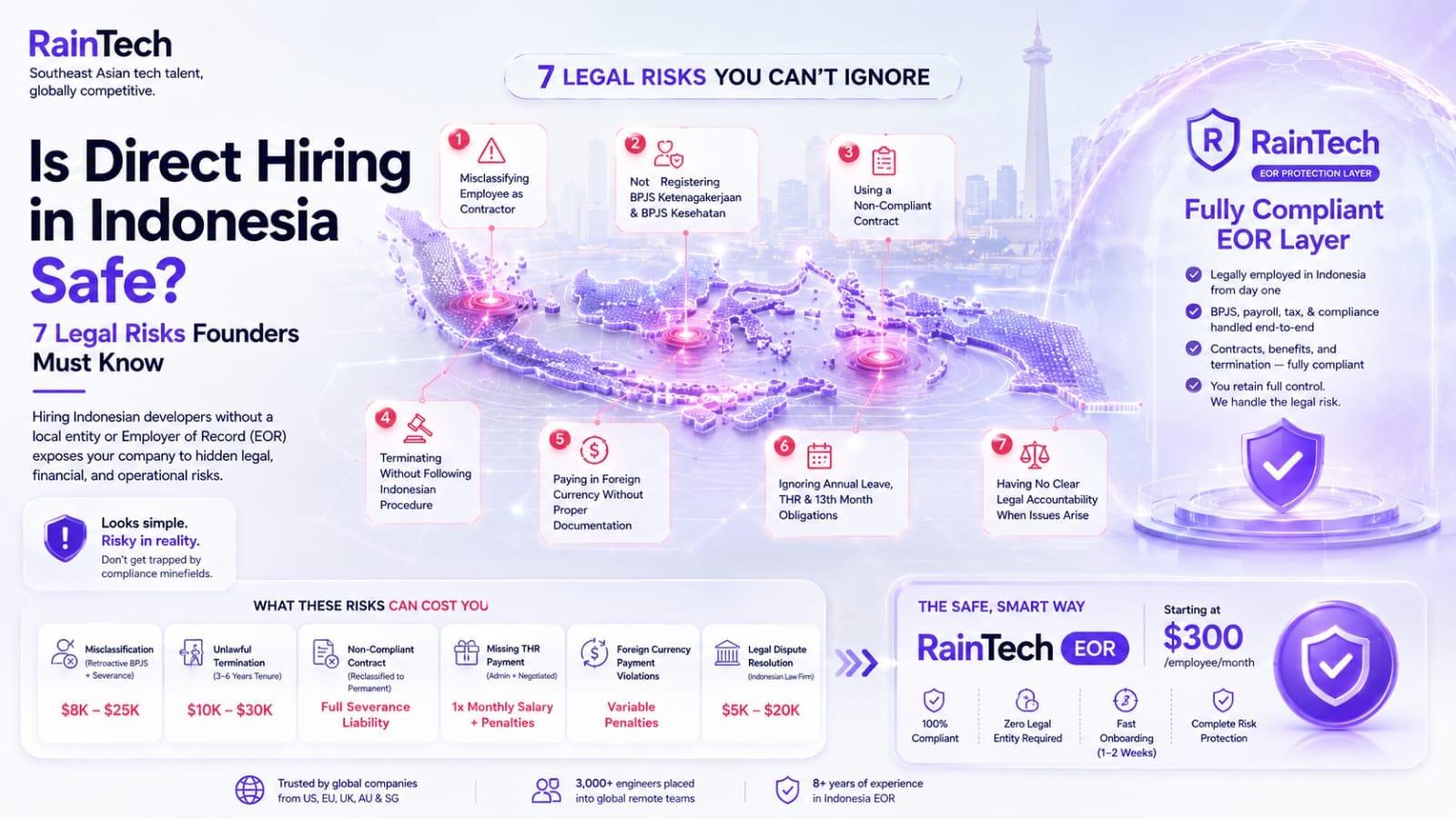
Hiring Indonesian developers without a local entity or Employer of Record (EOR) is legally possible in theory. But in practice, it exposes overseas companies to at least seven distinct compliance risks under Indonesian labor law.
The most common traps include contractor misclassification, unpaid BPJS contributions, non-compliant termination, and tax withholding errors. Each carries financial penalties, potential legal disputes, and — in some cases — full invalidation of the employment arrangement.
This guide covers what actually goes wrong when founders attempt direct hiring in Indonesia, based on RainTech's experience onboarding remote tech teams for global companies across the US, Europe, and Australia.
Why Founders Try to Hire Directly in Indonesia
It makes sense on paper. Indonesia has more than 3 million tech professionals, with mid-level engineers earning between $1,200–$2,500 per month — a fraction of equivalent talent in the US or UK.
Platforms like LinkedIn, Glints, and Kalibrr make it easy to find candidates. A quick contract, a bank transfer, and you're done.
Except you're not.
"The most common mistake we see is companies treating Indonesian hires as independent contractors when the actual working relationship meets every definition of full-time employment under Indonesian law," says Veri Ferdiansyah, Co-Founder & CEO of RainTech and former CTO at multiple tech startups. "By the time the issue surfaces — usually when the employee files a complaint or resigns — the company is already exposed."
Here are the seven traps, in order of how often they appear.
Trap 1: Misclassifying a Full-Time Employee as a Contractor
What Happens
A company hires an Indonesian developer, calls them a "freelancer" or "contractor," and pays them via bank transfer or PayPal without formal employment contracts. The arrangement looks clean until the developer works consistently for 3–6 months.
The Legal Reality
Under Indonesia's Manpower Law (UU No. 13/2003) and the Job Creation Law (UU No. 11/2020), a working relationship is classified as employment — not contracting — if it involves regular hours, ongoing supervision, and a fixed monthly payment. The label you put on the contract does not override the nature of the work.
The Consequence
If an employee files a complaint with the local labor office (Dinas Tenaga Kerja), the company can be required to retroactively pay all employment benefits — including BPJS contributions, severance, and paid leave — from the start of the engagement. Penalties can reach tens of thousands of dollars depending on tenure.
This is one of the most documented risk areas in Indonesian employment law and is covered in detail in RainTech's guide on EOR vs contractor misclassification in Indonesia.
Trap 2: Not Registering BPJS Ketenagakerjaan and BPJS Kesehatan
What Happens
An overseas company pays the employee's salary in full but does not set up mandatory Indonesian social security contributions.
The Legal Reality
Every employer of Indonesian workers — regardless of where the employer is based — is required to register employees with BPJS Ketenagakerjaan (work accident, death, and old-age insurance) and BPJS Kesehatan (national health insurance). This applies even if the company has no legal entity in Indonesia.
The Consequence
Failure to register results in administrative fines, and employees are left without coverage for work injuries or medical expenses. If an employee is injured and discovers they have no BPJS coverage, the employer becomes directly liable for all costs. For a detailed breakdown of contribution rates and employer obligations, see RainTech's BPJS Indonesia Employer Guide.
The Numbers
BPJS Ketenagakerjaan contributions total approximately 6.24% of salary (employer portion: 4.24%, employee: 2%). BPJS Kesehatan is 5% of salary up to the wage ceiling (employer: 4%, employee: 1%). These cannot be waived.
Trap 3: Using a Non-Compliant Employment Contract
What Happens
A company copies a standard US or UK employment contract template, translates it (or doesn't), and asks the Indonesian employee to sign.
The Legal Reality
Indonesian employment contracts must comply with specific requirements under the Manpower Law: they must be written in Bahasa Indonesia (bilingual versions are permitted, but the Bahasa Indonesia version is the legally binding one if there is a dispute), include probationary period terms within legal limits, and specify the type of employment agreement — PKWT (fixed-term) or PKWTT (permanent).
The Consequence
A contract that does not meet these requirements is considered void. A void PKWT contract is automatically reclassified as a PKWTT (permanent employment contract) under Indonesian law — meaning the employee has full permanent employment rights from day one, including full severance entitlements if terminated.
Trap 4: Terminating an Employee Without Following Indonesian Procedure
What Happens
A startup reduces headcount. The founder sends a termination email, pays the final month's salary, and considers it done.
The Legal Reality
Indonesian labor law requires a formal termination process (PHK — Pemutusan Hubungan Kerja) that includes written notice, a mandatory bipartite negotiation period, and in many cases, government mediation before termination is legally effective. Skipping this process means the termination can be challenged as unlawful.
The Consequence
An employee who successfully challenges an unlawful termination can claim reinstatement or receive severance pay equivalent to 9x their monthly salary (for a permanent employee with 3–6 years of tenure) under the current severance formula. For senior engineers earning $2,000/month, that is $18,000 in a single termination dispute.
"We've seen overseas companies come to us after they've already terminated an employee incorrectly," says Fatimah Hasna, Co-Founder & COO of RainTech, who has 8 years of experience in EOR and HR. "By the time they reach out, the legal process has started. The cost of not having an EOR in place is almost always higher than the EOR fee itself."
Trap 5: Paying in Foreign Currency Without Proper Documentation
What Happens
An overseas company pays an Indonesian employee directly from a US or European bank account, in USD or EUR, without proper documentation.
The Legal Reality
Indonesian employees must be paid in Indonesian Rupiah (IDR) unless a specific exception applies under Bank Indonesia regulations. Paying in foreign currency without the correct framework creates tax reporting problems for the employee and potential violations for the employer under foreign exchange regulations.
The Consequence
The employee may face penalties during their annual tax filing. The company may be flagged by Bank Indonesia's transaction monitoring. In more serious cases, payments structured to avoid tax withholding can be treated as tax evasion.
Trap 6: Ignoring Annual Leave, Religious Holiday Allowance (THR), and 13th Month Pay
What Happens
A company pays a monthly salary and assumes that it covers everything.
The Legal Reality
Indonesian employees are legally entitled to:
- A minimum of 12 days of paid annual leave per year after one year of employment.
- Tunjangan Hari Raya (THR) — a mandatory religious holiday bonus equivalent to one month's salary, paid before Eid al-Fitr (or the employee's religious holiday).
- Some collective companies also pay a 13th-month salary by practice, which can become a contractual expectation.
The Consequence
Failing to pay THR is a specific violation under Indonesian Ministry of Manpower regulations and carries administrative sanctions. Employees who are not paid THR can file complaints directly with the local labor office. THR disputes are among the most common employment complaints in Indonesia.
Trap 7: Having No Clear Legal Accountability When Something Goes Wrong
What Happens
An overseas company operates without a local entity and without an EOR. Everything runs fine for 12 months. Then a dispute arises — a termination, an injury, a salary disagreement.
The Legal Reality
Without a local legal entity or a licensed EOR acting as the employer of record, there is no clear responsible party under Indonesian law. The employee cannot easily sue a foreign company in an Indonesian court. But they can file with BPJS, the labor ministry, or pursue alternative channels that create reputational and operational damage.
The Consequence
The company is in legal limbo — not protected by Indonesian employer rights (because it was never formally an employer), but still exposed to liability claims. Resolving this retroactively requires engaging an Indonesian law firm, which typically costs $5,000–$20,000 for a contested employment dispute.
What Founders Actually Pay When These Traps Trigger
| Trap | Estimated Exposure |
|---|---|
| Contractor misclassification (retroactive BPJS + severance) | $8,000–$25,000 |
| Unlawful termination (severance, 3–6 years tenure) | $10,000–$30,000 |
| Non-compliant contract (reclassification to permanent) | Full severance liability |
| Missing THR payment (administrative + negotiated payment) | 1x monthly salary + penalties |
| Foreign currency payment violations | Variable; tax penalties + legal fees |
| Legal dispute resolution (Indonesian law firm) | $5,000–$20,000 |
These figures are why RainTech clients consistently cite compliance certainty — not just cost savings — as their primary reason for choosing an EOR.
What an EOR Actually Solves
An Employer of Record like RainTech becomes the legal employer of your Indonesian hires. That means:
- All BPJS contributions are registered and paid correctly from day one.
- Employment contracts are bilingual, legally compliant, and enforceable under Indonesian law.
- THR, annual leave, and all statutory benefits are calculated and distributed automatically.
- Termination processes, when needed, follow proper PHK procedures
- You retain full operational control over the employee's work — RainTech handles the legal and administrative layer
"When a European client needed to onboard a software engineer in Indonesia within five days to meet a project deadline, we managed everything — candidate confirmation, contract preparation, payroll setup, and onboarding — in under a week," says Fatimah. "The client told us they were genuinely surprised by how fast and organized the process was compared to providers they had used before."
The average timeline from first conversation to signed agreement at RainTech is 1–2 weeks. For companies that have already spent months trying to navigate direct hiring, that speed is the most valuable part.
The Decision Framework
If you are considering direct hiring in Indonesia, ask yourself three questions:
- Do you have a registered PT PMA or branch office in Indonesia?
- Do you have an Indonesian HR or legal team that understands Manpower Law, BPJS, and THR obligations?
- Are you prepared to manage compliance updates as Indonesian labor law evolves?
If the answer to any of these is no, direct hiring creates more risk than it saves in EOR fees.
For context: RainTech's EOR service starts at $300 per employee per month. A single contested termination dispute costs more than 3–5 years of EOR fees for the same employee.
Next Step
If you are evaluating how to legally hire Indonesian developers without setting up a local entity, RainTech's EOR service handles the full compliance layer — from contract to payroll to offboarding.
Ready to secure your remote hiring? Get started by viewing RainTech pricing to find a plan that fits your budget, or see how RainTech's EOR works to understand how we protect your business from these compliance traps. You can also compare EOR providers in Indonesia to see why global founders trust us with their tech teams.
FAQs
Can we just use a standard global contractor agreement for Indonesian hires?
No, simply labeling a contract as a "contractor agreement" does not override Indonesian law. If the relationship involves fixed monthly pay, set working hours, and direct supervision, local authorities will reclassify it as permanent employment. This triggers retroactive liabilities for benefits, social security, and severance pay.
Is it legal to pay remote developers in Indonesia using USD or EUR?
Bank Indonesia regulations strictly mandate the use of Indonesian Rupiah (IDR) for all domestic transactions and employment payments. Paying directly in foreign currency from an overseas account without the correct legal framework can lead to compliance audits. It also creates complex tax reporting issues and potential penalties for your local team.
What happens if a directly hired remote worker gets injured?
Without a local entity or an EOR to register them under BPJS Kesehatan and Ketenagakerjaan, the worker has no official health and accident coverage. If an injury occurs during working hours, your company can be held directly and fully liable for all medical expenses and lost wages. This exposes your business to severe financial risks and potential lawsuits.
How long does it take to safely onboard an Indonesian developer through an EOR?
Setting up a legal entity independently can take months, but partnering with an Employer of Record reduces that timeline significantly. At RainTech, the average turnaround from the first consultation to a fully compliant, signed bilingual contract is just 1 to 2 weeks. In urgent cases, we can even complete the full onboarding process in under 5 days.
Related articles: