Three months in. Your Indonesian engineer is technically capable, you confirmed that in the interview. But velocity is lower than expected. PRs take longer than they should. Blockers surface late. You are starting to wonder if the hire was a mistake.
It probably was not. The hire was fine. The onboarding was not.
This is the most consistent pattern RainTech sees across global companies bringing on their first Indonesian remote engineer: the technical bar was cleared, the EOR paperwork was handled, and then the engineer was onboarded exactly the same way a local hire would be.
A Slack invite, a few intro calls, an expectation of gradual ramp-up. That process was not designed for someone working 7 to 15 time zones away, navigating an async-first environment, joining a codebase they have never seen.
The underperformance at month three is almost never a talent problem. It is an onboarding design problem, and it is entirely preventable.
What The Data Says (and Most Companies Ignore)
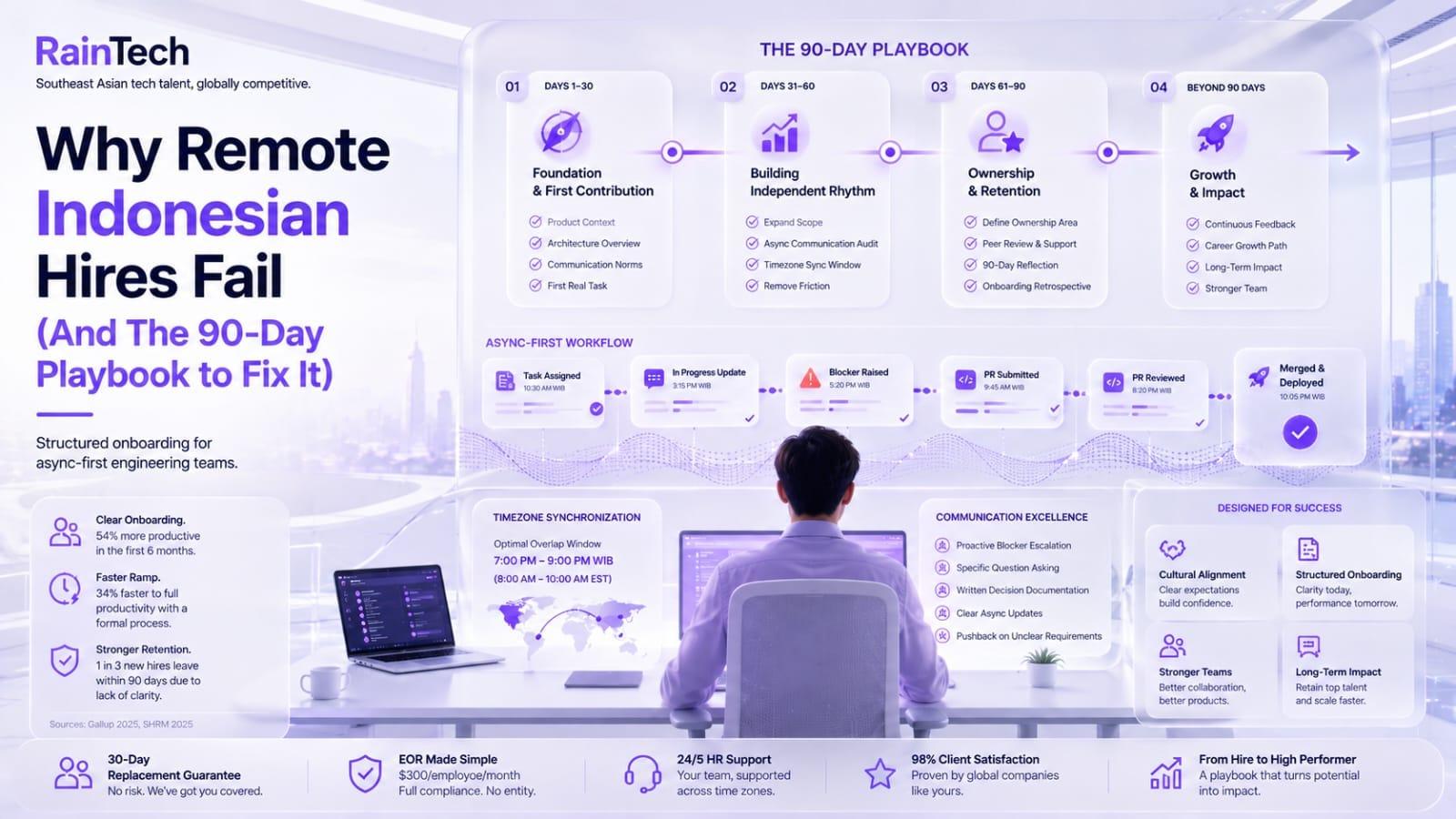
According to Gallup 2025, remote employees with effective onboarding are 54% more productive in their first six months, yet only 12% of employees say their company did a great job onboarding them. That gap is where underperformance lives.
SHRM 2025 adds the retention dimension: roughly 1 in 3 new hires leave within the first 90 days, and the leading cause is not compensation or role fit, it is absence of clarity. For remote engineers hired across significant timezone gaps, that absence of clarity is amplified by every hour of async lag.
The solution is not more video calls. It is a structured onboarding system designed for the remote, async, cross-timezone context your Indonesian engineer is actually working in.
Two Things That Make Indonesian Remote Onboarding Specific
Generic remote onboarding advice mostly applies here, but two things require additional design:
1.Communication Style Adaption
Indonesian professional culture has strong defaults around indirect communication and deference to seniority. An engineer who interviews confidently may go quieter than expected once working inside a real team dynamic, not asking questions they should ask, not pushing back on unclear requirements. This is not a red flag. It is a cultural transition that structured onboarding can accelerate significantly.
2.The Timezone Gap Creates Invisible Blockers
A question that cannot be asked until the next sync window, a PR that sits unreviewed for 18 hours, a decision that waits until tomorrow morning (UTC+7), these are not individual incidents. They compound across 90 days into a pattern that looks like underperformance but is actually a workflow design problem.
Both are solvable. Neither solves itself.
The 90-Day Playbook: Three Phases
Days 1-30: Foundation and First Contribution
The first week is not about productivity. It is about clarity. Every hour spent building context in week one saves three hours of confusion later.
Before day one: every tool access, repository permission, and environment credential should be provisioned and ready. Nothing signals poor organizational readiness faster than an engineer spending their first two days waiting for access.
In the first week, deliver four things deliberately:
A Product Context Document
Who your customers are, what problem you are solving, how the business works. Do not assume this is obvious. It is not.
An Architecture Overview
What systems exist, what the engineer will work in, what is stable versus in flux.
A Communication Norms Document
Written down explicitly: how your team escalates blockers, what a good async status update looks like, how disagreement is communicated. This document is especially important for Indonesian engineers because it removes the ambiguity that makes indirect communication feel safer.
A First Task — Scoped Tightly
Real work, not a tutorial. But clear input, clear expected output, clear definition of done. The goal by day 30 is one meaningful contribution shipped — not perfect, but real.
Assign a pair reviewer from your existing team: a senior engineer whose job is to respond to PRs within 24 hours and be explicitly approachable for questions that might feel too basic for a public channel.
Days 31-60: Building Independent Rhythm
By month two, the engineer has product context and one completed contribution. The onboarding job shifts from providing context to removing friction.
Expand task scope one level of ambiguity at a time. Give the engineer the "what" and let them propose the "how." Review the proposal asynchronously before they start. This is the transition from execution to contribution, and it needs to be deliberate, not abrupt.
At week six, do an async communication audit. Review the last four weeks of Slack, PR descriptions, and check-ins. Are blockers being surfaced proactively? Are questions specific?
This is not surveillance, it is identifying communication patterns that are working and patterns that are not, so you can give targeted feedback before they become habits.
Formalize the timezone sync window. By month two you should know the best 1–2 hour daily overlap between WIB and your team's timezone. Lock it in as a standing rhythm, the engineer knows that questions sent during this window get same-session responses.
Day 61-90: Ownership and Retention
The goal of month three is the transition from "new hire" to "team member with ownership." An engineer who reaches day 90 without a clearly defined area of accountability is at risk of the ambiguity-driven disengagement that drives early attrition.
By day 60, assign one ownership area — a system, a service, a feature area — where this engineer reviews PRs, fields questions, and proposes improvements. Ownership creates investment. Investment creates retention.
At day 90, run a brief written review: what was expected at day 30, 60, and 90 — and what actually happened. This is not a performance management exercise. It is a shared reflection that signals the company takes the engineer's progression seriously.
Finish with an onboarding retrospective: what worked, what was missing, what would have helped most in week one. Twenty minutes of input that directly improves your process for the next hire.
What RainTech Provides Beyond EOR Compliance
RainTech's role does not end at contract signing and BPJS registration. For every new placement, Fatimah Hasna, Co-Founder & COO, leads a client onboarding support process built on 8+ years of Indonesian HR experience — including communication norm templates calibrated for Indonesian remote engineers and a day-21 check-in with both client and engineer to catch friction before it becomes a pattern.
This is part of the 30-day replacement guarantee framework. But more importantly, it is how RainTech's 98% client satisfaction rate is maintained, not by delivering a hire and stepping back, but by supporting the transition that determines whether the hire actually works.
The EOR fee is 30% of monthly gross salary, capped at $300/employee/month, and covers payroll, BPJS, tax compliance, and 24/5 HR support.
FAQs
How long does it realistically take for an Indonesian remote engineer to reach full productivity?
With structured onboarding, most engineers reach meaningful independent contribution by day 30 and full productivity by day 60–75. Without it, this extends to 4–5 months, and the extended ramp is frequently misread as underperformance rather than the onboarding gap it actually is.
What is the single most common onboarding mistake for Indonesian remote engineers?
Skipping the communication norms document. Most companies assume async communication standards develop naturally. They do not, especially when an engineer is navigating cultural defaults around indirect communication. Writing this down takes two hours and prevents three months of friction.
Is structured 90-day onboarding more important for senior engineers or junior hires?
More important for senior engineers. They are given more autonomy earlier, which means less organic oversight of whether context transfer has actually happened. A Staff or Principal engineer without clear product context and ownership definition by day 30 will make architectural decisions based on incomplete information, and those are harder to reverse than a junior engineer's implementation choices.
What does RainTech's 30-day replacement guarantee cover if issues emerge early?
If a placed engineer does not meet expectations within the first 30 days, RainTech sources a replacement at no additional placement fee. Before invoking the guarantee, RainTech recommends the day-21 check-in to distinguish onboarding design issues — fixable — from genuine fit mismatches, which are not.
Conclusion
The first 90 days determine whether your Indonesian remote engineer becomes a high-performing team member or a difficult-to-diagnose underperformer.
The difference is almost never talent. It is almost always the presence or absence of a structured onboarding system designed for the async, cross-timezone context your hire is actually working in.
SHRM data is clear: employees who go through a formal onboarding process achieve full productivity 34% faster. For a senior Indonesian engineer at $2,500/month, that acceleration is worth more than the cost of designing the process correctly.
RainTech delivers a technically screened, communication-assessed engineer to your shortlist. What happens after offer acceptance is a shared responsibility, and this playbook is where that responsibility starts.
To seamlessly set your next hire up for success, book a placement call today and get our complete onboarding framework included.
Related Articles:
- Why Strong Engineers Fail in Remote Teams: A Guide to Screening Indonesian Tech Talent
- How APAC Startups Retain Tech Talent: Real Lessons from Remote Onboarding (2025 Edition)
- Building a Remote-Friendly Culture for Indonesian Tech Talent
- EOR Indonesia Pricing: Avoid Hidden Fees with Our 2026 Guide
- From Months to Weeks: Time to Hire in Indonesia