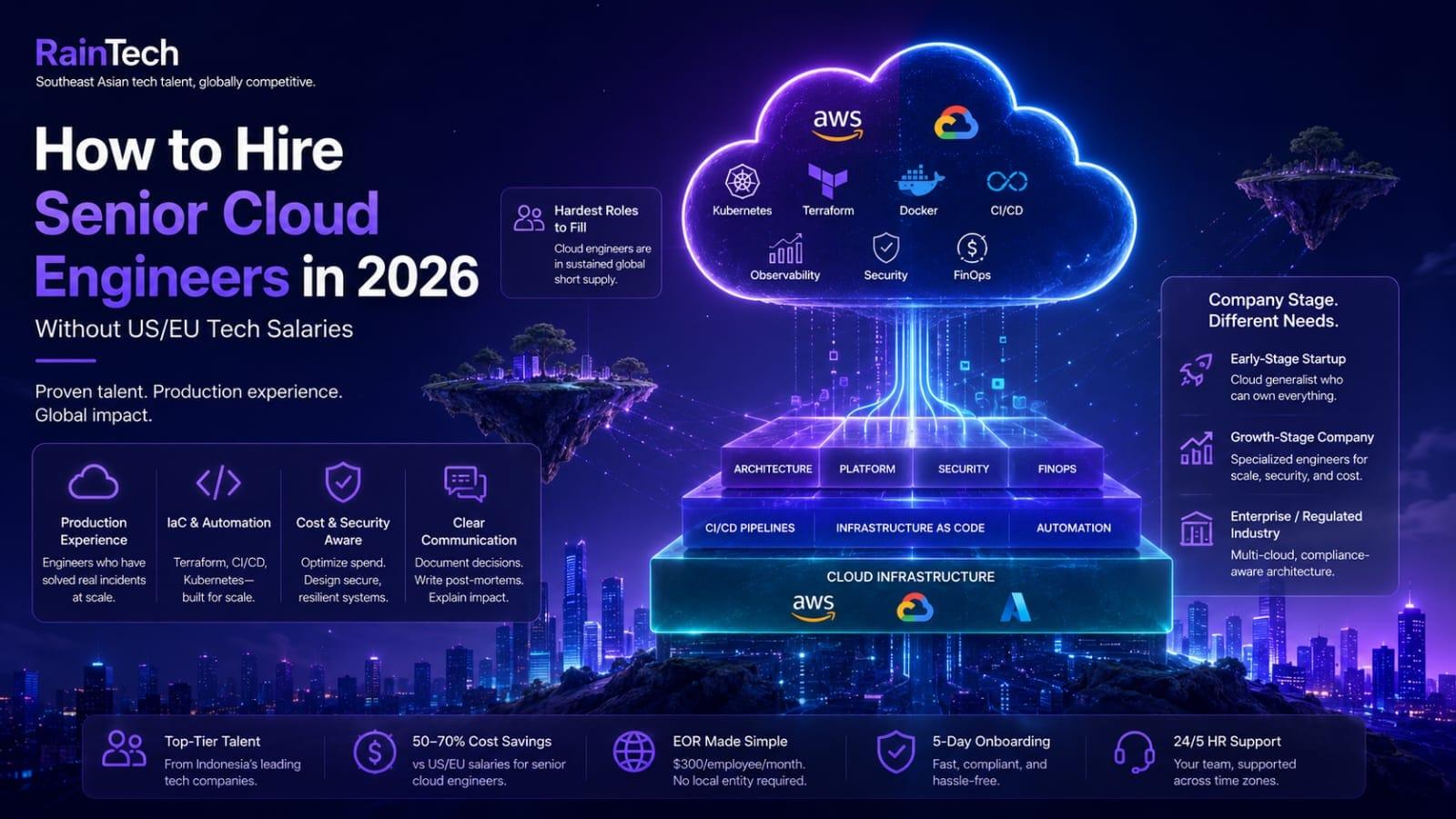
Cloud infrastructure roles are the hardest engineering positions to fill right now. Not frontend. Not mobile. Cloud — the engineers who design, build, and keep alive the infrastructure everything else runs on.
If you have been searching for a senior AWS architect or a platform engineer for more than two months without a hire, you already know this.
The US market is priced out of reach for most companies not named Google or Amazon. Eastern Europe is increasingly competitive. India's senior cloud pool is real but heavily contested. And most hiring managers have not seriously evaluated Indonesia. Not because the talent is not there, but because nobody told them to look.
This guide is the case for looking.
The Cloud Skills Gap is Structural, not Cyclical
This shortage is not going to resolve itself when the hiring market cools. It is a supply problem that predates the current cycle and will outlast it.
According to the Stack Overflow Developer Survey 2025, Docker usage jumped 17 percentage points in a single year, the largest single-year increase of any technology surveyed.
AWS is now used by 43.3% of professional developers globally. Kubernetes by 28.5%. These are not niche tools anymore, they are standard infrastructure. And the engineers who can operate them at production scale, under real load, with real consequences for downtime, are in sustained short supply across every market.
The AWS Global Skills Report puts numbers to what hiring managers already feel: cloud skills are consistently ranked among the most difficult to source, with organizations reporting that talent gaps are directly slowing down product delivery and digital transformation timelines. More job postings will not solve this. Finding supply that your competitors have not found yet will.
What Indonesian Cloud Engineering Actually Looks Like by Company Stage
The most useful frame for evaluating Indonesian cloud talent is not the seniority tier, it is company stage. Different stages need different cloud profiles, and Indonesia's talent pool serves some stages better than others. Being clear about this upfront saves a sourcing cycle.
Early-Stage Startup: You Need a Cloud Generalist Who Can Own Everything
At this stage, you do not need a cloud architect with deep specialization. You need someone who can set up your AWS or GCP environment correctly from the start, implement CI/CD, write Terraform for your core infrastructure, and not create technical debt that becomes expensive to unwind at Series B.
Indonesia has strong supply here: mid-level engineers (3–5 years) with AWS or GCP experience, IaC fluency in Terraform, and Docker/GitHub Actions familiarity.
These engineers have often come from Indonesia's startup ecosystem — comfortable with ambiguity, used to owning infrastructure without a large DevOps team behind them.
Salary range: Tier 2 — $1,200–$2,000/month + $300 EOR fee.
Growth-Stage Company: You Need Specialization Starting to Separate
At this stage, the generalist is no longer sufficient. You need engineers who have gone deep in specific areas: a platform engineer who owns Kubernetes and can design for scale, a cloud security engineer who has implemented zero-trust architecture and CSPM tooling, or a FinOps engineer who has run a real cost optimization cycle and can show the results.
This is where Indonesia's unicorn alumni pool becomes directly relevant. Engineers who have come through GoTo, Traveloka, or Tokopedia have operated infrastructure at consumer scale — millions of requests, real incident response, real cost pressure. They have done the specialization work inside environments that demanded it.
Salary range: Tier 3 — $2,000–$3,000/month + $300 EOR fee.
Enterprise or Regulated Industry: Multi-Cloud, Compliance-Aware Architecture
At this stage, requirements become more specific: multi-cloud architects, engineers familiar with compliance frameworks like SOC 2 or ISO 27001 in a cloud context, SREs who can design for five-nines availability. Indonesia can support this level but requires targeted sourcing — the pool is smaller and the brief needs to be precise.
Salary range: Tier 3–4 — $2,500–$3,000+/month + $300 EOR fee.
The Specialization Matrix: What is Available and What to Expect
| Specialization | Supply Depth | Recommended Seniority | Salary Range |
|---|---|---|---|
| AWS Solutions Architect | Medium-High | Mid to Senior | $1,200–$3,000/mo |
| GCP Data & ML Infrastructure | Medium | Mid to Senior | $1,200–$3,000/mo |
| DevOps / CI-CD Engineer | Medium-High | Mid to Senior | $1,200–$3,000/mo |
| Kubernetes / Platform Engineer | Medium | Senior | $2,000–$3,000/mo |
| Cloud Security (IAM, CSPM) | Medium | Mid to Senior | $1,200–$3,000/mo |
| FinOps / Cloud Cost Optimization | Low-Medium | Senior | $2,000–$3,000/mo |
| Azure Engineer | Low-Medium | Mid to Senior | $1,200–$3,000/mo |
| Site Reliability Engineer (SRE) | Medium | Senior | $2,000–$3,000/mo |
| Multi-cloud Architect | Low | Senior to Staff | $2,500–$3,000+/mo |
The One Thing that Separates Real Cloud Engineers from Certified Ones
Certifications — AWS Solutions Architect, GCP Professional Cloud Architect, CKA — are useful filters.
They are not sufficient predictors of production competency, and in Indonesia's cloud engineering pool specifically, some of the strongest candidates have not prioritized certification exams because they have been too busy operating real infrastructure.
The single most reliable signal in a cloud engineering assessment is incident response history.
Ask the candidate to walk you through a real production incident they were personally responsible for resolving. Not a hypothetical. Not "what would you do if."
A real incident: what broke, how they diagnosed it, what they changed, and what they put in place afterward. Engineers who have only worked in sandbox or staging environments cannot give specific answers here.
Engineers who have operated production infrastructure under real conditions — with real consequences for downtime — can, and the specificity of their answer tells you more than any certification ever will.
Secondary signals worth probing in the assessment:
IaC Fluency in Practice
Ask for examples of Terraform or CDK they have written for production systems, not tutorials. The ability to review a Terraform plan and identify problems is a practical test.
Make this a stated requirement in your role brief, not an afterthought — companies that skip it consistently end up with engineers who default to manual console management, creating undocumented infrastructure drift over time.
Cost Optimization Experience
Engineers who have gone through a real FinOps cycle understand cloud systems at a level that purely build-focused engineers do not. This is particularly relevant at the growth stage, where AWS bills have a tendency to surprise.
Security Posture Awareness
IAM design, least-privilege implementation, and basic CSPM familiarity should be baseline for any cloud engineer handling production systems with user data. This is not a specialist security role requirement, it is table stakes.
The Communication Layer that Cloud Roles Specifically Require
Cloud engineers operate at the intersection of development, operations, and business impact. Their work affects uptime, cost, and security simultaneously, and explaining tradeoffs across all three to both technical and non-technical stakeholders is a core part of the role, not an optional extra.
At GITEX Asia 2026, this was a consistent theme in conversations with engineering leaders who had previously hired cloud talent remotely without communication screening: the friction was not technical.
The engineer could configure the infrastructure. The problem was the post-mortem that never got written, the architecture decision that was never documented, the cost spike that was not flagged until the bill arrived.
RainTech screens cloud engineering candidates for async communication proficiency as a separate evaluation from technical competency.
The specific skills that matter for cloud roles: writing clear incident post-mortems, documenting infrastructure decisions in a way that a future engineer can read and understand, and explaining cost and security tradeoffs to non-technical stakeholders without losing precision.
How RainTech Sources and Places Cloud Engineers
Step #1 — Role Specification Call
RainTech's team works with your CTO or DevOps lead to define cloud provider focus, IaC requirements, company stage, specialization depth, and communication expectations. The more specific the brief, the faster and more accurate the shortlist.
Step #2 — Targeted Candidate Sourcing
Candidates are sourced from specialist networks and alumni of Indonesia's scaled tech companies, not from general job boards. For cloud roles specifically, RainTech prioritizes engineers with documented production infrastructure history over those with certifications alone.
Step #3 — Technical + Communication Screening
Every candidate is assessed on production evidence — incident history, IaC fluency, cost optimization background — and on async communication proficiency. Both evaluations complete before candidates reach your shortlist.
Step #4 — Your Technical Interview
You run your own assessment. RainTech can provide cloud role-specific interview frameworks on request, including architecture walkthroughs and IaC review exercises.
Step #5 — EOR Onboarding
RainTech handles all Indonesian employment legalities as Employer of Record: labor contracts, BPJS registration, payroll in IDR, tax compliance, and 24/5 HR support at $300/employee/month. No local entity required. Full onboarding typically completes within 5 business days of offer acceptance, based on our track record with European clients.
FAQs
Do Indonesian cloud engineers have real AWS and GCP production experience, or is it mostly certification-based?
Production experience exists and is concentrated among engineers from GoTo, Traveloka, and Indonesia's fintech sector. RainTech's screening process verifies production history specifically — incident response experience, IaC work in live systems, and cost optimization cycles — rather than relying on certification status.
Which cloud provider has the deepest talent pool in Indonesia?
AWS has the deepest pool, driven by its dominance in Indonesia's startup and enterprise sectors. GCP follows, particularly among engineers with data and ML infrastructure backgrounds. Azure exists but requires more targeted sourcing. Specify your provider in the role brief.
Is Kubernetes experience common among Indonesian cloud engineers?
Present at mid-to-senior level, particularly among engineers from DevOps and platform engineering functions at scaled companies. Not universal, specify it as a requirement if essential. CKA holders exist in the pool but are a smaller subset.
What IaC tools are most common among Indonesian cloud engineers?
Terraform is the most common, consistent with global dominance. AWS CDK and Ansible are also present, particularly in AWS-heavy environments. Pulumi adoption is growing but less widespread.
Can I hire an Indonesian cloud engineer as a contractor instead of through EOR?
RainTech's Payroll Management service covers contractors at $30/contractor/month. However for full-time engagements, EOR is the legally correct structure under Indonesian labor law. Misclassification carries real penalties including back-payment of BPJS contributions and potential labor court liability.
How does the 30-day replacement guarantee work for cloud roles?
Under RainTech's Talent Placement model, if a placed candidate does not meet expectations within 30 days, RainTech sources a replacement at no additional placement fee. This applies to all roles including cloud and DevOps specialists.
Conclusion
The cloud skills shortage is structural, and traditional markets won't see relief anytime soon. Indonesian cloud engineers, especially those who have scaled AWS and GCP infrastructure inside the country’s tech unicorns, represent an untapped, high-caliber talent pool that international companies are only just beginning to notice.
The window of opportunity is open right now. Just as early adopters gained a massive competitive edge by hiring Indonesian software engineers a few years ago, the same logic applies to cloud infrastructure today.
If you're ready to stop losing months to unfilled roles, book a cloud engineering requirements call with RainTech to map out your team's expansion before your competitors beat you to the source.
Related Articles: