Your engineering backlog is longer than your runway allows. You have three open roles, two candidates who ghosted after the second interview, and a board asking why feature velocity has stalled.
You are not alone, this is the exact situation most B2B SaaS engineering leaders are navigating in 2026.
The instinct is to keep searching in the same markets. Post again on LinkedIn. Raise the comp band. Wait.
But the companies that are actually closing the gap are doing something different: they are building engineering capacity in Indonesia, and they are doing it faster and at lower cost than their competitors are filling the same roles in San Francisco or London.
This guide is for SaaS CTOs and engineering leaders who want to understand how that actually works. Not the marketing version, but the operational reality of what Indonesian engineering talent looks like for a B2B SaaS product team specifically.
Why B2B SaaS is Where Indonesian Engineering Talent Fits Best
Not every company type benefits equally from remote hiring in Southeast Asia. B2B SaaS is specifically well-suited, and the reasons are structural, not incidental.
According to Bessemer Venture Partners' State of AI 2025, the Cloud 100 cohort surpassed $1 trillion in value for the first time in 2025, driven by the intersection of AI adoption and SaaS growth.
The engineering talent demand this creates is not concentrated in consumer apps or infrastructure — it is distributed across hundreds of B2B SaaS companies at Series A through Series C that need to ship products faster than their current team allows, without burning the runway that a US engineering hire would require.
The US Bureau of Labor Statistics Occupational Outlook projects software developer employment to grow 15% from 2024 to 2034 — approximately 140,100 new openings per year.
That growth rate outpaces the supply pipeline in Western markets. The gap does not close by waiting. It closes by finding talent that the competition has not found yet.
Indonesia fits this gap for B2B SaaS specifically because of how its engineering talent developed. The engineers who came through GoTo, Traveloka, and Tokopedia built consumer-facing products at scale — but more importantly, they built internal tooling, API layers, multi-tenant architectures, and data pipelines that mirror exactly what B2B SaaS companies need.
The product-mindset that Indonesia's tech ecosystem produces is not an accident. It is the output of an engineering culture shaped by fast-moving, outcome-oriented product companies — the same culture that B2B SaaS rewards.
What B2B SaaS Engineering Actually Requires — and Where Indonesia Delivers
Before mapping Indonesian talent to your team, it helps to be specific about what B2B SaaS engineering actually demands. Not all "software engineering" is the same, and the fit between Indonesian talent and SaaS product teams is strongest in specific areas.
Backend API Development
Multi-tenant SaaS backends, RESTful and GraphQL API design, and service-layer architecture are the bread and butter of B2B product engineering. Indonesian engineers with TypeScript/Node.js or Python/FastAPI backgrounds — particularly those who have built APIs serving external customers at scale — are strong fits here. This is the deepest and most immediately available skill set in Indonesia's senior engineering pool.
Frontend Engineering for SaaS Products
React with TypeScript is the dominant stack for B2B SaaS frontends globally, and Indonesia's frontend engineering community has moved in this direction. Engineers with experience building multi-step onboarding flows, complex data tables, permission-based UI, and dashboard interfaces for B2B products are available at mid to senior level. The caveat: engineers with exposure specifically to B2B UX patterns — not just consumer app interfaces — require more targeted sourcing.
Data Engineering & Analytics Infrastructure
SaaS companies at a growth stage increasingly need data engineers who can build the pipelines, warehouses, and reporting layers that power customer-facing analytics and internal product decisions. Indonesia's data engineering community — shaped by fintech and e-commerce companies that run serious data operations — is a strong fit here. dbt, Airflow, BigQuery, and Spark experience is present at mid-to-senior level.
DevOps and Platform Engineering for SaaS
CI/CD pipelines, Kubernetes clusters, multi-environment infrastructure, and deployment automation — the operational layer that keeps a SaaS product running reliably — maps well to Indonesian cloud and DevOps talent. Engineers from scaled Indonesian tech companies have operated this infrastructure under real production conditions.
Where to Set Expectations
Product management, SaaS go-to-market tooling (revenue operations, PLG infrastructure), and roles requiring deep enterprise sales process familiarity are less immediately available in Indonesia. Engineering-adjacent roles that require sustained exposure to Western B2B buying cycles are better filled locally or through markets with longer enterprise software track records.
The B2B SaaS Engineering Skills Matrix
| Role | Stack | Supply Depth | Recommended Seniority | Salary Range (RainTech Tiers) |
|---|---|---|---|---|
| Backend API Engineer | TypeScript/Node.js, Python/FastAPI | High | Mid to Senior | $1,200–$3,000/mo |
| Frontend Engineer (SaaS) | React + TypeScript | Medium-High | Mid to Senior | $1,200–$3,000/mo |
| Full-Stack SaaS Engineer | TypeScript, React, Node.js/NestJS | Medium-High | Mid to Senior | $1,200–$3,000/mo |
| Data Engineer | dbt, Airflow, BigQuery, Spark | Medium | Mid to Senior | $1,200–$3,000/mo |
| DevOps / Platform Engineer | Terraform, Kubernetes, GitHub Actions | Medium | Mid to Senior | $1,200–$3,000/mo |
| AI Integration Engineer | Python, LLM APIs, FastAPI | Growing | Mid to Senior | $1,500–$3,000/mo |
| Staff/Principal Engineer | System design, architecture | Low-Medium | Senior to Staff | $3,000+/mo |
The SaaS-Specific Hiring Mistakes that Cost Engineering Leaders Six Months
Mistake #1: Hiring for Stack Instead of Product Velocity
The most common SaaS hiring mistake is optimizing the job description around technology requirements and under-weighting the ability to ship product iteratively in an async environment.
A React + TypeScript engineer who has only built internal dashboards for a local company is not the same as one who has shipped customer-facing SaaS features through a full sprint cycle, even if their CV lists identical technologies. In the interview, ask for specific features they shipped: what was the requirement, what was the tradeoff they made, how did they know it was done.
Mistake #2: Not Accounting for Async-First Product Culture
B2B SaaS product teams at global companies typically run on async-first workflows — tickets with detailed context, PRs with written explanations, decisions documented in Notion or Confluence.
Indonesian engineers who have worked in fast-moving product companies adapt to this naturally. Those who have only worked in local companies with in-person-heavy cultures may take longer to adjust. RainTech's communication screening specifically assesses async documentation habits, not just English proficiency.
Mistake #3: Underestimating Onboarding Investment for Remote SaaS Teams
The companies that struggle most with remote Indonesian engineers are the ones that onboard them the same way they would onboard a local hire: a Slack invite, a few video calls, and an expectation of immediate autonomy.
SaaS product onboarding for a remote engineer requires deliberate documentation: how the product works, who the customers are, what the key metrics mean, and how engineering decisions connect to business outcomes. Indonesian engineers who receive this context perform significantly faster than those who are expected to absorb it organically.
Mistake #4: Hiring One Engineer Instead of Two
A common pattern: a SaaS CTO hires one Indonesian engineer as a "trial." The engineer takes three months to fully ramp because they have no peer context in the same timezone.
The CTO concludes the experiment was marginal. The lesson drawn is wrong. Indonesian engineering capacity works better when there are at least two engineers in the same timezone who can provide peer review, context, and async support for each other. A two-engineer pod in WIB (UTC+7) timezone is a meaningfully different proposition than a single remote hire.
How the Economics Works for a B2B SaaS Company at Series A-B
For a Series A or B SaaS company, every engineering hire is a capital allocation decision with direct runway implications.
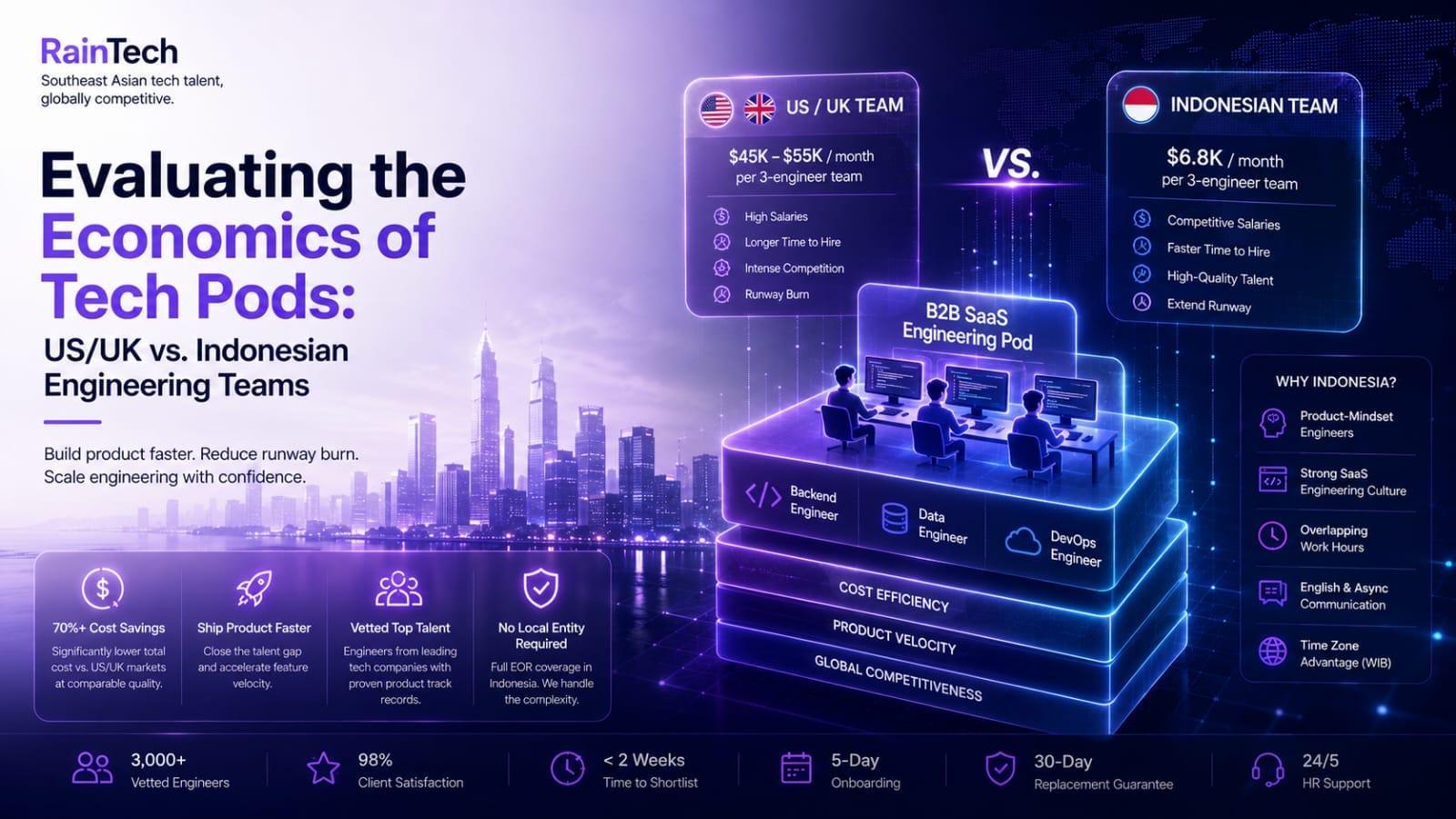
Here is what the math looks like for a realistic three-engineer expansion via RainTech:
Scenario: Series B B2B SaaS Company, US-Based, Expanding Backend and Data Engineering Capacity
| Role | Salary (RainTech Tier) | EOR Fee | Monthly Total |
|---|---|---|---|
| Senior Backend Engineer (5+ yr) | $2,500/mo | $300/mo | $2,800/mo |
| Mid-level Data Engineer (3–5 yr) | $1,800/mo | $300/mo | $2,100/mo |
| Mid-level Full-Stack Engineer (3–5 yr) | $1,600/mo | $300/mo | $1,900/mo |
| 3-engineer team total | $6,800/mo |
The equivalent team in San Francisco at market rate: approximately $45,000–$55,000/month in fully-loaded compensation. The equivalent in London: approximately $30,000–$38,000/month.
The Indonesian team via RainTech EOR at $6,800/month delivers 70%+ savings against US market rates — for engineers with production experience in B2B SaaS-adjacent environments, pre-screened for technical depth and async communication readiness.
How RainTech Sources and Places B2B SaaS Engineers
Step #1 — Product Team Brief
RainTech's team works with your CTO or VP Engineering to understand your product architecture, tech stack, sprint methodology, and the specific features or systems the new hire will own.
This is not a job description exercise. It is a product context conversation that determines which candidates will actually succeed in your environment.
Step #2 — Targeted Sourcing
RainTech surfaces candidates from its pool of 3,000+ vetted Indonesian engineers, with priority given to those who have shipped product features in B2B-adjacent or multi-tenant environments. Sourcing is not from job boards.
Step #3 — Technical + Async Communication Screening
Every candidate is assessed on technical depth relevant to your stack and on async communication behaviors specific to product team environments: PR documentation quality, how they handle unclear requirements, how they communicate blockers. Both evaluations complete before shortlist delivery.
Step #4 — Your Technical Interview
You run your own assessment. RainTech can provide SaaS-specific interview frameworks on request, including a take-home task designed to simulate your actual sprint workflow.
Step #5 — EOR Onboarding
RainTech handles all Indonesian employment legalities: labor contracts, BPJS registration, payroll in IDR, tax compliance, and 24/5 HR support at $300/employee/month.
No Indonesian legal entity required. Based on our track record with European clients, full onboarding typically completes within 5 business days of offer acceptance.
FAQs
Do Indonesian engineers have experience with B2B SaaS products specifically, or mostly consumer apps?
Both exist in the pool. Indonesia's unicorn alumni — GoTo, Traveloka, Tokopedia — built primarily consumer-facing products, but the engineering patterns they developed (multi-tenant data, API design, product analytics) transfer directly to B2B SaaS. RainTech's sourcing process specifically targets engineers with experience in these transferable patterns, not just those who happen to have worked on consumer apps.
What is the typical timezone overlap between an Indonesian engineer and a US-based SaaS team?
WIB (UTC+7) is 12 hours ahead of US Eastern and 15 hours ahead of US Pacific. Most US-based SaaS teams structure a 1–2 hour sync window in the morning WIB/UTC+7 (evening US time) and rely on async workflows for the rest. Indonesian engineers who have worked in remote-first environments are accustomed to this model. It works best when the team has strong async documentation habits, which RainTech screens for specifically.
How do I manage sprint ceremonies with an engineer in a significantly different timezone?
The most common model: daily standups async via Loom or written Slack updates, sprint planning and retrospectives in the sync window, code review and PR feedback async throughout the week. Indonesian engineers from product-company backgrounds are familiar with this structure. RainTech can share sprint workflow templates used successfully by current clients upon request.
Is it better to hire one Indonesian engineer or build a small pod from the start?
Two-engineer pod in the same timezone is meaningfully more effective than a single remote hire. Two engineers can provide peer code review, share context, support each other during overlap gaps, and ramp faster together. If budget allows, RainTech recommends starting with at least two hires to maximize the likelihood of successful integration.
How does the 30-day replacement guarantee work?
Under RainTech's Talent Placement model, if a placed engineer does not meet expectations within the first 30 days, RainTech sources a replacement at no additional placement fee. This applies to all roles including B2B SaaS engineering positions.
What is RainTech's talent placement fee for a B2B SaaS engineering hire?
RainTech's Talent Placement fee is 2x the candidate's monthly salary, paid once at placement. This covers sourcing, technical screening, and communication assessment. The ongoing EOR fee of $300/employee/month is separate and covers all employment compliance, payroll, and HR support.
Conclusion
B2B SaaS engineering capacity is a capital allocation problem as much as a talent problem. The companies that scale engineering teams fastest are not the ones winning hyper-competitive talent wars in Western tech hubs, they are the ones identifying high-quality global supply before their competitors do.
Indonesian engineers who have shipped products in fast-moving tech ecosystems bring exactly what B2B SaaS teams need: product-mindset thinking, API-first development experience, and the discipline to execute in async-first environments.
The economics make the decision straightforward, but execution requires the right sourcing framework. To skip the hiring bottleneck and design a high-velocity remote squad tailored to your stack, book a SaaS engineering team brief with RainTech and secure your product timeline.
Related Articles:
- Indonesia Tech Talent Tiers 2026: Exact Salaries, Output by Level, and ROI vs US Developers
- How Australian SaaS Companies Build Indonesia-Based Product Squads
- Hiring in Indonesia: Why Go Engineers are High Quality (But Node.js is Faster to Source)
- From Months to Weeks: Time to Hire in Indonesia
- EOR Indonesia Pricing: Avoid Hidden Fees with Our 2026 Guide