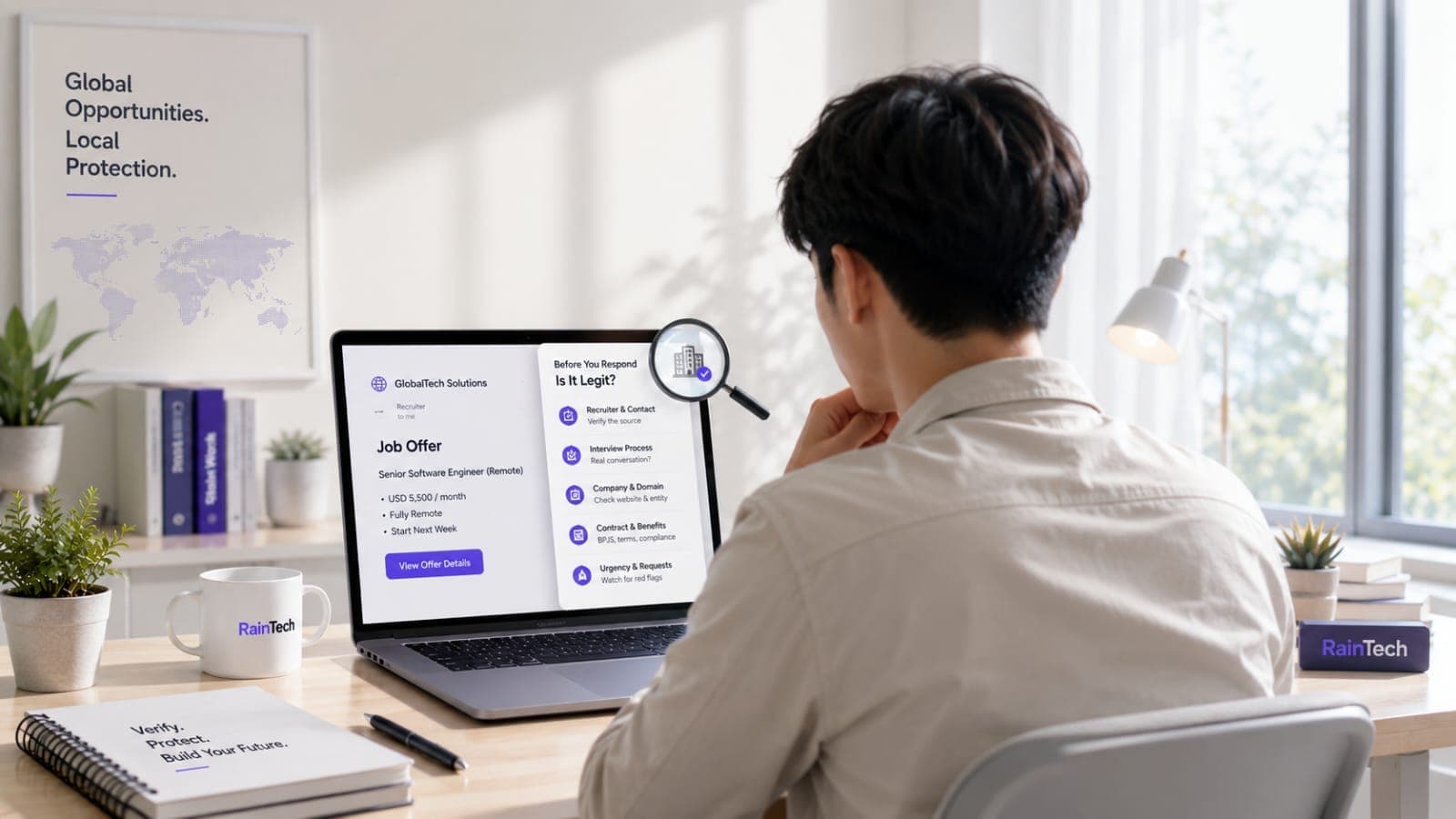
Before responding to any remote job offer from a foreign company, an Indonesian engineer should verify five things: how the recruiter made first contact, whether payment is ever requested before employment starts, whether a real video interview happens, whether the company has a verifiable domain and legal entity, and whether signing or paying comes with unusual urgency.
Most fake offers fail at least two of these checks in the very first message.
A message lands on WhatsApp. "We found your profile online. USD salary, fully remote, starts next week." No interview yet, no company website you recognize — just a friendly recruiter moving fast.
For an engineer earning in rupiah, that message can feel like the opportunity you've been waiting for. It's also, increasingly, the opening line of a scam.
Global remote hiring has grown fast enough that fraud has grown right alongside it, and in 2026 the fake offers look almost identical to the real ones — same tone, same professionalism, sometimes even the same interview format.
This isn't a fringe problem anymore. It's a volume problem, and it's one that specifically targets the exact profile RainTech works with every day: skilled, English-capable engineers actively looking for global-paying remote work.
Why Indonesian Engineers Are a Growing Target
Job scams tied to remote work have scaled dramatically in the past two years, and the numbers explain why a checklist like this one matters more now than it did even twelve months ago.
In the United States alone, reported losses from job and employment scams reached $521 million in 2026, roughly triple the $90 million reported four years earlier.
That growth hasn't been gradual — fraud-detection firm McAfee tracked a spike of nearly 1,000% in job-related scam activity between May and July 2026 alone, driven largely by how easily generative AI now produces convincing fake job postings, recruiter messages, and even company websites.
The Federal Trade Commission's own data shows reported losses to job scams more than tripled between 2020 and 2023, and topped $220 million in just the first half of 2024 alone.
Task-based "gamified" scams specifically exploded in that period — from about 5,000 reports across all of 2023 to roughly 20,000 in the first six months of 2024, and confidence in spotting these scams remains low even among experienced job seekers: research from Norton found that only 61% of US adults feel confident they could actually identify a job scam if they encountered one.
That confidence gap matters even more for Indonesian engineers evaluating offers from unfamiliar foreign companies. A US-based applicant at least has domestic reference points — familiar company names, local news coverage, colleagues who've been through similar hiring processes.
An Indonesian engineer messaged out of nowhere by a "US startup" or "European SaaS company" often has none of that. There's no local office to walk past, no former colleague to ask, nothing to check the message against except the message itself. Scammers know this, and remote-work recruitment fraud increasingly targets exactly this gap.
The Scam Patterns Actually in Circulation Right Now
Fake remote job offers aren't one scam. They're a cluster of related schemes, and knowing which one you're looking at makes the red flags easier to spot.
Research from Remote Work Europe's 2026 scam guide groups the most common patterns into a few recognizable categories: AI-generated fake job postings that read as polished as real ones, task-based "trial work" scams where unpaid deliverables are harvested under the label of an assessment, overpayment or fake-check schemes, crypto recruitment fraud, resume and personal-data harvesting disguised as onboarding paperwork, and deepfake video interviews.
That last category deserves particular attention for technical roles. The same research cites data from Resume Genius showing that 17% of HR managers have already encountered deepfake technology during a video interview, with the figure running even higher in tech and finance hiring specifically.
Scammers pull profile photos — often lifted straight from LinkedIn — and layer them onto a live video feed using real-time deepfake software, sometimes combined with AI voice cloning.
The result can look and sound like a real hiring manager asking real interview questions, which is exactly what makes this pattern so hard to catch by instinct alone.
Red Flags Before You Even Get an "Offer"
Scam recruiting almost always looks different from real recruiting from the very first contact. Watch for:
- Outreach through WhatsApp or Telegram from a personal number rather than a company email address — legitimate recruiters at real companies contact candidates from a company domain, not a personal messaging app, especially on first contact.
- A job description too generic to explain what you'd actually build. Real postings reference specific tools, a specific product area, or a specific team. Vague listings that could apply to any engineer at any company are a consistent red flag across nearly every fraud-tracking source.
- A salary well above market, offered before any technical conversation happens. Legitimate companies benchmark compensation and confirm it after assessing skill level, not before.
That third point is worth checking against real numbers rather than gut feeling. RainTech's breakdown of the Indonesian developer salary gap lays out what legitimate global companies actually pay by experience tier, which makes it far easier to judge whether a number you've been offered is generous or simply bait.
Red Flags at the "Technical Test" or Offer Stage
This is where scams have gotten noticeably better at mimicking real hiring, and where even careful engineers get caught off guard.
1.Fake Technical Assessments
Some listings ask for a "paid trial task" that turns out to be unpaid work in disguise — a real feature, a real dataset, sometimes production-quality code, collected for free under the label of an assessment, with no actual job on the other end.
"A genuine technical test has a scope that matches the role, and a clear evaluation process behind it," says Veri Ferdiansyah, Co-Founder & CEO of RainTech, who personally leads technical screening for engineers entering RainTech's network. "When someone's asked to build something that looks suspiciously close to a real product feature, with no structured feedback afterward, that's usually the tell. A real hiring process explains what it's testing for and gives you something back, even a rejection with reasoning."
2.No Real Video Interview
Given how accessible deepfake tools have become, a video call happening at all isn't proof of legitimacy on its own anymore. If the audio and video don't quite sync, the "interviewer" avoids follow-up questions about specific details in your CV, or the conversation feels scripted regardless of what you say, treat that as a signal worth pausing on rather than a coincidence.
Red Flags at the Contract and Onboarding Stage
If a fake offer makes it this far, the tells shift from behavior to paperwork:
- No named legal entity — just a vague line like "our partner will handle local employment," with no specific, licensed company named anywhere in the contract.
- No mention of BPJS enrollment at all. Any legitimate employer hiring an Indonesian engineer, whether directly or through an EOR, is required to register you for BPJS Kesehatan and BPJS Ketenagakerjaan. Silence on this isn't a minor omission.
- Requests for documents beyond what's normal — bank login credentials rather than an account number, for example, or copies of documents that have nothing to do with payroll setup.
- Pressure to sign or pay a "processing fee" within hours. Urgency is one of the most consistent tactics across job scam research; legitimate onboarding simply doesn't require same-day decisions.
If you're at the stage of actually holding a written contract, it's worth reading it properly — even a real-looking offer can contain terms that don't protect you the way you'd expect.
RainTech's guide to 5 EOR contract red flags for Indonesian engineers walks through the specific clauses worth checking before signing anything, and the guide to negotiating a remote contract with an Indonesian tax lens covers how to raise concerns about missing terms without it coming across as accusatory.
What Happens to Your Data If You Don't Catch It
It's worth understanding what these scams are actually after, because it isn't always money directly.
Resume and personal-data harvesting is one of the most common end goals — your CV, ID scans, and bank details get resold or used for identity-related fraud well after the "job" itself disappears.
Fraud-reporting research consistently notes that a large share of these incidents go unreported entirely, in part because victims feel embarrassed rather than defrauded by an obvious criminal, which is exactly the dynamic that lets these schemes keep scaling.
Recognizing the pattern early is the only real defense, since most of the damage happens before anyone realizes what's going on.
The 5-Minute Verification Method
Before sharing anything personal, run through this:
1.Check the email domain against the company's actual website.
A one-letter difference from the real domain (a lookalike domain) is one of the most common tells and one of the easiest to miss on a phone screen.
2.Search the company name plus "review" or "scam" on Google and Glassdoor.
Real companies, even small ones, tend to have some digital footprint beyond a single job posting.
3.Check the recruiter's LinkedIn tenure and mutual connections.
A profile created weeks ago with no shared network and no employment history is a signal worth taking seriously.
4.Ask for a video call, and ask specific questions during it.
A legitimate employer never hesitates on this, and a real interviewer can answer follow-ups about the role in detail.
5.Check whether the company is part of a vetted talent network.
Companies hiring through RainTech's talent pool are screened before they're ever introduced to a candidate, which removes this entire category of risk from the process.
For a broader sense of what real hiring managers actually look for versus what a scam listing tries to skip past entirely, RainTech's guide on why strong applications don't convert on global job boards breaks down what a genuine evaluation process looks like from first message to signed contract.
If You've Already Shared Information or Sent Money
Move quickly, but don't spiral:
- Contact your bank immediately if any payment or account access was involved, and ask about reversing or flagging the transaction.
- Change passwords on any account that shares a login or recovery email with what you disclosed.
- Report it to Patroli Siber Polri (patrolisiber.id) and to whichever platform surfaced the listing, so the pattern gets flagged for other job seekers too.
FAQs
What's the difference between an aggressive recruiter and a scam recruiter?
An aggressive recruiter moves fast but still answers direct questions about the company, the role, and the interview process without hesitation. A scam recruiter avoids specifics and leans on urgency instead — "the role closes today" is a pressure tactic, not a real hiring timeline.
Is every high USD salary offer suspicious?
No. Legitimate global companies do pay well above local Indonesian rates, and that's not inherently a warning sign. The difference is process: a real offer follows an actual interview and a written contract, while a suspicious one tends to skip straight from first contact to a salary number with nothing in between.
The company is legitimate but not well known in Indonesia, how do I check it?
Look it up on LinkedIn for employee count and company history, check how long its domain has existed, and search the recruiter's name alongside the company name specifically, not just the company name on its own.
I've had two interviews but still no written contract — is that a red flag?
Not necessarily on its own, but it's worth asking directly for a timeline. A real employer can give you a clear answer; a fake one usually can't, or responds with more urgency instead of information.
Can a fake offer still ask for legitimate-sounding documents, like a signed NDA?
Yes — scammers increasingly use real-looking paperwork specifically because it lowers suspicion. An NDA or contract template being professionally formatted doesn't confirm the company or entity behind it is real; that still has to be verified independently.
Next Step
A good opportunity and a real one aren't always the same thing, and the only way to tell them apart is to check before you engage, not after signing something you can't undo.
Want offers that never require this level of guesswork in the first place? Join RainTech's talent pool and get matched only with companies that have already been vetted.