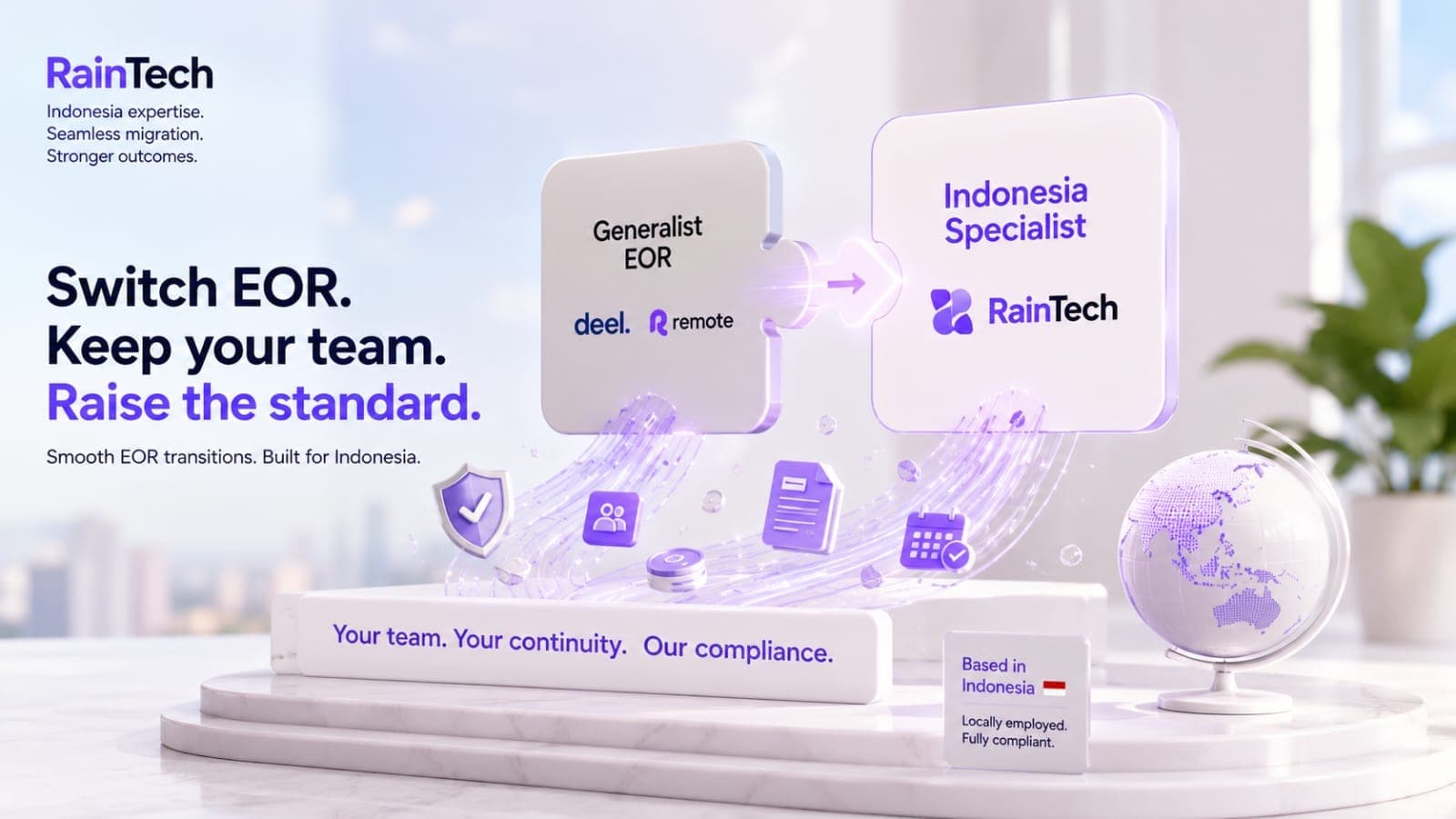
Switching EOR providers for an Indonesian team doesn't require terminating anyone. Employment transfers to the new legal entity through a fresh employment agreement that preserves the original start date and tenure, while payroll, BPJS registration, and tax reporting move over on a set timeline — typically two to four weeks for a small team. The risk isn't the switch itself; it's doing it without a structured handover of employee data and compliance records.
Generalist EOR platforms are genuinely good at one thing: getting a company from zero to hired, fast, in dozens of countries at once. That's exactly why so many companies start with Deel or Remote when they make their first Indonesian hire.
The friction usually shows up later, but at the point where Indonesia-specific compliance details start mattering more than platform breadth.
BPJS registration handled a step late. A THR payment calculated using a generic template instead of the actual Indonesian formula. A support ticket that takes three days to get a straight answer because the person answering it manages accounts across forty countries, not one.
None of that means the generalist platform did anything wrong by design. It means the tradeoff that made sense at hire #1 stops making sense once Indonesia becomes a real, ongoing part of the team.
Not sure whether your current EOR setup is still the right fit?
Download the free Indonesia EOR Migration Readiness Assessment to identify potential payroll, compliance, and migration risks before making a decision.
Why Companies Actually Make the Switch
The reasons companies move off a generalist EOR are consistent across the industry, and they rarely come down to price alone.
A 2026 breakdown of EOR switching found the most common drivers are service quality problems — slow response times, payroll delays, inconsistent local support — limited depth in specific markets, and pricing that looked simple at signup but grew opaque over time.
Compliance complexity is the backdrop for nearly all of it: 87% of companies planning international expansion in 2026 say meeting local tax and employment regulations will be their hardest operational challenge, and a platform managing that complexity across a hundred-plus countries at once has less room to specialize in any single one.
Price is part of the picture too, even if it's rarely the only reason. As of 2026, Deel and Remote's EOR plans both land around $599 to $699 per employee per month depending on billing terms — a flat platform fee that doesn't shift based on how complex a given country's compliance actually is.
Indonesia's BPJS structure, THR obligations, and severance formulas under Government Regulation No. 35 of 2021 are meaningfully more involved than payroll in a country with simpler statutory requirements, but a generalist platform typically charges the same regardless.
That's not a pricing failure; it's just what happens when one number has to cover every country on the roster.
What Actually Happens During a Migration
The mechanics matter more than most companies expect going in, largely because the process is unfamiliar the first time. Employees don't resign and get rehired.
According to Deel's own guide to EOR provider switches, the standard approach is a new employment agreement with the incoming legal entity that preserves the employee's original start date and service history — so tenure-based entitlements like long-service pay aren't reset by the switch.
What does need active management is the data handover: personal details, salary history, tax records, and benefits information typically have to be collected and transferred by the client company directly, not moved automatically between providers, because data privacy regulations and existing contract terms often prevent one EOR from pulling records straight out of another's system.
That transfer phase is where the real risk sits. It's not that switching is dangerous, it's that switching without a structured handover plan is.
A payroll cycle that falls in the middle of an unplanned transition, or a BPJS registration that lapses for even a few weeks between providers, creates exactly the kind of compliance gap that made switching necessary in the first place.
Planning a migration?
Use our free Indonesia EOR Migration Readiness Assessment to make sure your employee records, payroll timeline, and compliance documents are ready before switching providers.
→ Download the Free Assessment
The Indonesia-Specific Risk a Generalist Platform Doesn't Carry
There's one structural detail worth checking regardless of which provider you're moving to: whether the new EOR employs your team through its own entity in Indonesia, or through a local partner it contracts with.
Some global platforms operate in Indonesia through an aggregator or partner model rather than owning the local entity directly, which lengthens the accountability chain if a payroll issue or termination dispute comes up.
This distinction rarely shows up on a pricing page, which is exactly why it's worth confirming directly before any handover begins — RainTech's guide to evaluating your current EOR or outsourcing partner covers the specific questions to ask.
A Realistic Migration Timeline
For a small-to-mid-size Indonesian team (5–10 employees), a well-planned migration typically runs two to four weeks:
- Week 1: Data collection and verification — employment contracts, salary history, BPJS registration numbers, tax records, and any outstanding leave balances.
- Week 2: New employment agreements drafted and issued under the incoming entity, with start dates and tenure explicitly preserved.
- Week 3: A parallel payroll run to catch discrepancies before go-live. BPJS re-registration and payroll setup under the new entity are already done, because RainTech completes them within 24–48 hours of the new agreements being signed in week 2.
- Week 4: Full cutover, with the outgoing provider's final payroll and tax filings closed out cleanly.
RainTech's week-by-week EOR onboarding breakdown covers this same structure in more detail for teams planning the switch alongside their current provider's notice period.
What Changes on the Cost Side
The platform fee is only one line in the comparison. RainTech's full EOR pricing breakdown for Indonesia lays out monthly fees, BPJS pass-through at zero markup, and the absence of setup fees without the "contact us for a quote" step most generalist platforms default to — useful for comparing against what you're currently paying Deel or Remote on a fully-loaded basis, not just the headline monthly rate.
For a side-by-side on how an Indonesia-specialist model compares structurally to the two largest generalist providers, RainTech's Deel vs. Remote vs. RainTech comparison breaks down local compliance depth, support responsiveness, and pricing model differences directly.
FAQ
Will my Indonesian employees notice the switch happening?
Minimally, if it's planned properly. They'll sign a new employment agreement, but their role, manager, salary, and start date all carry over unchanged. The main visible change is which entity appears on their payslip and BPJS registration.
Can we switch mid-contract with our current EOR, or do we have to wait for renewal?
Most EOR contracts allow switching mid-term, though some carry a notice period or early-termination clause worth checking before starting the process. This is worth confirming with your current provider's contract terms directly.
How long does BPJS re-registration take under a new entity?
With RainTech, within 24–48 hours of the employee signing the new agreement, provided the documents from week one are complete, which is why data collection in week one of the migration timeline matters more than any other step.
What's the biggest mistake companies make when switching EOR providers?
Starting the switch without a clean handover plan for employee data, and letting it overlap with an active payroll cycle. Both are avoidable with a two-to-four-week structured timeline rather than an abrupt cutover.
Next Step
Thinking about whether switching makes sense for your Indonesian team?
Before making a decision, download our free Indonesia EOR Migration Readiness Assessment. In just a few minutes, you'll identify potential compliance, payroll, and migration risks that could affect your transition.
→ Download the Free Indonesia EOR Migration Readiness Assessment
If you'd like a second opinion after completing the assessment, RainTech also offers a complimentary migration review. We'll walk through your current setup, highlight potential risks, and outline a practical migration plan tailored to your Indonesian team—before you commit to switching providers.